Ask an ABA owner how the month went and you will hear a number: hours billed. Usually 97153, usually up.
It is the wrong number to stop at. You do not pay RBTs for billed hours. You pay them for every hour on the timesheet. The gap between the two is your billable utilization rate, and most of your margin lives inside it.
Billed hours can go up while you make less
Utilization is simple. Hours billed divided by hours paid. An RBT paid for 25 hours who bills 20 is at 80%.
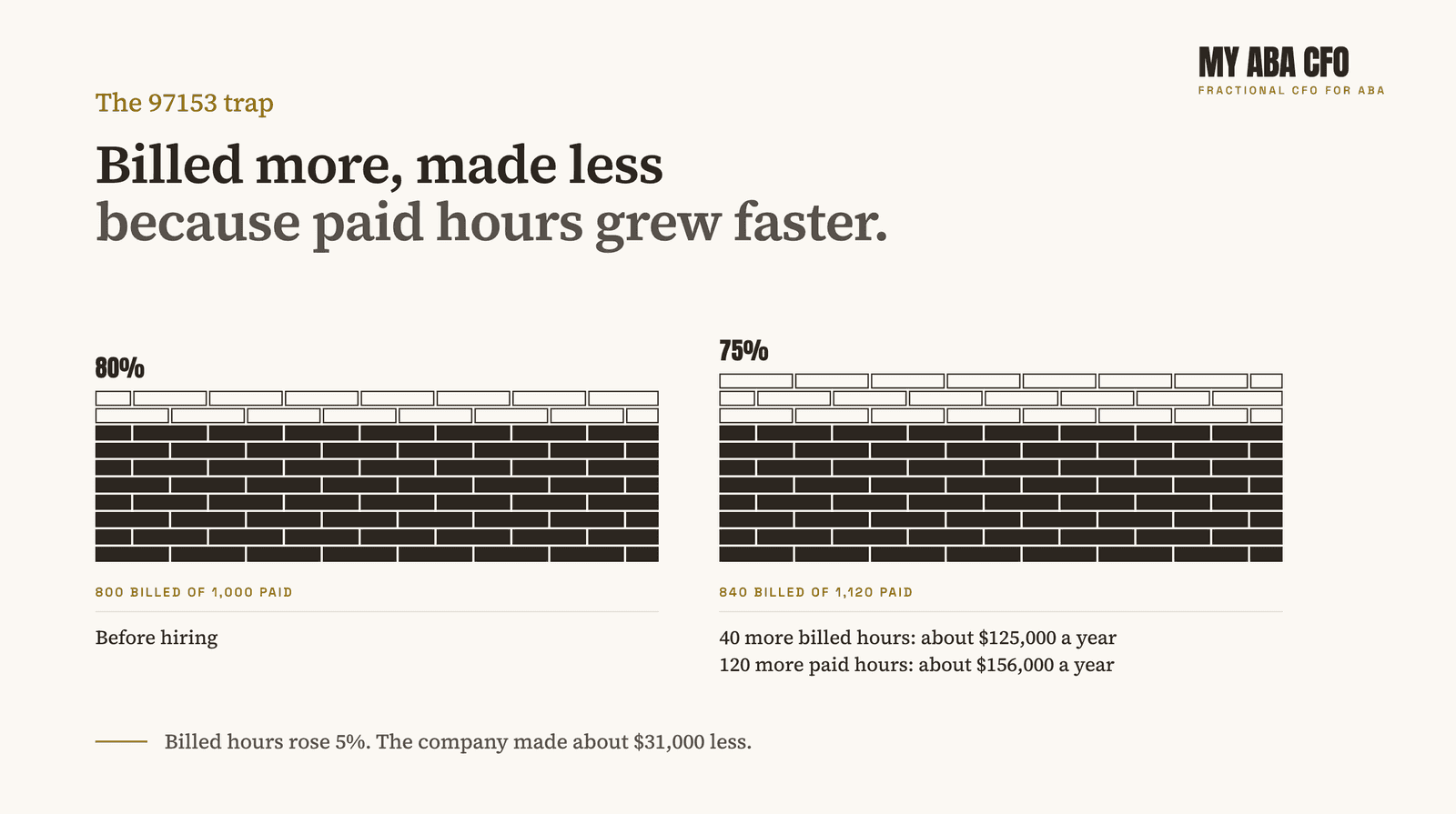
Here is the trap. Take a company with 40 RBTs, paid for 1,000 hours a week and billing 800 of them. That is 80%. The owner hires to meet demand. A few months later the company bills 840 hours a week. Billed hours are up 5%. It feels like growth.
But paid hours went to 1,120. Utilization is now 75%.
Run rough numbers on it. At $60 an hour for 97153, the extra 40 billed hours bring in about $125,000 a year. At a loaded cost of roughly $25 per paid hour, the extra 120 paid hours cost about $156,000. The company billed more and made about $31,000 less.
A billed-hours report will never show you that. It only counts one side.
Do this now: put paid hours next to billed hours on the same report, for the same weeks. If you only have one of the two, you do not have a utilization rate.
Where the paid hours go
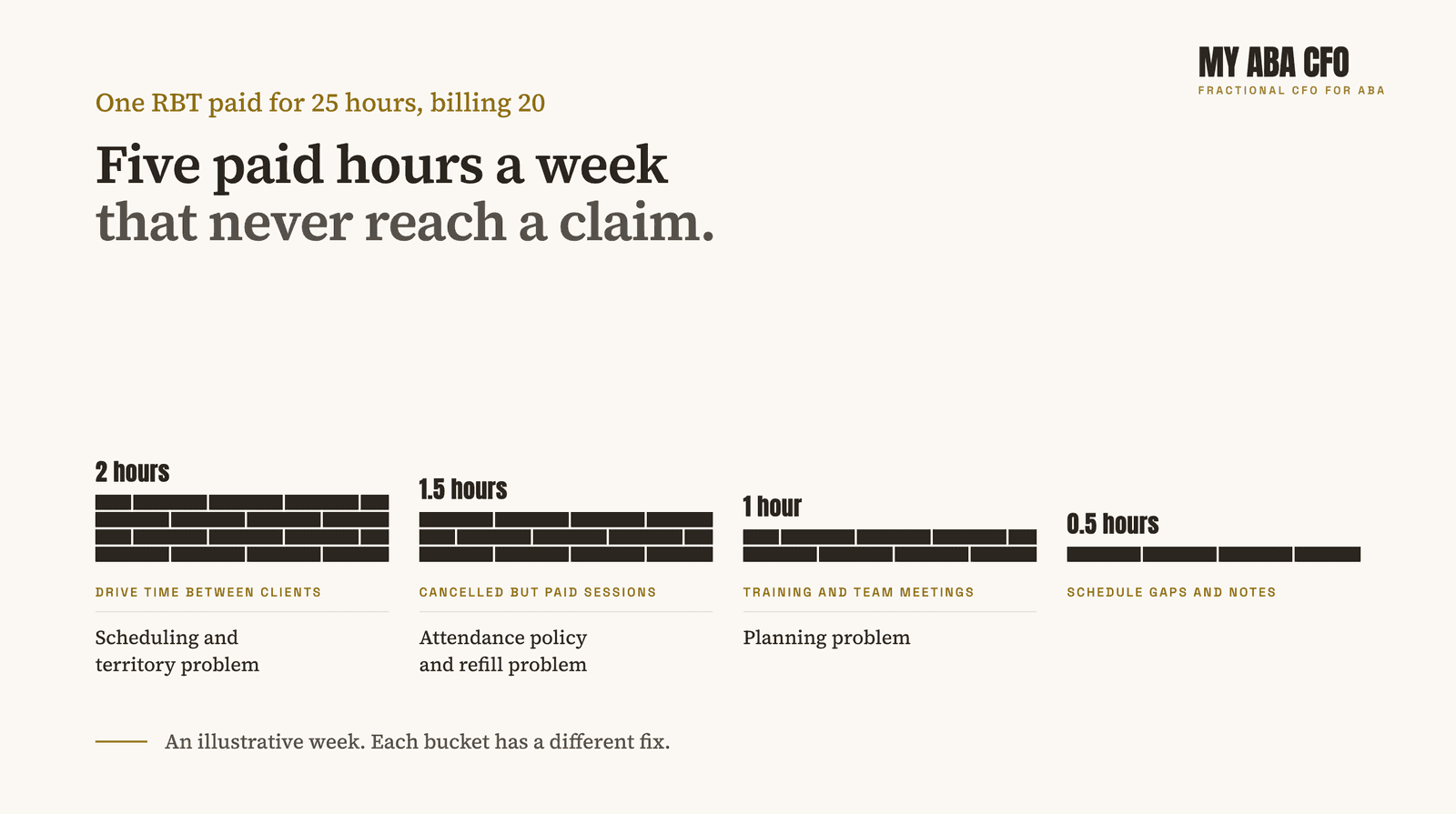
No RBT bills every hour. The question is where the rest went. A typical week for one tech paid 25 hours might look like this. The numbers are illustrative.
| Where the hour went | Hours a week |
|---|---|
| Billed 97153 | 20 |
| Drive time between clients | 2 |
| Cancelled sessions you paid for anyway | 1.5 |
| Training, team meetings, supervision that is not billed | 1 |
| Gaps in the schedule and notes | 0.5 |
Five hours on the payroll that never reach a claim.
Some of that is the cost of doing this work properly. Travel between clients generally has to be paid. Training is not optional. The goal is not 100%, and a company that chases it burns out its techs.
But each bucket has a different fix. Drive time is a scheduling and territory problem. Cancellations are an attendance policy and a refill problem. Training is a planning problem: it belongs in the slow hours, not the full ones.
Measure it: give each kind of non-billed time its own pay code. If it all sits in one line called "hours," you cannot tell a routing problem from a cancellation problem.
What five points does to your margin
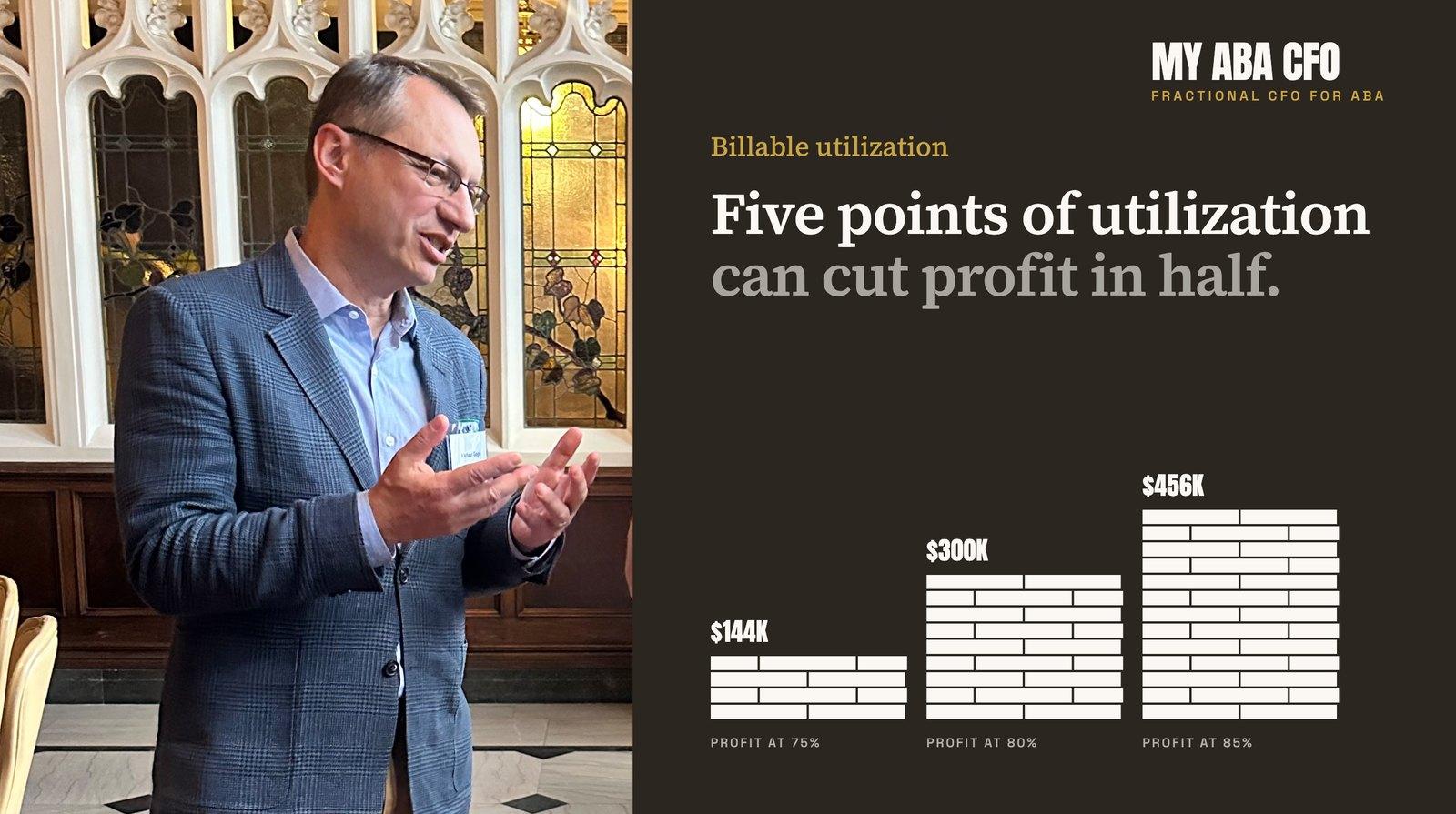
Back to the 40-RBT company before it hired. Call it about $3 million in revenue and a 10% margin, so roughly $300,000 in profit. Paid hours hold at 1,000 a week. Only utilization moves.
Five points is 50 billed hours a week. At $60 an hour, that is about $156,000 a year. Payroll does not change, because those hours were paid either way. So nearly all of it lands on profit.
| Utilization | Billed hours a week | Annual profit | Margin |
|---|---|---|---|
| 75% | 750 | about $144,000 | about 5% |
| 80% | 800 | about $300,000 | 10% |
| 85% | 850 | about $456,000 | about 14% |
These are rough figures, and your rate and wages will differ. The shape will not. Five points down cuts profit in half. Five points up adds half again. Same clients, same staff, same payroll.
That is why I look at utilization before almost anything else. Each point in this example is worth about $31,000 a year. Few other numbers in an ABA company move profit that much without anyone noticing.
Do this now: work out what one point of utilization is worth in your company. Weekly paid hours, times 1%, times your rate, times 52. Keep that number where you can see it.
What the rate is really telling you
A company-wide average hides more than it shows. 80% overall can be one team at 88% and another at 70%.
So break it down. By RBT, by supervising BCBA, by location, by week. Paid hours come from payroll. Billed hours come from claims, not from the schedule. A scheduled hour that was never billed does not count.
Then read the pattern. Low utilization across one territory points to drive time. Low on Mondays and Fridays points to cancellations. Low among new hires points to slow onboarding. Low everywhere means you staffed ahead of your caseload.
Do this now: review utilization by BCBA team every month, and ask each team about the bottom three techs. The answer is usually a schedule, not a person.
Start with one report
Hours billed tells you how busy you are. Hours billed against hours paid tells you whether you are making money. If your reports only show the first, that is the place to start.
If you want a second set of eyes on yours: thirty minutes on your business, your numbers and your next move. No pitch if it is not a fit.
Sources and further reading
- Billing Codes (ABA Coding Coalition)
- First Children Services Lowered BCBA Billing Targets. BCBA Turnover Plummeted and Hours Rose (Breaking News ABA)
Common questions
What is a billable utilization rate in ABA?
It is hours billed divided by hours paid. An RBT paid for 25 hours who bills 20 is at 80%. You pay RBTs for every hour on the timesheet, not for billed hours, so most of your margin lives in the gap between the two.
How do you calculate the ABA billable utilization rate?
Put paid hours next to billed hours on the same report, for the same weeks, and divide billed by paid. Paid hours come from payroll. Billed hours come from claims, not from the schedule. A scheduled hour that was never billed does not count.
Can billed 97153 hours go up while an ABA company makes less money?
Yes. In the article's example a company goes from 800 billed hours a week to 840, but paid hours go from 1,000 to 1,120, so utilization falls from 80% to 75%. The extra billed hours bring in about $125,000 a year and the extra paid hours cost about $156,000. The company billed more and made about $31,000 less.
How much is one point of RBT utilization worth?
Take weekly paid hours, times 1%, times your rate, times 52. In the article's example of a 40-RBT company paid for 1,000 hours a week at $60 an hour, each point is worth about $31,000 a year. Five points down cuts profit in half, and five points up adds half again.
Should an ABA company aim for 100% billable utilization?
No. Travel between clients generally has to be paid and training is not optional. The goal is not 100%, and a company that chases it burns out its techs. The useful work is giving each kind of non-billed time its own pay code so you can tell a routing problem from a cancellation problem.