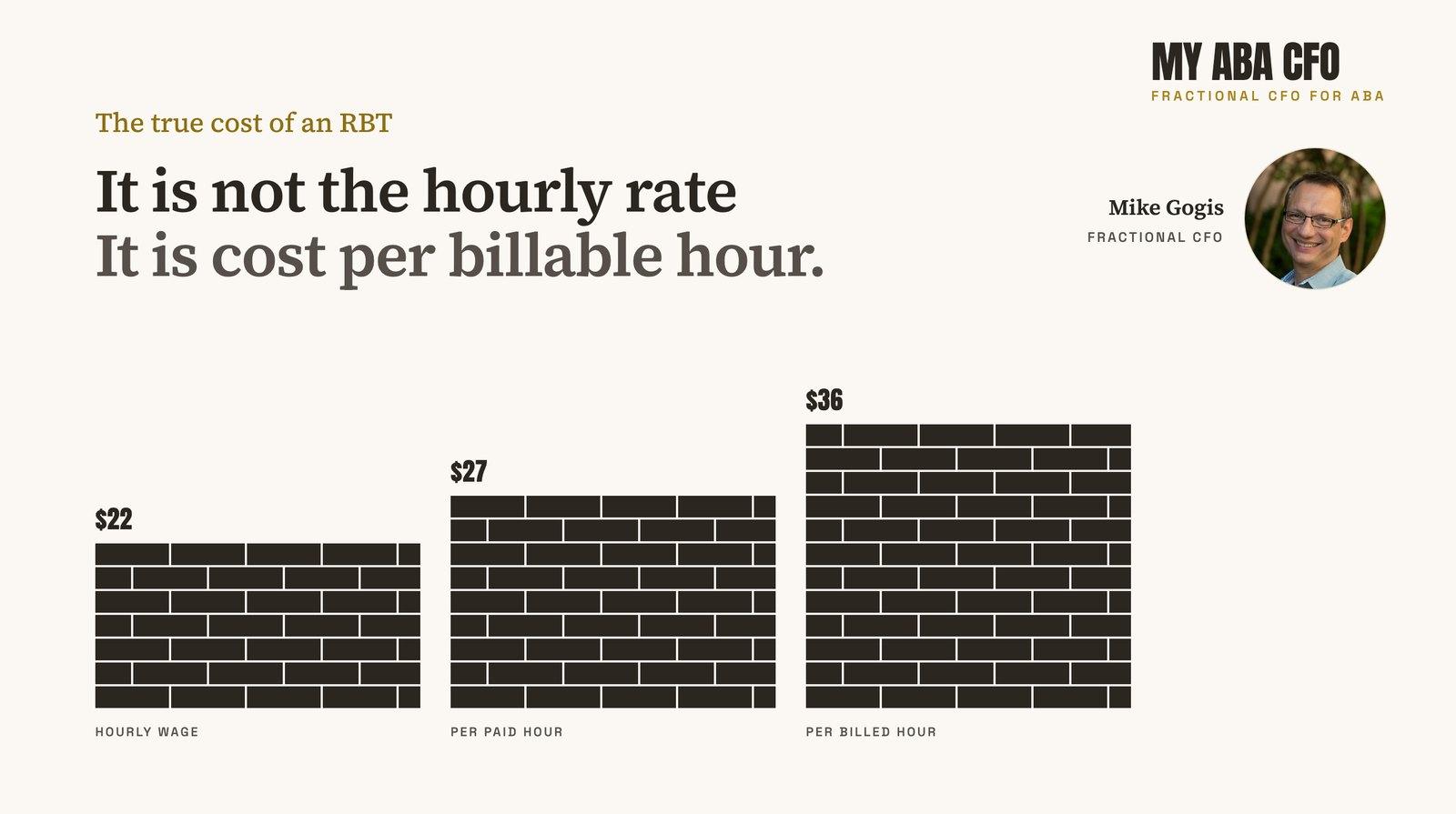
Ask an owner what an RBT costs and you get the number off the offer letter. Twenty-two dollars an hour. Maybe twenty-four.
That is the wage. It is not the cost. The cost is what you spend for every hour that RBT actually bills, and it runs a long way above the wage. Most owners I talk to have never worked it out.
Here is the math on one RBT: $22 an hour, paid 25 hours a week, 50 weeks a year. That is 1,250 paid hours. The numbers are round and rough. Yours will differ. The method will not.
Start with what a paid hour costs
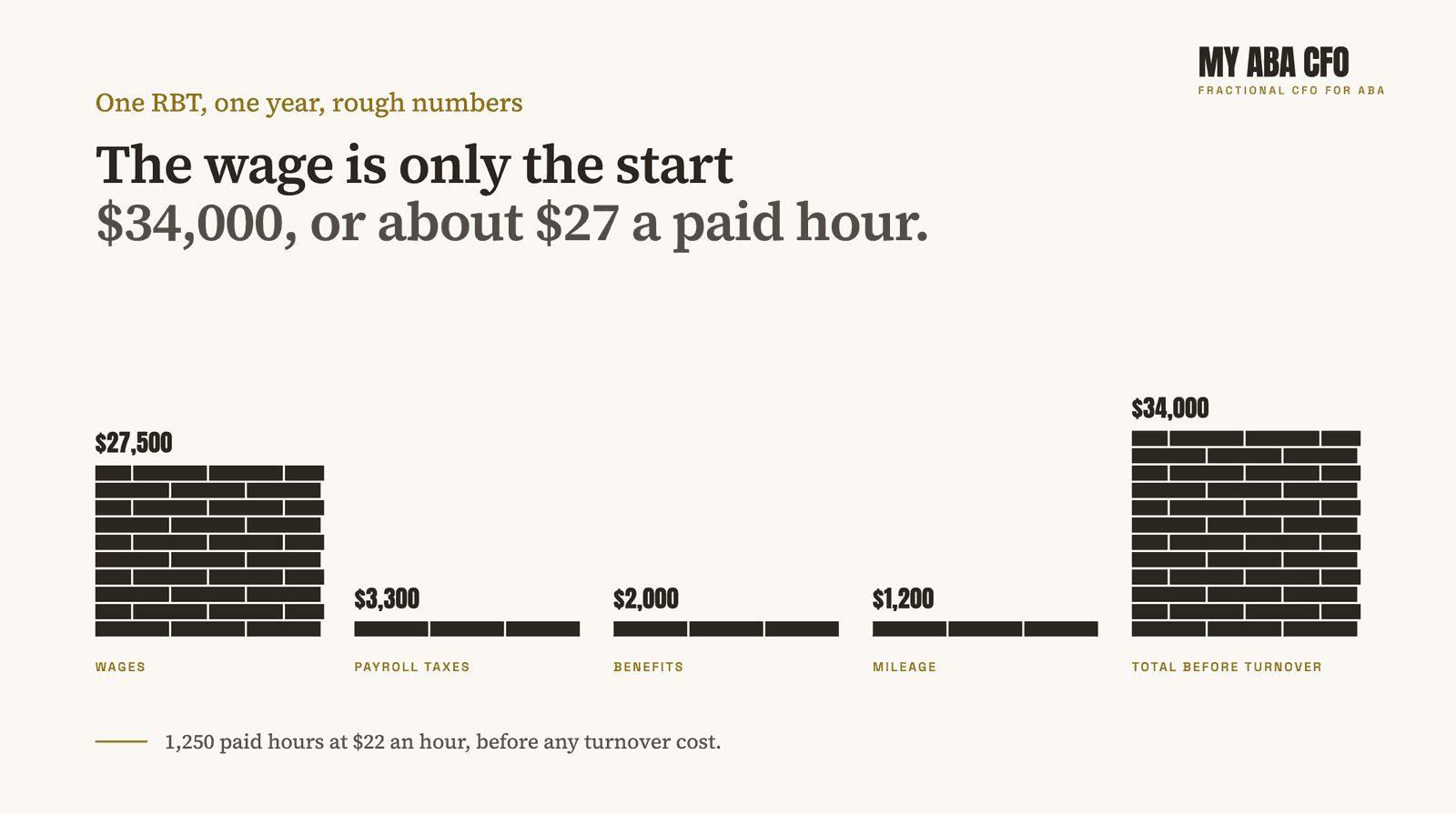
Wages first. 1,250 hours at $22 is $27,500.
Then payroll taxes. Your share of Social Security and Medicare is 7.65%. Add unemployment tax and workers' comp and you land somewhere around 12%, depending on your state. That is $3,300.
Then benefits. Paid time off, holidays, whatever you put toward health coverage. Call it $2,000 for a part-time RBT. A full-time RBT on your health plan costs a good deal more.
Then mileage. Drive time is already sitting in the paid hours. The mileage check is not. Call it $1,200 for an RBT working in homes.
That is $34,000, or about $27 for every paid hour. You are already $5 over the wage, and nobody has left yet.
Do this now: Pull last year's payroll register. Add employer taxes, benefits and mileage to RBT wages, then divide by RBT paid hours.
Add the ones who leave
Every new RBT costs you money before the first billed hour. The job ad. The background check. The 40-hour training. A BCBA's time on the competency assessment. Shadow shifts, where you pay two people and bill for one.
Call it $4,000 a hire. That is a rough figure, and it leaves out the revenue you lose while the seat sits empty.
Now spread it. Say half your RBT seats turn over in a year. Then every seat carries $2,000 a year in hiring and training, whether that particular RBT stays or not.
The running total is $36,000.
Measure it: Count the RBTs you hired last year and divide by your average RBT headcount. Multiply by what one hire costs you.
Divide by the hours you can bill
This is the step owners skip. You paid for 1,250 hours. You did not bill 1,250 hours.
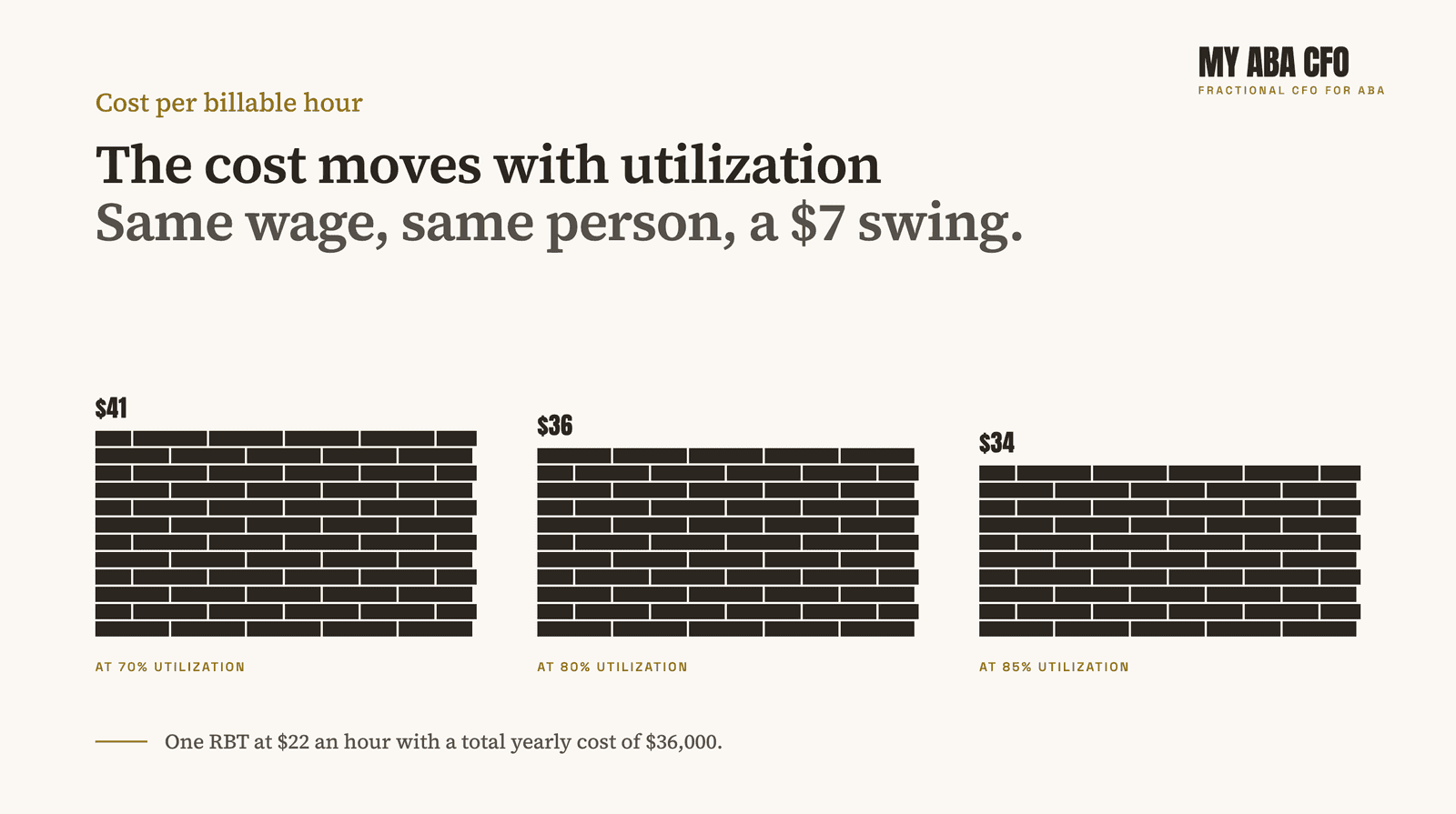
Some went to driving between clients. Some went to sessions that cancelled after the RBT was already on the clock. Some went to team meetings, training and notes. At 80% utilization, 1,250 paid hours become 1,000 billable hours.
| One RBT, one year | Rough amount |
|---|---|
| Wages (1,250 paid hours at $22) | $27,500 |
| Payroll taxes and workers' comp | $3,300 |
| Benefits and paid time off | $2,000 |
| Mileage | $1,200 |
| Turnover (share of hiring and training) | $2,000 |
| Total cost | $36,000 |
| Billable hours | 1,000 |
| Cost per billable hour | $36 |
Thirty-six dollars. Not twenty-two. The real cost is about 60% above the wage.
And it moves with utilization. At 70%, the same RBT costs about $41 per billable hour. At 85%, about $34. Same wage, same person, a $7 swing.
Do this now: Divide your total RBT cost by hours billed, not hours paid. That is your number.
What the real number changes
Your margin, to start. If 97153 pays $60, you do not keep $38 an hour. You keep $24. That $24 has to cover BCBA time you cannot bill, billing, rent, admin and your profit.
Your payer decisions. A contract at $48 looks fine against a $22 wage. Against a $36 cost it leaves $12 an hour, and $12 will not carry your overhead.
Your raises. A $1 raise is not $1. With taxes on top and only 80% of hours billed, it is about $1.40 per billable hour.
And where you look for savings. The wage is the hardest line to cut and the worst one to try. Move utilization from 80% to 85% and cost per billable hour drops about $2. Cut turnover in half and it drops another $1. Tighter routes, fuller schedules and RBTs who stay will do more for your margin than a lower wage ever will.
Build it into your reporting: Put cost per billable hour on your monthly report, next to your average rate per hour. Watch the gap between them.
Know your number
Most ABA owners can tell me their RBT wage to the penny. Very few can tell me what a billable hour costs them. The second number is the one that decides whether a payer, a client or a new hire makes you money.
If you want help finding yours, that is what I do. Thirty minutes on your business, your numbers and your next move. No pitch if it is not a fit.
Sources and further reading
- Topic no. 751, Social Security and Medicare withholding rates (Internal Revenue Service)
- Registered Behavior Technician Handbook (BACB)
- RBT Turnover: The 40% Annual Rate That's Breaking ABA Clinics (Breaking News ABA)
Common questions
What is the true cost of an RBT per hour?
It is what you spend for every hour the RBT actually bills, not the wage. In the article's rough example, an RBT paid $22 an hour costs $36 per billable hour once payroll taxes, benefits, mileage and turnover are added and the total is divided by billable hours. The real cost is about 60% above the wage.
How do I calculate RBT cost per billable hour in my ABA company?
Add employer taxes, benefits and mileage to RBT wages, then add a share of hiring and training cost for turnover. Divide that total by hours billed, not hours paid. In the example, $36,000 of total cost divided by 1,000 billable hours is $36.
How does utilization change what an RBT costs?
You pay for more hours than you bill, because some go to driving between clients, cancelled sessions, team meetings, training and notes. At 80% utilization the example RBT costs $36 per billable hour. At 70% it is about $41, and at 85% about $34. Same wage, same person, a $7 swing.
How much does RBT turnover add to the cost of an RBT?
Every new RBT costs money before the first billed hour: the job ad, the background check, the 40-hour training, a BCBA's time on the competency assessment and shadow shifts. The article uses a rough $4,000 a hire. If half your RBT seats turn over in a year, every seat carries $2,000 a year in hiring and training.
What does a $1 raise for an RBT really cost?
A $1 raise is not $1. With taxes on top and only 80% of hours billed, it is about $1.40 per billable hour. The article's view is that tighter routes, fuller schedules and RBTs who stay will do more for your margin than a lower wage.