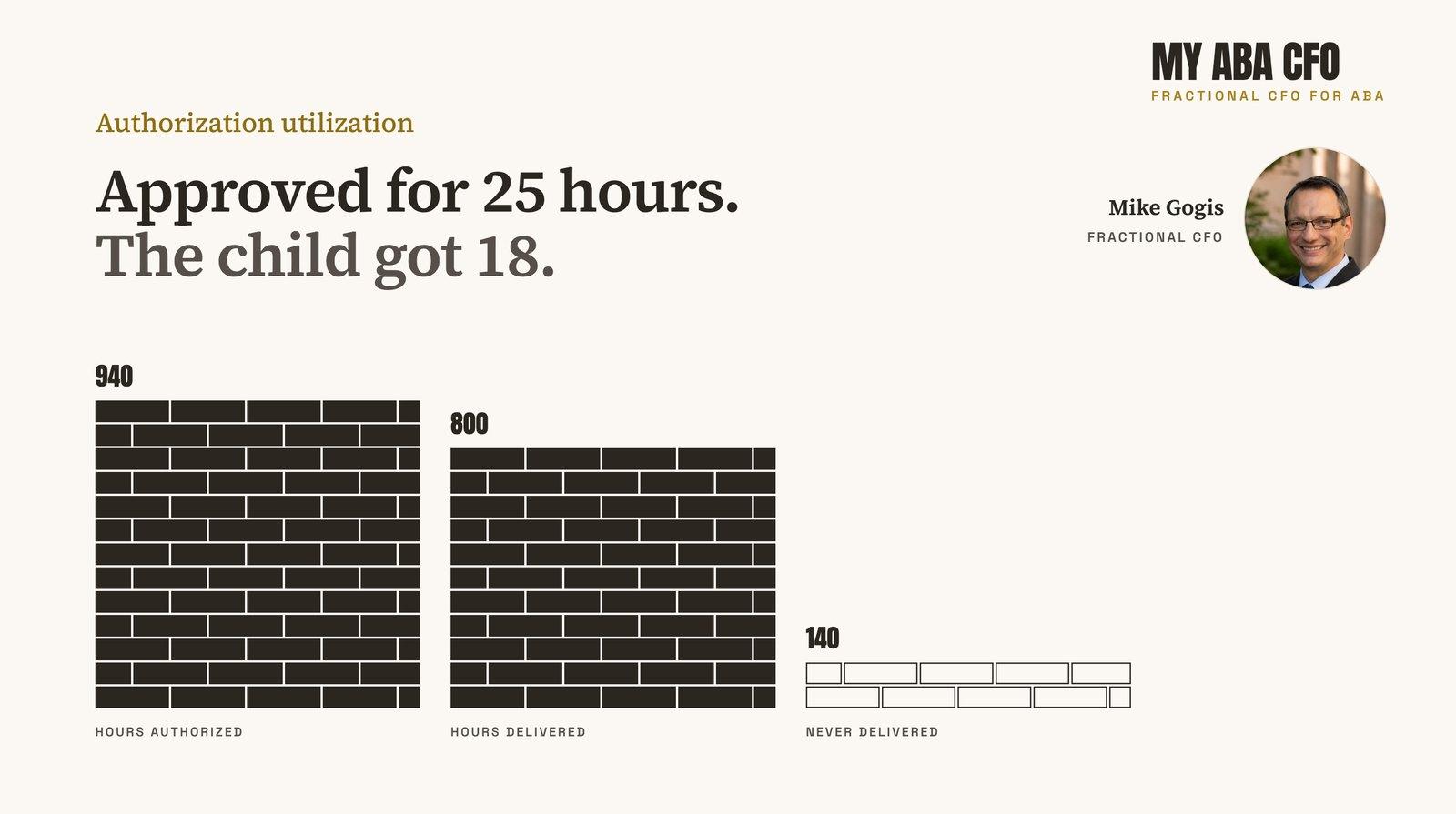
The payer approved 25 hours a week. The child got 18. Nobody decided that. It happened one unstaffed afternoon and one cancelled session at a time.
That is the gap between authorized hours and delivered hours, and I see it in nearly every ABA company I look at. It never shows up on your P&L, because you cannot see revenue you did not bill. But it is usually the largest pile of money in the building that nobody is managing.
What the gap costs
Take a company doing about $3 million a year. Forty RBTs, a blended rate around $60 an hour. These are round numbers to show the math, not benchmarks.
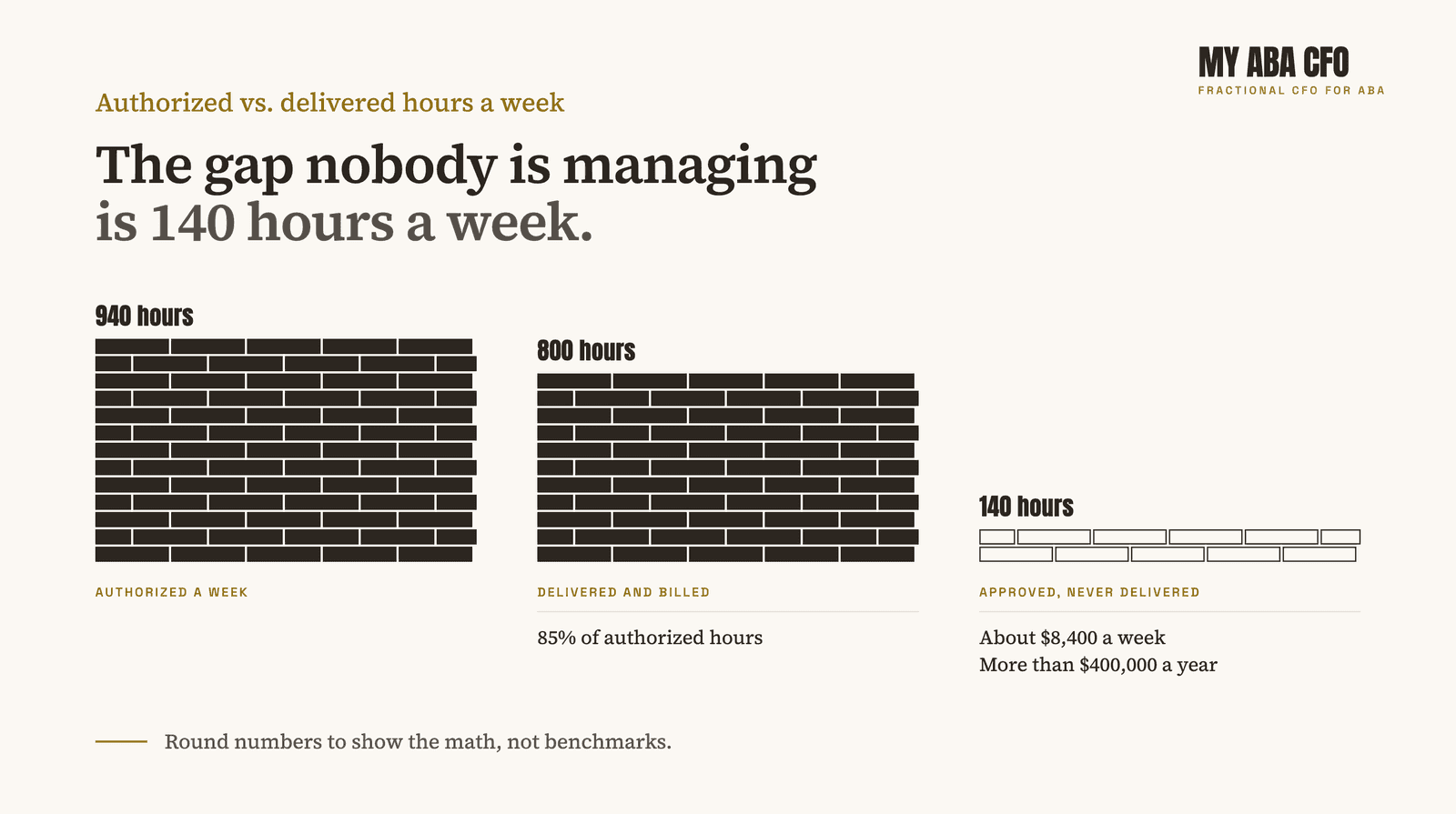
Add up every client's authorization and you get 940 hours a week. Add up what was delivered and billed: 800. That is 85%. Sounds respectable.
The other 15% is 140 hours a week. At $60, that is about $8,400 a week, or more than $400,000 a year. Already approved by the payer. Already prescribed by your BCBA. Never delivered.
And it is not only your money. Those hours are in the treatment plan because a clinician said the child needs them.
Do this now: Total your authorized hours per week and your delivered hours per week. Divide. If you cannot produce that number in an hour, that is your first finding.
Why it happens: staffing, cancellations, scheduling
Three causes. Each needs a different fix.
Staffing. The hours are authorized but there is no tech to cover them. A client approved for 25 hours has a tech for 15, and the rest sits on a waiting-for-staff list. The RBT who quit in the spring left ten hours a week that never got reassigned.
Cancellations. The session was on the schedule and did not happen. The family cancelled or the tech called out, and nobody made it up. Every cancelled hour that is not rescheduled becomes a gap hour.
Scheduling. The authorization says 30 hours, but the child is in school until 3:00 and the family can do 3:30 to 6:00. So can every other family. Those hours were never deliverable, and everyone knew it the day the authorization came back.
Do this now: Tag every gap hour with one of the three. Staffing is a hiring problem. Cancellations are a policy problem. Scheduling is a conversation between the BCBA and the family.
How to measure it per client
The company-wide 85% is an average, and averages hide things. It is rarely every client at 85%. More often it is most clients in the 90s and a handful near 60%.
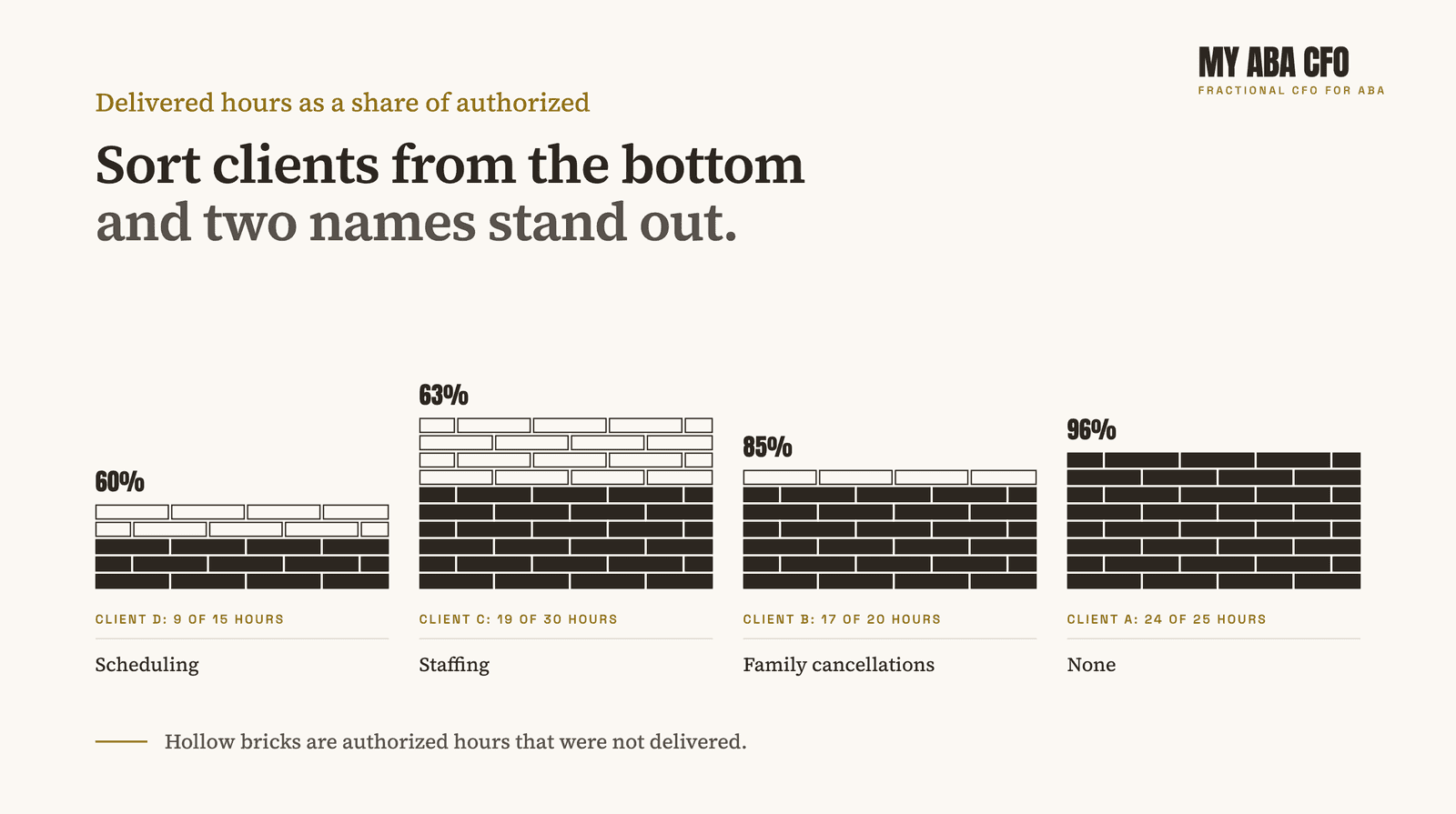
So run it per client, every month: weekly hours delivered divided by weekly hours authorized. Sort from the bottom.
| Client | Authorized hours a week | Delivered hours a week | Delivered | Main reason |
|---|---|---|---|---|
| D | 15 | 9 | 60% | Scheduling: only free after 4:00 |
| C | 30 | 19 | 63% | Staffing: no afternoon tech |
| B | 20 | 17 | 85% | Family cancellations |
| A | 25 | 24 | 96% | None |
Client A needs nothing. Clients C and D are missing 17 hours a week between them. Two names, and you know where to start.
Three rules when you build it. Use weekly hours, not the total for the authorization period, or a client who started late looks fine until month five. Count only billed hours as delivered. And put the BCBA's name on every row, because the BCBA owns the fix.
The goal is not 100%. Kids get sick. Families travel. And if a family can truly only do 15 hours, the answer is a treatment plan that says 15, not pressure to fill 25. A client using 60% of an authorization also gives the payer an easy reason to approve less next time.
Do this now: Review the bottom ten clients every month with your clinical director. One reason and one next step per name.
Why closing the gap beats adding clients
Most owners who want more revenue go looking for more clients. Look at what a new client costs before the first billed hour: intake, a benefits check, an assessment, a wait for the authorization, a BCBA with room on the caseload, and usually a new tech to hire, train and credential.
Gap hours skip most of that. The client is already yours. The authorization is in hand. The BCBA is already assigned.
Say you recover 50 of those 140 hours a week, about a third. That is $156,000 a year in revenue. Even if every one of those hours needs new tech time at roughly $25 an hour loaded, about $90,000 reaches profit. For a company making $300,000, that is a 30% raise.
To get the same 50 hours from growth, you need about three new clients. And they will leak at the same 85%, so you really need to win close to 60 authorized hours to deliver 50.
I am not telling you to stop growing. I am telling you to fix the leak first. Otherwise you are growing the leak.
Do this now: Before you approve the next marketing dollar, price your gap. In this example, each point of authorized hours you recover is worth roughly $29,000 a year.
Find your number
If you do not know your gap, or you know it and cannot move it, that is the kind of problem I work on. Thirty minutes on your business, your numbers and your next move. No pitch if it is not a fit.
Sources and further reading
- ABA Practice Guidelines for ASD (Council of Autism Service Providers)
- Virginia's Draft ABA Rules: In-Person Autism Evaluations and 20 Hour Caps for ABA (Breaking News ABA)
Common questions
What is ABA authorization utilization?
It is the share of authorized hours that are actually delivered and billed. In the article's example a company has 940 authorized hours a week and delivers 800, which is 85%. The gap never shows up on the P&L, because you cannot see revenue you did not bill.
How do you measure authorized versus delivered hours per client?
Every month, divide weekly hours delivered by weekly hours authorized for each client and sort from the bottom. Use weekly hours, not the total for the authorization period. Count only billed hours as delivered, and put the BCBA's name on every row, because the BCBA owns the fix.
Why are authorized ABA hours not delivered?
Three causes, and each needs a different fix. Staffing: the hours are authorized but there is no tech to cover them. Cancellations: the session was scheduled, did not happen and was not made up. Scheduling: the hours were never deliverable given when the child and family are available.
How much revenue does an authorization gap cost an ABA company?
In the article's example a gap of 140 hours a week at $60 an hour is about $8,400 a week, or more than $400,000 a year. Those hours were already approved by the payer and prescribed by the BCBA. Each point of authorized hours recovered is worth roughly $29,000 a year in that example.
Should an ABA company aim to deliver 100% of authorized hours?
No. Kids get sick and families travel. If a family can truly only do 15 hours, the answer is a treatment plan that says 15, not pressure to fill 25. A client using 60% of an authorization also gives the payer an easy reason to approve less next time.