
Most ABA owners hear about denials the way they hear about a leaky faucet. Billing mentions it. Billing is working on it. Nobody puts a number on it.
That is the mistake. A denied claim is a cost, a cash delay and, more often than owners think, revenue that never arrives. And most denials are caused long before the claim reaches your billing team.
I treat the denial rate as a finance number. Here is why you should too.
What a denied ABA claim really costs
A denied claim costs you three ways.
Rework. Someone has to read the denial, find the cause, chase a note or an authorization, correct the claim, resubmit it and follow up. Call it 45 minutes. With a biller who costs you about $70,000 a year loaded, that is roughly $25 a claim.
Delay. A clean claim pays in a few weeks. A denied one that gets fixed pays a month or two later. Your payroll does not wait.
Write-offs. This is the big one. Some denials never get worked. Some lose on appeal. Some sit until the payer's filing deadline passes, and then the money is gone for good. In my experience the write-off pile is larger than owners guess, because it disappears into an adjustment line nobody reads.
Do this now: Ask how many denied dollars were written off in the last 12 months. If nobody can tell you, that is your first finding.
The math on a $3 million ABA company
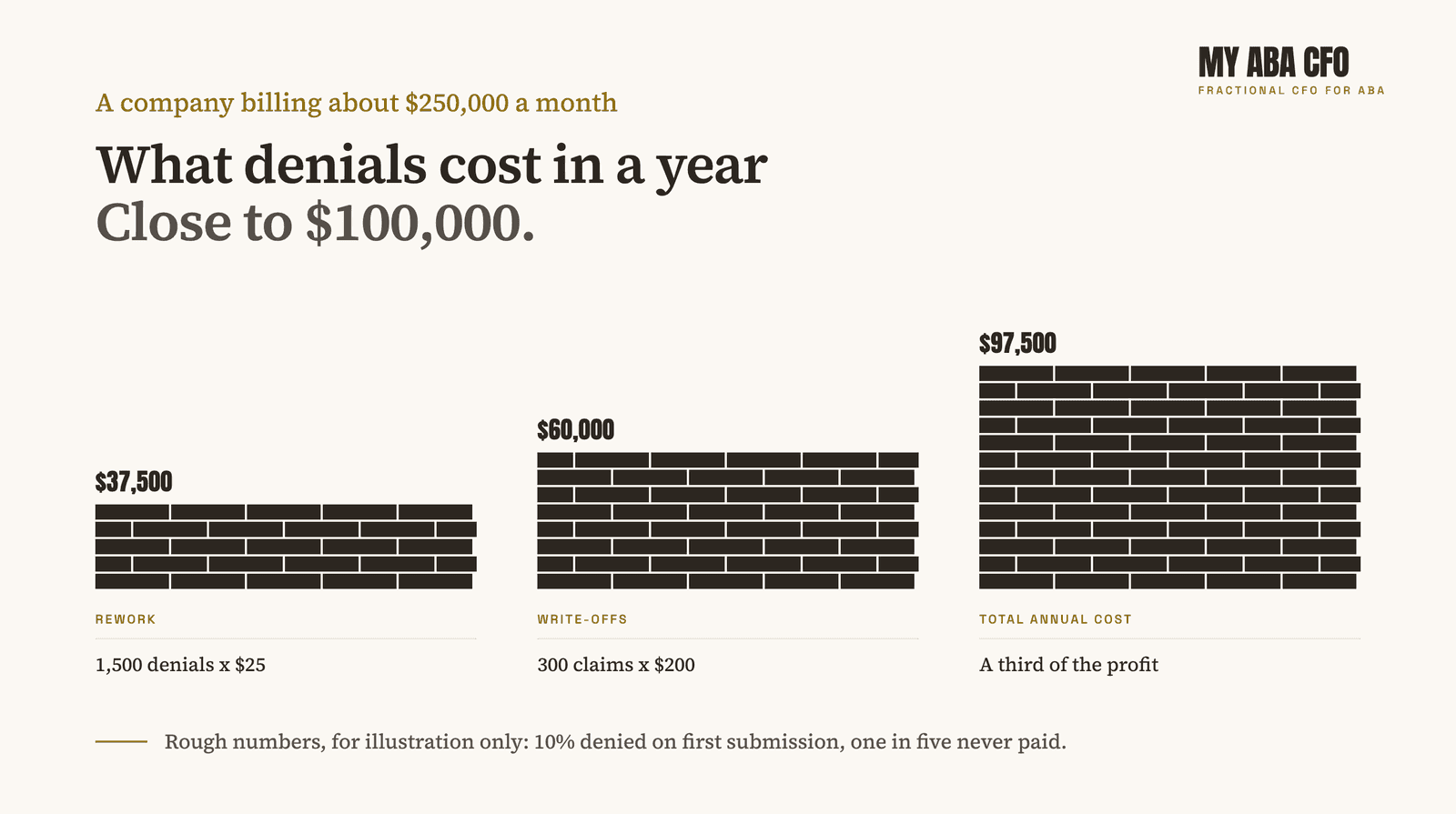
Rough numbers, for illustration only. Take a company billing about $250,000 a month. Call that 1,250 claims at an average of $200.
Say 10% are denied on first submission. That is 125 claims and $25,000 a month sent back. Say one in five of those is never paid.
| Annual cost | Rough math | Amount |
|---|---|---|
| Rework | 1,500 denials x $25 | $37,500 |
| Write-offs | 300 claims x $200 | $60,000 |
| Total | $97,500 |
Close to $100,000 a year. At a 10% margin that company earns about $300,000, so denials are eating a third of the profit. Put another way, each denial costs about $65 on a $200 claim.
Then the cash. The denials that do get paid arrive about 45 days late. That leaves roughly $30,000 stuck in receivables all year long.
Cut the denial rate from 10% to 5% and you keep about $50,000 a year. No new clients. No new hires.
Do this now: Run the same math with your own claim count, denial rate and write-offs.
The handful of root causes behind most ABA denials
When I sort a denial report by reason, the same few causes show up almost every time.
- Authorization. Expired, out of units, or issued for a different code or provider than the one billed.
- Eligibility. The plan changed in January. Medicaid coverage lapsed. A second insurer appeared and nobody updated the file.
- Credentialing. The clinician was seeing clients before the payer had enrolled them.
- Documentation. A missing signature, times that do not match the claim, a note finished after the claim went out.
- Claim errors. Wrong modifier, wrong units, wrong place of service, a duplicate, a late filing.
Look at who owns each one. Authorizations belong to whoever schedules and tracks them. Eligibility belongs to intake. Credentialing belongs to HR or operations. Notes belong to clinical. Only the last one is truly billing's.
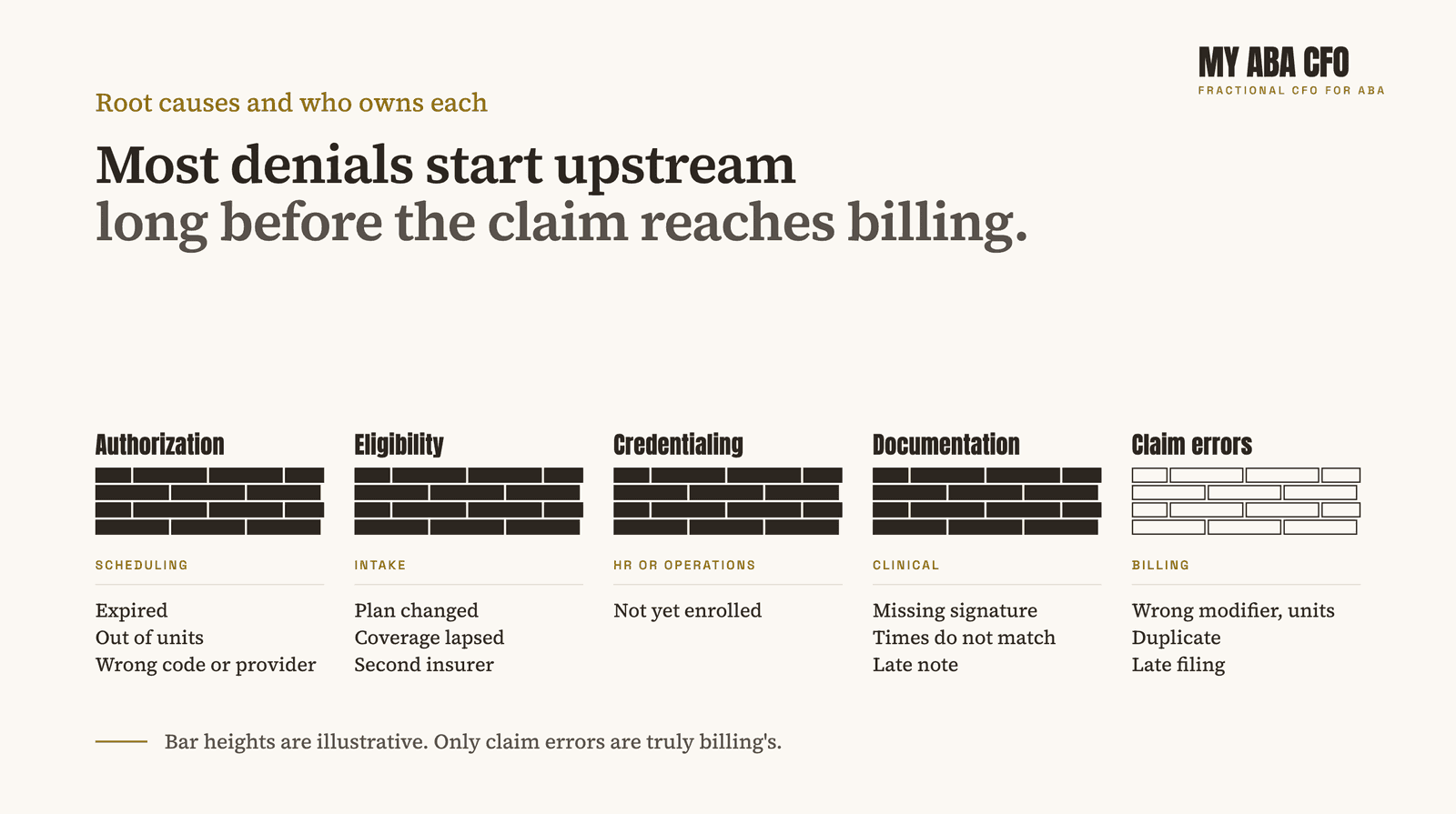
So when you tell billing to "fix denials," you are asking the last person in line to fix what four other people did. They can rework the claim. They cannot stop the next one.
Do this now: Get last quarter's denials sorted by reason and by dollars. Write the name of the person who owns each cause next to it.
Put denials on the finance report
Fixing denials one claim at a time is a treadmill. Fixing the cause is a one-time job.
Four numbers belong on your monthly report: first-pass denial rate, denied dollars by reason, denied dollars by payer, and dollars written off. Watch the trend as well as the level.
Then run it like any other cost. Pick the largest cause each month and fix the process behind it. An authorization check before the schedule is built. Eligibility verified again every month, and for every client in January. No claim released without a signed note. No write-off above a small threshold without a second approval.
None of that is expensive. It does need someone senior enough to walk into scheduling, intake and clinical and change how they work. That is rarely the billing lead. It is you, or whoever runs finance for you.
Do this now: Set a target for your denial rate and review it monthly with the people who own the causes, along with the people who rework the claims.
Want a second set of eyes on your denials?
If your denial rate is a number you hear about but never see, start there. I am glad to look at it with you.
Thirty minutes on your business, your numbers and your next move. No pitch if it is not a fit.
Sources and further reading
Common questions
What does a denied ABA claim really cost?
It costs you three ways: rework, delay and write-offs. Rework is roughly $25 a claim in the article's example. A denied claim that gets fixed pays a month or two later. Some denials are never paid at all, and in the example each denial costs about $65 on a $200 claim.
How much do ABA claim denials cost a company in a year?
In the article's rough example, a company billing about $250,000 a month with 10% of claims denied on first submission loses $37,500 to rework and $60,000 to write-offs, close to $100,000 a year. At a 10% margin that is a third of the profit. Cutting the denial rate from 10% to 5% keeps about $50,000 a year.
What are the most common reasons ABA claims are denied?
The same few causes show up almost every time: authorization, eligibility, credentialing, documentation and claim errors. Authorizations belong to whoever schedules and tracks them, eligibility to intake, credentialing to HR or operations, and notes to clinical. Only claim errors are truly billing's.
Why are ABA claim denials a finance problem and not a billing problem?
Most denials are caused long before the claim reaches the billing team. Billing can rework the claim but cannot stop the next one. Fixing the cause takes someone senior enough to walk into scheduling, intake and clinical and change how they work, which is the owner or whoever runs finance.
What denial numbers should an ABA owner track every month?
Four numbers belong on the monthly report: first-pass denial rate, denied dollars by reason, denied dollars by payer, and dollars written off. Watch the trend as well as the level. Then pick the largest cause each month and fix the process behind it.