
Your P&L says you made money last month. Your bank balance says you cannot cover Friday's payroll. Both are telling the truth.
I see this in ABA companies more than any other financial problem, and it is almost never a profit problem. It is a timing problem. You pay your people every two weeks. Your payers pay you when they get around to it. The gap between those two clocks is where good companies get into trouble.
Billed, collected, banked: three different numbers
Most owners use one word, revenue, for three different things.
Billed is what you sent to payers. On an accrual P&L, that is your revenue. Collected is what payers will actually pay once denials, adjustments and write-offs come out. Banked is what has landed in your account and can be spent.
A rough illustration. Say you bill $250,000 this month. If you collect 95 cents on the dollar, about $237,000 of it will ever turn into cash. And how much of this month's work is banked by month end? Very little. The deposits you see this month are for sessions you delivered six weeks ago.
So the P&L shows what you earned. The bank shows what you were paid for work done a month and a half back. In a flat month those two look alike. In any other month they do not.
Do this now: ask your bookkeeper for last month's billed, collected and deposited totals, side by side. If nobody can produce all three, that is your first problem.
Days in A/R: how long your money is out
Days in A/R tells you how long, on average, a dollar sits with the payer after you bill it. The math is simple. Take what payers owe you and divide by what you bill in an average day.
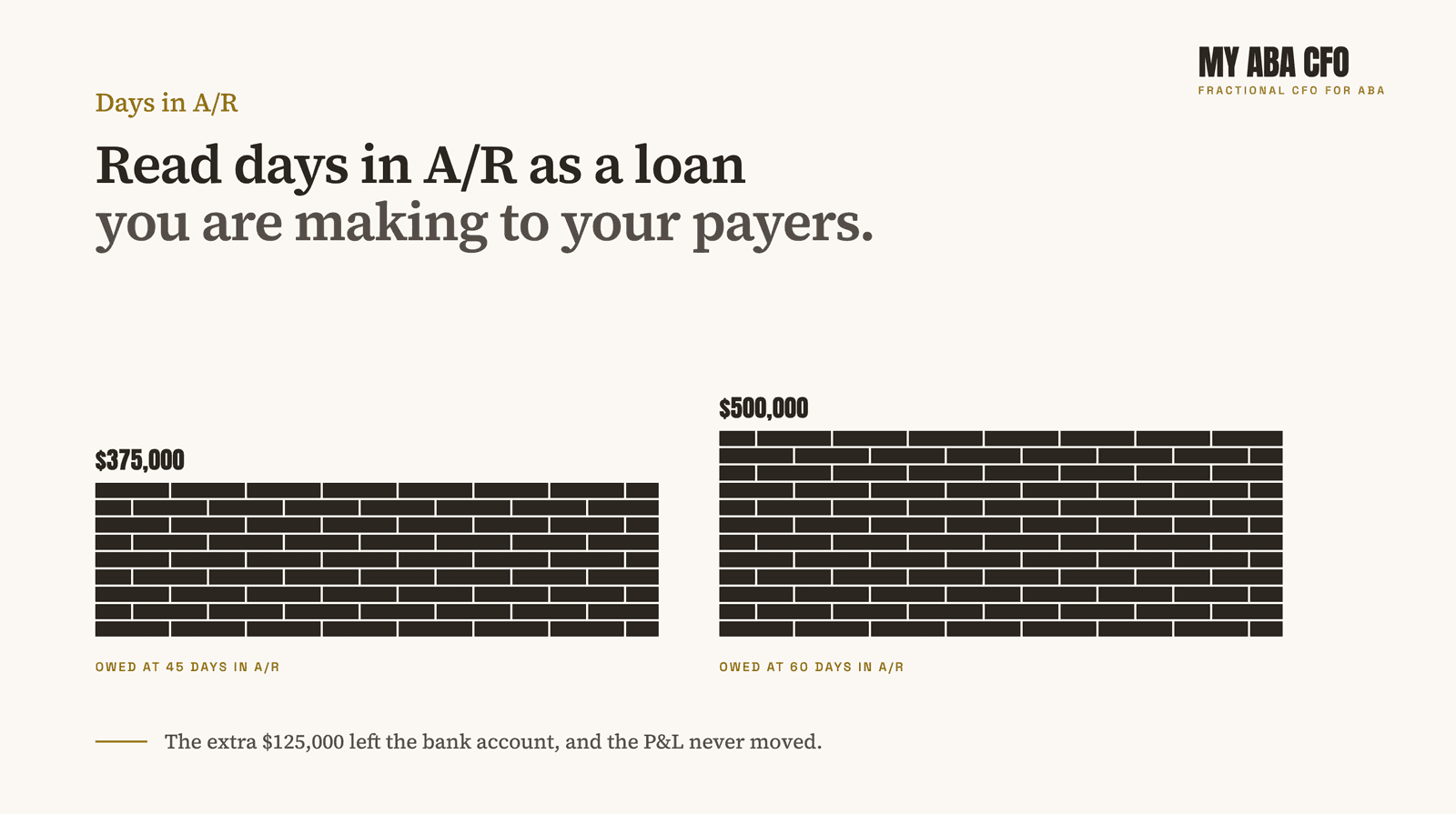
Same company. $250,000 a month is about $8,300 a day. If payers owe you $375,000, you are at 45 days.
Read that number as a loan. You have lent your payers $375,000, interest free, and you are funding it out of your own cash.
Now let it slip. A billing person leaves, an authorization lapses, one payer changes a portal. Days in A/R drifts from 45 to 60. You are now owed $500,000. That is $125,000 that left your bank account, and your P&L never moved. Every extra day costs this company about $8,300 in cash.
Do this now: calculate your days in A/R today, then for each of your top three payers. The average hides the one payer that is dragging it.
Why a 45-day payer cycle squeezes biweekly RBT payroll
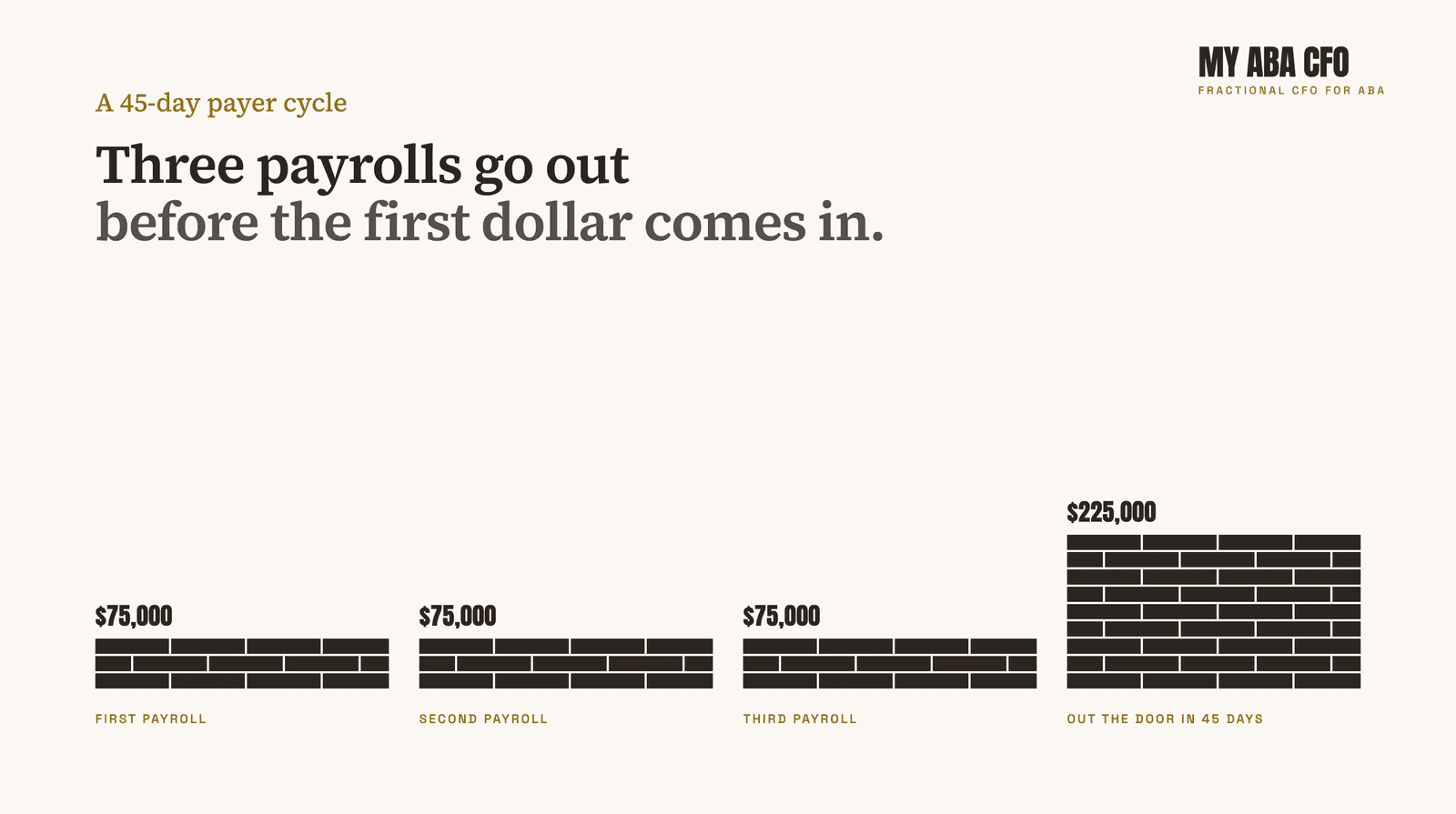
Follow one session. Your RBT delivers it today. You pay that RBT within two weeks. The payer pays you in about 45 days.
In those 45 days you run three payrolls. If payroll is $75,000 every two weeks, that is $225,000 out the door before the first dollar comes in for that work.
In a steady company you never notice. Old collections pay for new payroll, and the wheel keeps turning. Three things break the wheel.
- Growth. Add 20% more clients and payroll goes up on the next pay date. Collections go up six weeks later. For this company, A/R grows by about $75,000, and that cash comes from you. Growth eats cash before it makes any.
- The calendar. Biweekly payroll means two months a year have three pay dates. Payers do not send a third check.
- A slow payer. One held batch of claims and your 45 days becomes 60.
This is why the companies I see miss payroll are so often the growing ones. They are not failing. They are outrunning their cash.
Do this now: mark the three-payroll months on next year's calendar, and price your next growth step in cash, not just in revenue.
The three numbers to check every Monday
You do not need a finance department to see this coming. You need three numbers and ten minutes.
- Cash in the bank, counted in payrolls. Not dollars. Payrolls. $150,000 in the bank with a $75,000 payroll is two payrolls. My rough rule: below two, I want a written plan for the next six weeks.
- Cash collected last week against what you expected. A company billing $250,000 a month should see somewhere around $55,000 land each week. One light week is noise. Two in a row is a signal. Call billing before you call the bank.
- Days in A/R, and which way it is moving. The level matters less than the direction. Three Mondays of drift upward means cash is about to get tight, usually a few weeks before you feel it.
Write them down every week in the same place. The trend is the point. These numbers are rough and illustrative, and yours will differ, but the habit does not.
When the three numbers start to worry you, the next tools are a 13-week cash forecast and a line of credit arranged before you need it.
Do this now: put a ten-minute meeting on your calendar for Monday morning. Three numbers. No exceptions.
Profit is an opinion. Cash is a fact.
A profitable ABA company can still run out of cash. It happens when nobody is watching the gap between billed and banked. Close that gap and payroll stops being a Thursday night worry.
If you want a second set of eyes on yours: thirty minutes on your business, your numbers and your next move. No pitch if it is not a fit.
Sources and further reading
- 42 CFR 447.45, Timely claims payment (Cornell Law School, Legal Information Institute)
- Molina Called Its Florida Kids' Plan Launch "Nearly Flawless." ABA Providers Report Not Getting Paid (Breaking News ABA)
Common questions
Why can a profitable ABA company still miss payroll?
Because profit and cash run on different clocks. You pay staff every two weeks, while payers pay in about 45 days. The P&L shows what you earned; the bank shows what you were paid for work done a month and a half ago. When the company grows, a month has three pay dates, or a payer slows down, cash runs short even though the P&L shows a profit.
What is days in A/R and how do you calculate it?
Days in A/R is how long, on average, a dollar sits with the payer after you bill it. Divide what payers owe you by what you bill in an average day. A company billing $250,000 a month bills about $8,300 a day, so $375,000 owed is 45 days.
Why does growth make cash tighter in an ABA company?
Payroll goes up on the next pay date, but collections go up about six weeks later. For a company billing $250,000 a month, adding 20% more clients grows A/R by about $75,000, and that cash comes from the owner. Growth eats cash before it makes any.
What cash numbers should an ABA owner check every week?
Three: cash in the bank counted in payrolls, cash collected last week against what you expected, and days in A/R along with which way it is moving. A rough rule is that below two payrolls of cash, you want a written plan for the next six weeks.