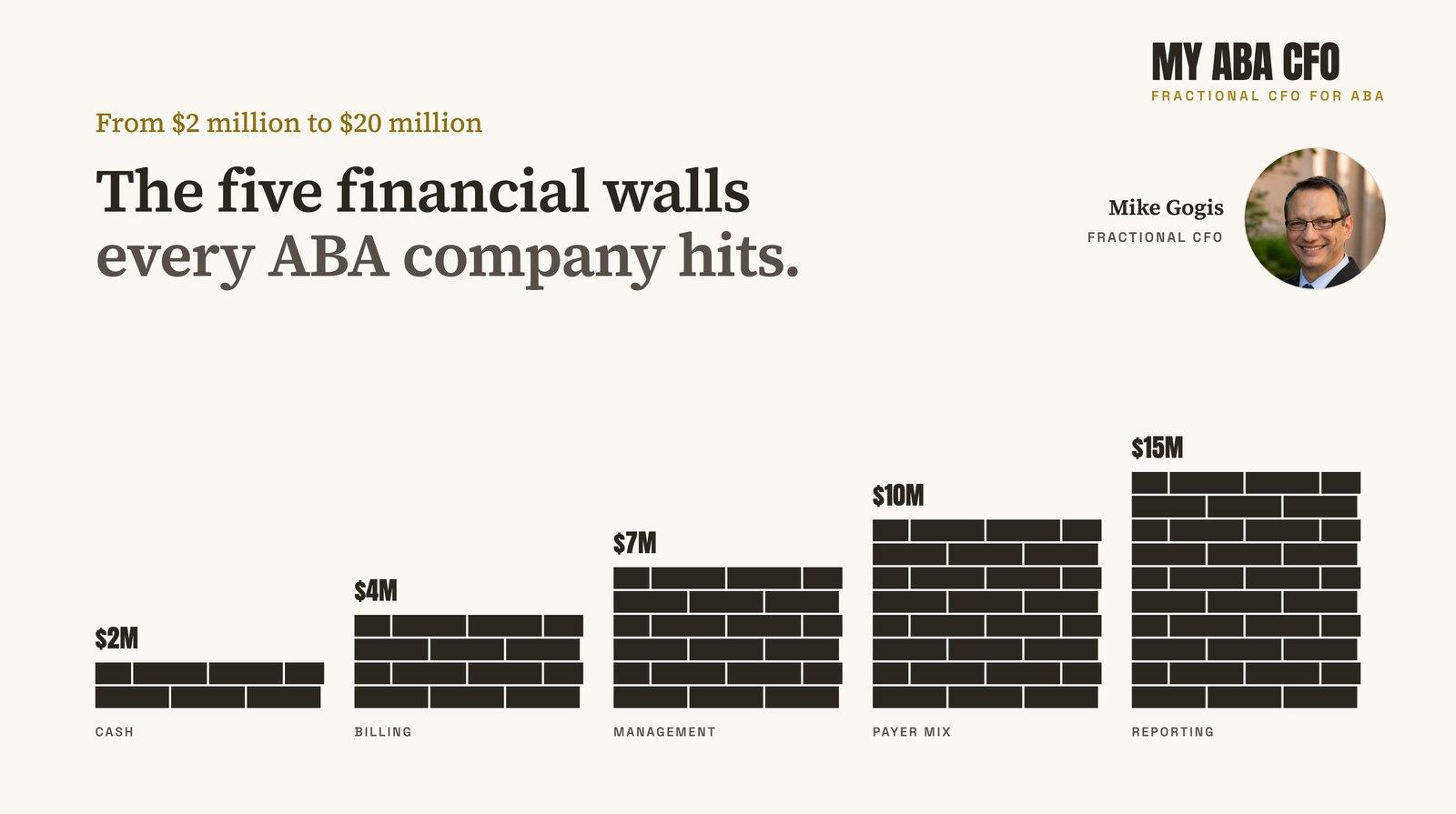
Most ABA owners think growth fixes money problems. More clients, more revenue, more room to breathe. In my experience it works the other way. Growth exposes every weak spot in your finances, and it does so in a predictable order.
Between $2 million and $20 million in revenue, I see five walls. Owners rarely hit them because they did something wrong. They hit them because what worked at the last stage stops working at the next one.
The revenue ranges below are rough, and your company may meet the walls in a different order. Here is each one, and what to build before you reach it.
The five walls at a glance
| Wall | Revenue | What breaks | Build first |
|---|---|---|---|
| 1. Cash | $2M to $4M | Payroll is due before payers pay | 13-week cash forecast, line of credit |
| 2. Billing capacity | $4M to $7M | Denials and old claims pile up | Weekly A/R aging review, denial tracking |
| 3. Middle management | $7M to $10M | Overhead arrives before the revenue that pays for it | A budget that plans the margin dip |
| 4. Payer mix | $10M to $15M | One payer carries too much of the risk | Margin by payer, a ceiling per payer |
| 5. Reporting | $15M to $20M | Banks, boards and buyers ask for numbers you cannot produce | Accrual books, monthly close by the 15th |
Wall 1: Cash ($2 million to $4 million)
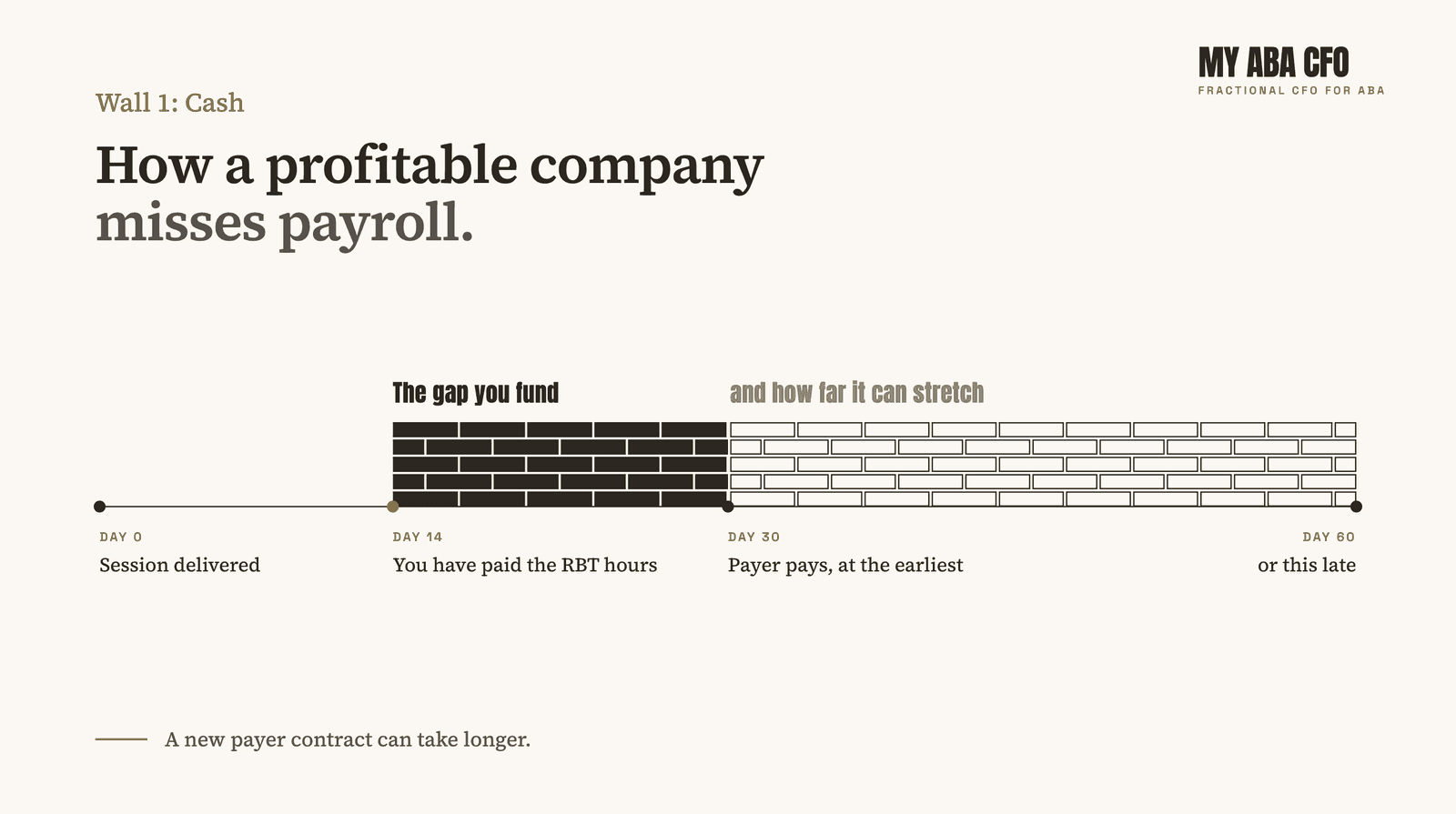
Growth eats cash. Every new client means RBT hours you pay for within two weeks. The payer may not pay you for 30 to 60 days, and a new payer contract can take longer. The faster you add clients, the bigger the gap you have to fund.
This is how a profitable company misses payroll. The P&L shows a profit. The bank account shows something else.
Build before you get there: a 13-week cash forecast, updated every week. Add a line of credit while your numbers look good. Banks prefer to lend to companies that do not need the money yet.
Wall 2: Billing capacity ($4 million to $7 million)
At $2 million, one sharp biller and the owner's attention can keep claims moving. At $5 million, the volume buries that person. Denials sit unworked. Authorizations lapse before anyone notices. Receivables past 90 days grow, and old claims run into timely filing limits and become write-offs.
Nobody announces this wall. Revenue keeps climbing while collections fall behind.
Build before you get there: a weekly review of A/R aging, denial tracking by cause and by payer, and one person who owns authorizations. Then decide on purpose whether billing stays in-house or goes to an outside firm.
Wall 3: Middle management ($7 million to $10 million)
At some point you cannot be in every clinic or review every schedule. So you hire clinical directors, a scheduling lead, HR, maybe a head of operations. All of them are necessary. None of them bill.
That overhead arrives before the revenue that pays for it. Margin dips, often for a year or more, and owners either panic or cut the wrong thing.
Build before you get there: a budget that plans the dip instead of discovering it. Set productivity targets for BCBAs and utilization targets for each location, so every new manager is tied to a number they are expected to move.
Wall 4: Payer mix ($10 million to $15 million)
Small companies take whatever contracts they can get. By $10 million, that history is your risk. One Medicaid plan may be half your revenue, and one rate cut or one audit can then erase a year of profit.
Some contracts do not earn money at all. Once you count cancellations, authorization hassle and slow payment, a payer can cost more than it pays.
Build before you get there: margin by payer, alongside revenue by payer. Set a ceiling on how much any single payer can represent. Bring your own data to rate negotiations, and add payers or markets before you are forced to.
Wall 5: Reporting ($15 million to $20 million)
At this size, other people start reading your numbers. A bank. A board. A buyer. They ask questions that cash-basis books and a year-end tax return cannot answer.
They want accrual financials, closed on a schedule every month. They want results by location and a forecast you can defend. If you cannot produce those, you lose leverage, whether you are borrowing, raising money or selling.
Build before you get there: accrual accounting, a monthly close by the 15th, a rolling 12-month forecast, and a one-page dashboard you review every month. Start two years before you think you need it.
Build one stage ahead
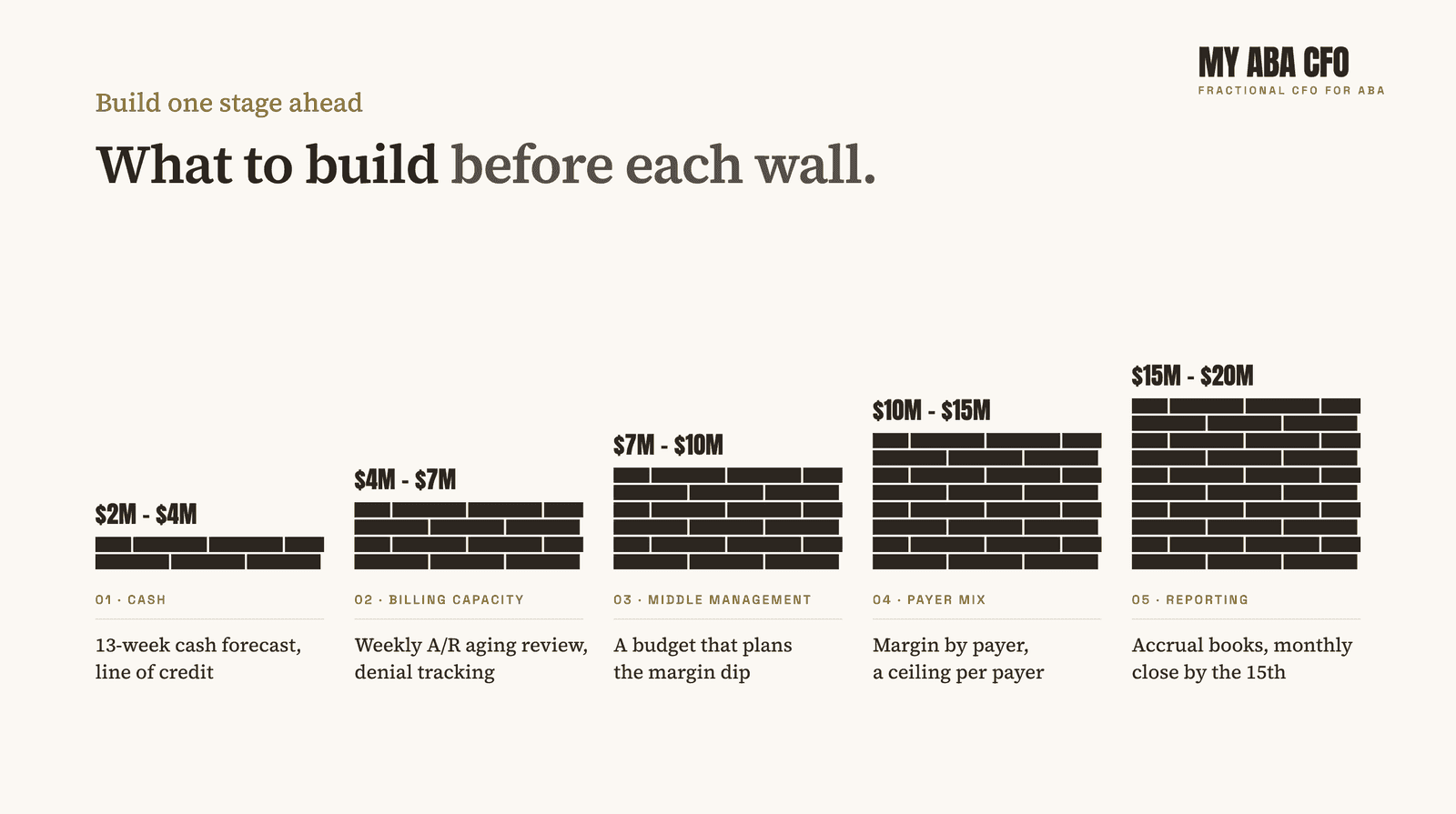
The pattern is the same at every stage. The fix takes months to build, and the wall gives you days of warning. The owners who scale well build one stage ahead.
If you are not sure which wall is next for your company, that is what a conversation is for. Thirty minutes on your business, your numbers and your next move. No pitch if it is not a fit.
Common questions
What are the five financial walls ABA companies hit between $2 million and $20 million?
They are cash (roughly $2 million to $4 million in revenue), billing capacity ($4 million to $7 million), middle management ($7 million to $10 million), payer mix ($10 million to $15 million) and reporting ($15 million to $20 million). The ranges are rough, and a company may meet the walls in a different order.
Why does a profitable ABA company run short of cash?
Because payroll is due before payers pay. RBT hours are paid within two weeks, while a payer may not pay for 30 to 60 days and a new payer contract can take longer. The faster the company adds clients, the bigger the gap it has to fund, so the P&L can show a profit while the bank account runs low.
When should an ABA company set up a line of credit?
While the numbers look good and before the money is needed. Banks prefer to lend to companies that do not need the money yet. Pair the line of credit with a 13-week cash forecast that is updated every week.
Should an ABA company keep billing in-house or outsource it?
There is no single right answer, but the decision should be made on purpose, usually between $4 million and $7 million in revenue, when claim volume outgrows one biller. First put in a weekly review of A/R aging, denial tracking by cause and by payer, and one person who owns authorizations. Then decide whether billing stays in-house or goes to an outside firm.
When does an ABA company need accrual accounting and a monthly close?
Before a bank, a board or a buyer starts reading the numbers, which usually happens between $15 million and $20 million in revenue. Start about two years before you think you need it: accrual accounting, a monthly close by the 15th, a rolling 12-month forecast and a one-page dashboard reviewed every month.