Most ABA companies start on cash-basis books. Money in is revenue. Money out is expense. Simple, cheap, and fine when you have ten clients.
Then you grow, and the books start lying. Not because anyone made a mistake. Because cash-basis accounting answers a different question than the one you are asking. You want to know what the business earned last month. Your books are telling you what cleared the bank.
In ABA, those two things sit about six weeks apart.
What cash-basis books actually measure
On cash basis, a session does not count as revenue the day your RBT delivers it. It counts the day the payer pays, often 30 to 60 days later. Payroll for that same session counts within two weeks.
So every monthly P&L pairs this month's wages with revenue from sessions delivered a month or two ago. The two halves of the page describe different periods.
Timing noise makes it worse. A payer releases a backlog of held claims and you have a record month. A month with three paydays looks like a disaster. Neither one says anything about how the practice actually ran.
Do this now: Lay out your last twelve monthly profit figures. If they swing wildly while your census barely moved, you are looking at timing, not performance.
Why growth makes the lie bigger
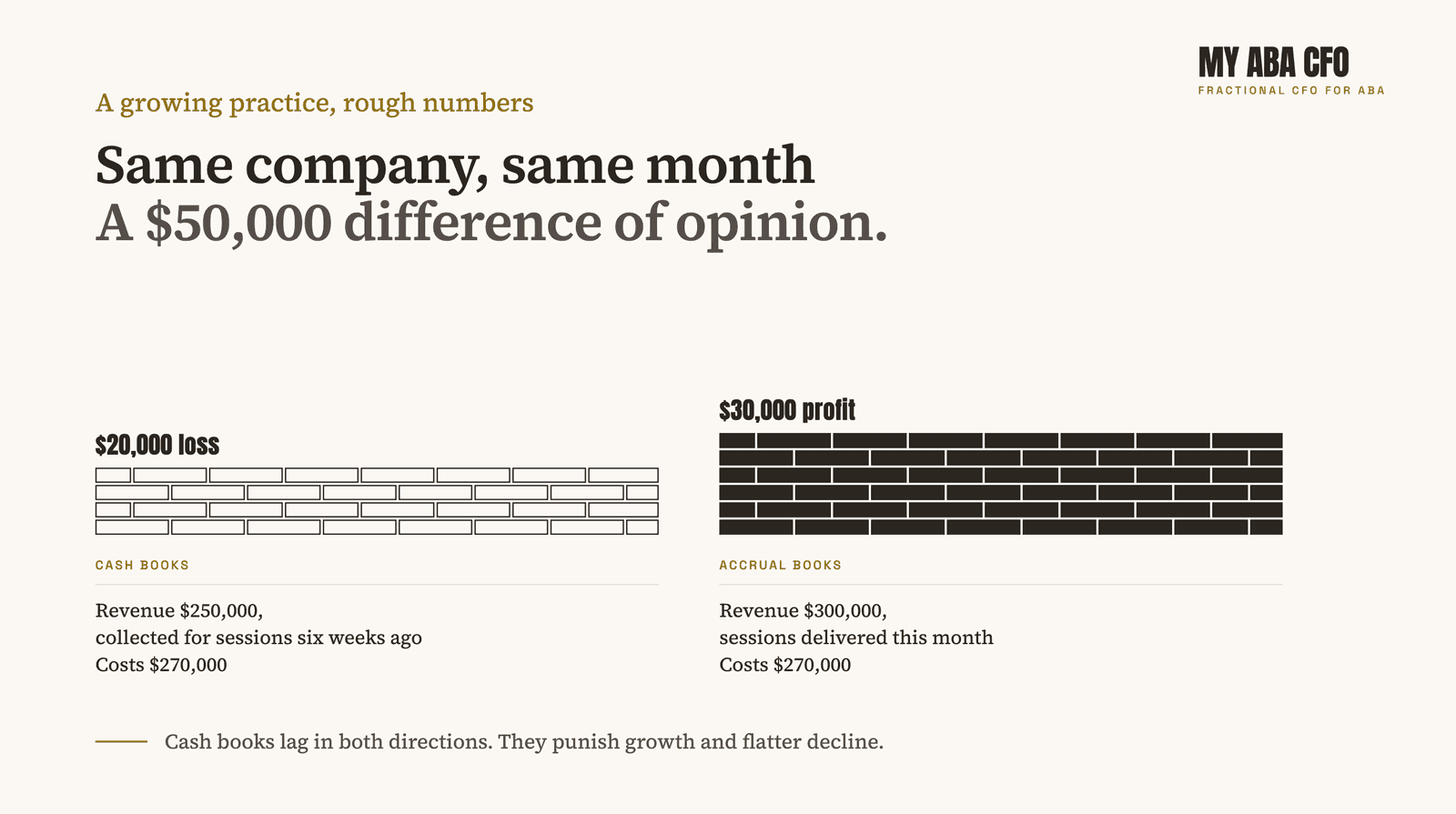
Take a practice billing about $250,000 a month at a 10% margin. These are rough, round numbers. Over a quarter it adds clients and staff and gets to $300,000 of services delivered a month, with costs around $270,000.
Here is the same month on both sets of books.
| Cash books | Accrual books | |
|---|---|---|
| Revenue | $250,000, collected for sessions six weeks ago | $300,000, sessions delivered this month |
| Costs | $270,000 | $270,000 |
| Profit | $20,000 loss | $30,000 profit |
Same company. Same month. A $50,000 difference of opinion.
The cash books say growth is losing money, so I see owners pull back on hiring right when the business is working. The cash strain is real, and you have to fund it. But it is a financing problem, not a profit problem. Those get different fixes.
The reverse is more dangerous. Lose two BCBAs and delivered services drop back to $250,000. Collections from the bigger months keep arriving for six more weeks. On cash books, your best-looking month comes just after things started going wrong.
Remember: Cash books lag in both directions. They punish growth and flatter decline.
What accrual books show you
Accrual accounting records revenue when the session is delivered and expenses when they are incurred. Wages land in the month the hours were worked. Revenue lands in the same month, at what you expect to collect, not what you billed.
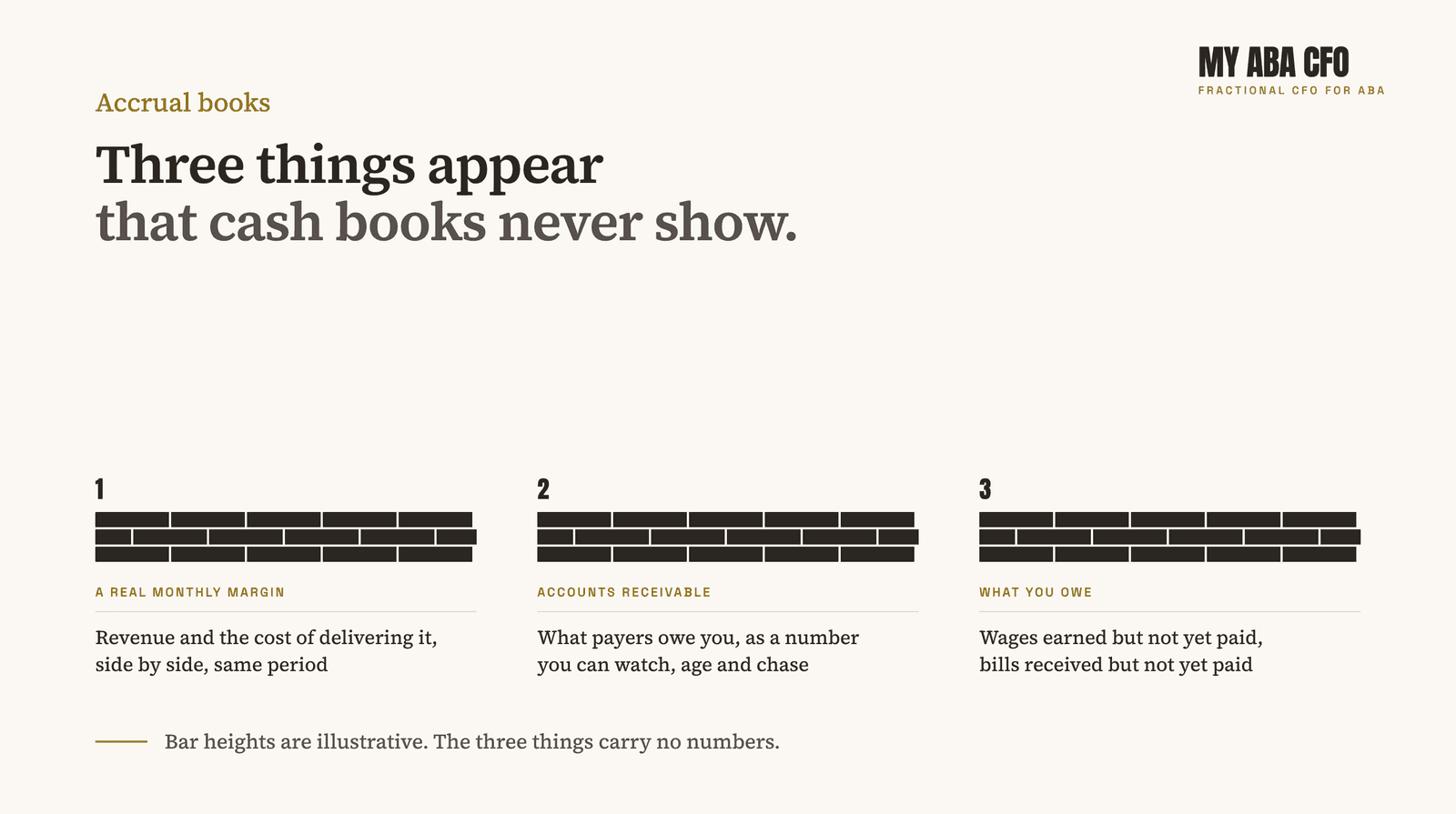
Three things appear that cash books never show:
- A real monthly margin. Revenue and the cost of delivering it, side by side, same period. Now you can compare months, clinics and payers.
- Accounts receivable on the balance sheet. What payers owe you becomes a number you can watch, age and chase.
- What you owe. Wages earned but not yet paid, and bills received but not yet paid.
It is also what outsiders read. A bank sizing a line of credit wants to see receivables. A buyer will rebuild your numbers on an accrual basis anyway, and you would rather do that yourself, first.
You do not give up the cash view. You still need a cash forecast. You just stop asking one report to answer two questions.
Know the difference: Accrual tells you whether the business is making money. Cash tells you whether you can make payroll. You need both.
When to switch from cash to accrual
With one site, steady census and revenue under a couple of million dollars, cash books are usually fine. I would switch when any of these is true:
- Revenue is past roughly $2 million, or growing fast at any size.
- You are opening a second location or entering a new state.
- You want to borrow, or a sale is possible in the next two or three years.
- You cannot explain why your profit and your bank balance disagree.
Two practical notes. Switching your books does not have to change how you file taxes. Many companies this size keep accrual books for management and still file on a cash basis. That is a question for your tax CPA.
And accrual takes more work. Someone has to close the books every month: record revenue from your practice management system, tie receivables to the aging report, accrue payroll, and estimate what will not be collected. That is controller-level work, not something to hand a part-time bookkeeper without help.
Do this now: Pick a clean start date, the first day of a year or quarter, and ask whoever keeps your books what a monthly accrual close would take.
Find out what your books are hiding
If your books are on cash basis and the business is growing, you are steering by numbers that are six weeks old and mismatched. That is fixable.
Thirty minutes on your business, your numbers and your next move. No pitch if it is not a fit.
Sources and further reading
- Publication 538, Accounting Periods and Methods (Internal Revenue Service)
- Manage your business: Manage your finances (U.S. Small Business Administration)
Common questions
What is the difference between cash and accrual accounting for an ABA company?
On cash basis, a session counts as revenue the day the payer pays, often 30 to 60 days after it was delivered, while payroll for that session counts within two weeks. Accrual accounting records revenue when the session is delivered and expenses when they are incurred. Accrual tells you whether the business is making money. Cash tells you whether you can make payroll. You need both.
Why do cash-basis books make a growing ABA practice look unprofitable?
Because each monthly P&L pairs this month's wages with revenue from sessions delivered a month or two ago. In the article's example, a practice that grew to $300,000 of services a month shows a $20,000 loss on cash books and a $30,000 profit on accrual books for the same month. The cash strain is real and you have to fund it, but it is a financing problem, not a profit problem.
What does ABA accrual accounting show that cash books do not?
Three things. A real monthly margin, with revenue and the cost of delivering it in the same period. Accounts receivable on the balance sheet, so what payers owe you is a number you can watch, age and chase. And what you owe: wages earned but not yet paid and bills received but not yet paid.
When should an ABA company switch from cash to accrual accounting?
With one site, steady census and revenue under a couple of million dollars, cash books are usually fine. Switch when revenue is past roughly $2 million or growing fast, when you are opening a second location or entering a new state, when you want to borrow or a sale is possible in the next two or three years, or when you cannot explain why your profit and bank balance disagree.
Does switching to accrual books change how my ABA company files taxes?
It does not have to. Many companies this size keep accrual books for management and still file on a cash basis. That is a question for your tax CPA.