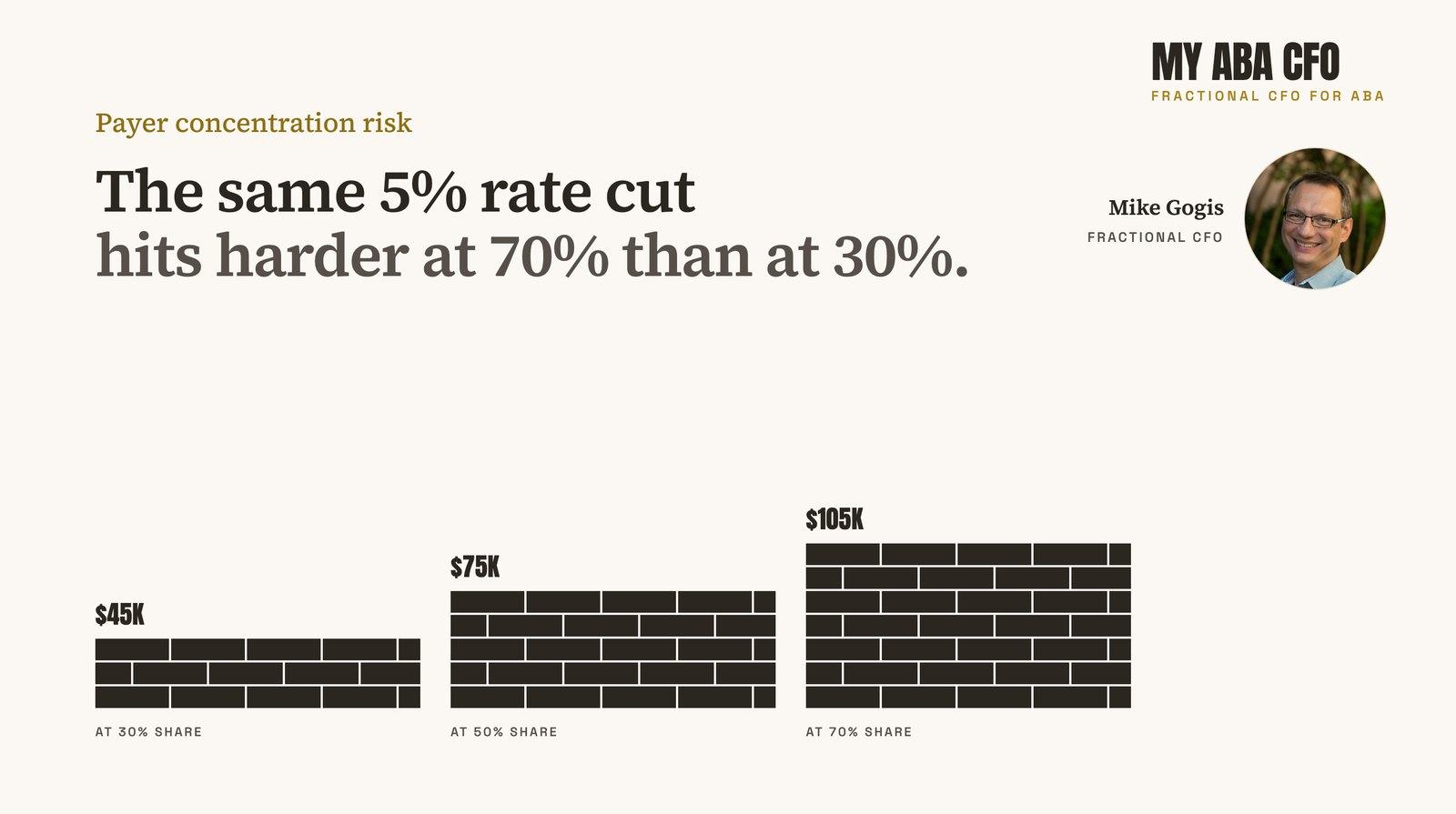
Pull up your revenue by payer for the last twelve months. If one name is more than half the page, that payer has more say over your ABA company than you do.
It decides what you get paid, how fast, and for how many hours. You find out by letter. Most owners I talk to know who their biggest payer is. Few have priced what that payer can do to them.
Measure your payer concentration first
Payer concentration is each payer's share of your revenue. Take twelve months of collections, sort by payer, and divide each by the total. Ten minutes if your billing system is clean.
Two cautions. Count by who sets the rate, not by the name on the remittance. If three Medicaid managed care plans all follow the same state fee schedule, one decision moves all three. For rate risk, they are one payer.
And look at the trend. A payer that went from 40% of revenue to 55% in two years tells you where your intake is drifting.
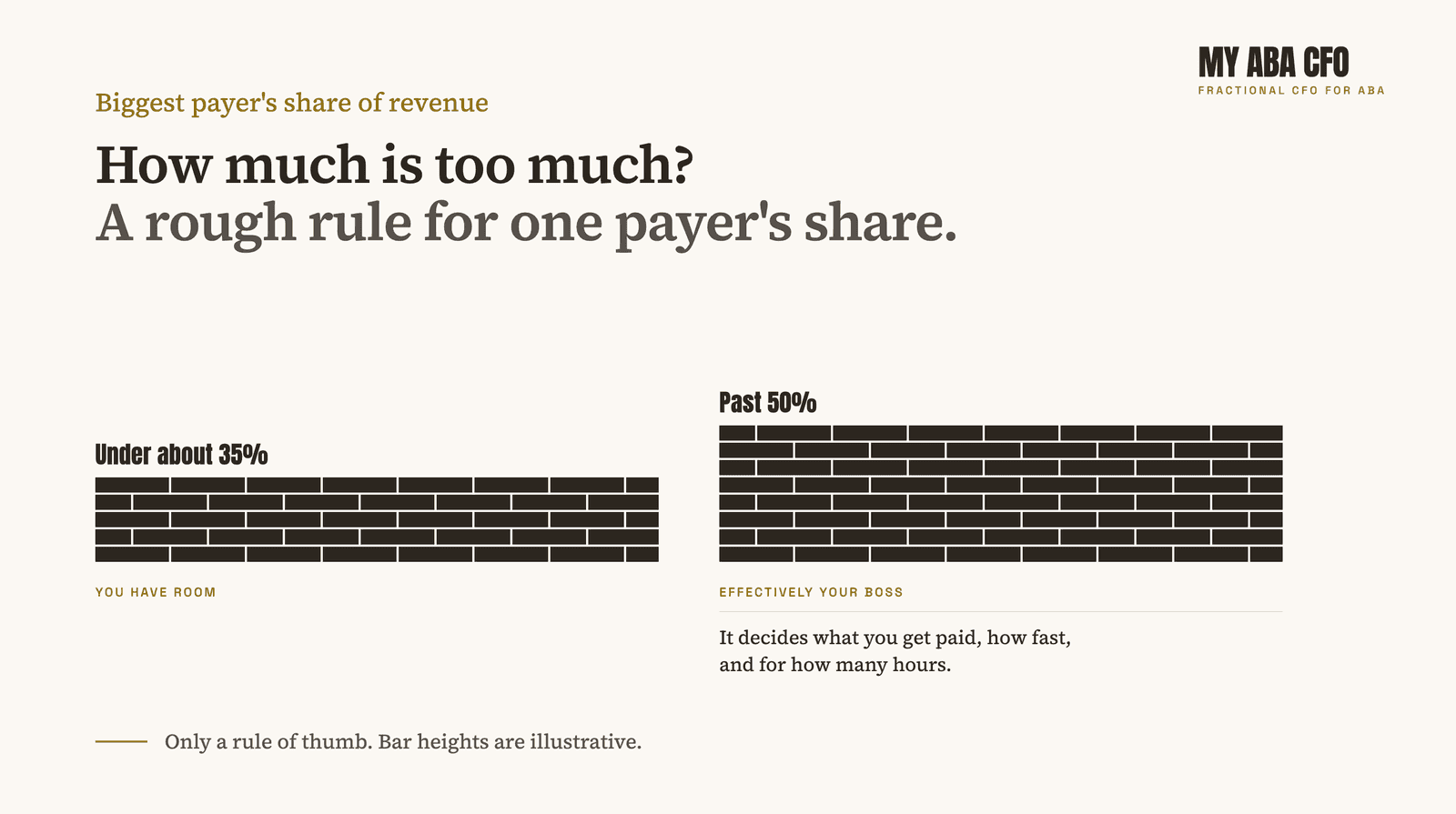
My rough rule, and it is only a rule of thumb: under about 35% from any one payer, you have room. Past 50%, that payer is effectively your boss.
Do this now: Build a one-page table of revenue by payer, this year and last, with each payer's share.
What a rate cut from your biggest payer does
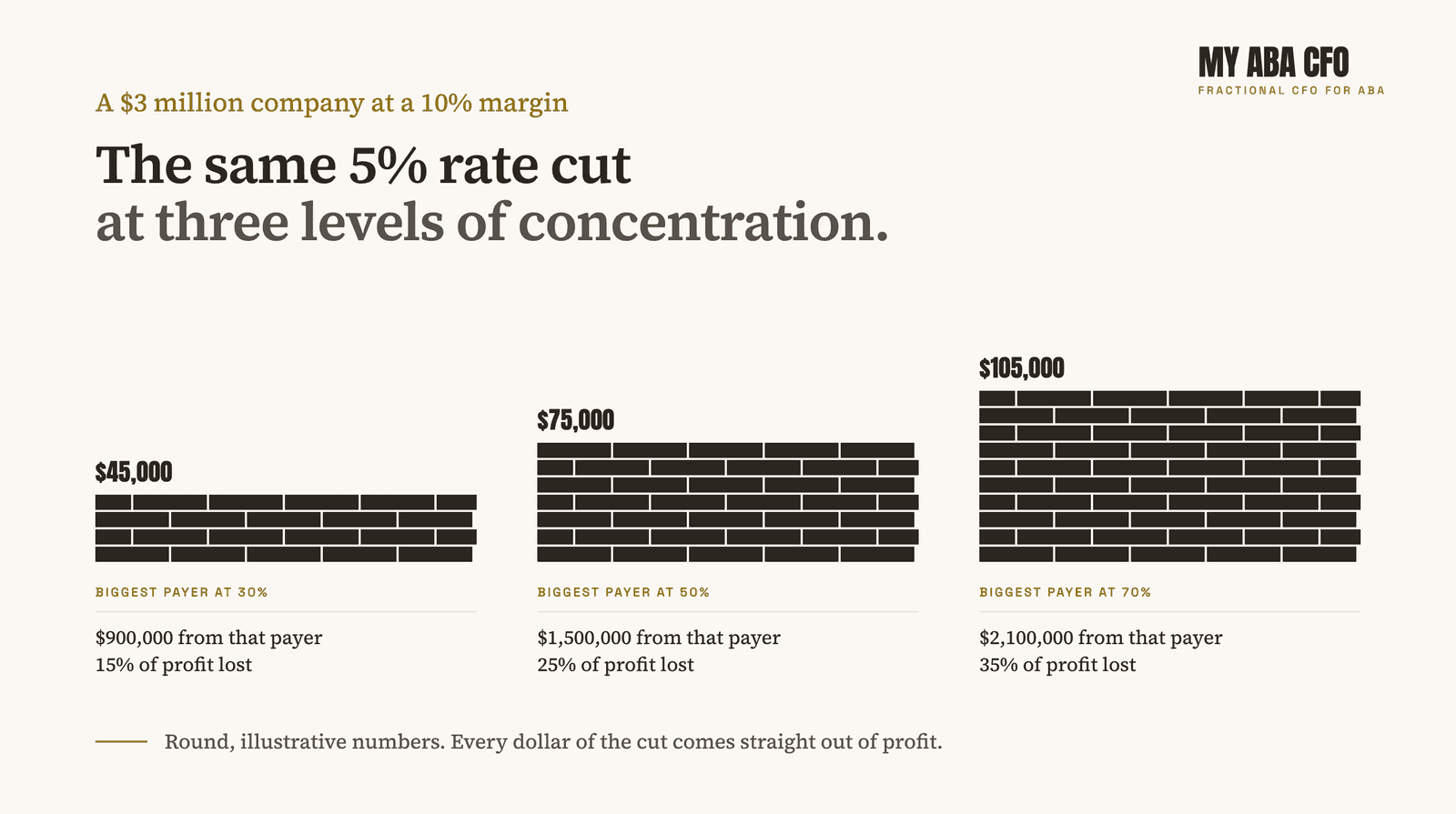
Take a company doing about $3 million a year at a 10% margin. That is $300,000 of profit. These numbers are round and illustrative, but the pattern holds.
A rate cut takes revenue and leaves your costs alone. Same RBTs, same hours, same rent. So every dollar comes straight out of profit. Here is a 5% cut from the biggest payer at three levels of concentration.
| Biggest payer's share | Revenue from that payer | Cost of a 5% cut | Share of profit lost |
|---|---|---|---|
| 30% | $900,000 | $45,000 | 15% |
| 50% | $1,500,000 | $75,000 | 25% |
| 70% | $2,100,000 | $105,000 | 35% |
Same cut. Same company. At 30% it is a bad quarter. At 70% it is a third of what you earn in a year, and a 10% cut takes more than two-thirds.
Concentration does not cause the cut. It multiplies it.
Do this now: Multiply your biggest payer's annual revenue by 5% and by 10%. Put both numbers next to last year's profit.
Rates are not the only lever
A rate cut at least comes with notice. The other levers are quieter.
- Payment speed. A payer at 60% of that company's revenue accounts for about $150,000 of billing a month. If a system change or a new review step slows them by 30 days, $150,000 of your cash is late. That is roughly two payrolls.
- Authorizations. Tighter reviews or fewer approved hours cut your revenue without touching the rate.
- Audits. A repayment demand from the payer that is most of your revenue is sized to match.
- The contract itself. Many provider agreements can be ended without cause, or amended by the payer, on a few months' notice. Read yours.
With a payer at 20% of your business, each of these is a problem. At 60%, each one threatens the company.
It also weakens your hand. You cannot push back hard on a payer you cannot afford to lose, and the payer knows it. Buyers know it too. Heavy concentration is one of the first things they check, and it gets priced in.
Do this now: Find the termination, amendment and notice clauses in your largest contract. Write the notice periods on your payer table.
How to take some of the power back
You will not fix this in a quarter. In some states Medicaid is most of the market, and no strategy changes that. But you have more moves than you think.
- Get credentialed with other payers before you need them. Credentialing takes months. Start while things are calm.
- Steer growth, not families. Do not turn kids away to tidy a ratio. Point new referral relationships, your marketing and your next location toward where other payers' members are. Mix shifts through new intake, slowly.
- Watch two numbers every month. Share of revenue by payer, and share of new intakes by payer. The intake number shows where your mix will be a year from now.
- If you cannot diversify, carry more cushion. More cash in the bank, a line of credit already in place, and a margin that can absorb a 5% cut. A concentrated company has to be a stronger company.
Build before you need it: Set a target for your biggest payer's share two years out, and pick one action this quarter that moves toward it.
Know who is in charge
Concentration is not a mistake. It is usually what fast growth looks like. One payer said yes, the referrals came, and you built around them. The mistake is not knowing what it costs you if they change the terms.
If you want a second set of eyes on your payer mix and what a cut would do to your numbers, that is the kind of work I do with owners. Thirty minutes on your business, your numbers and your next move. No pitch if it is not a fit.
Sources and further reading
- Managed Care (Medicaid.gov)
- Georgia Senator Calls Amerigroup's 30% ABA Technician Rate Cut 'Indefensible.' Amerigroup Calls It 'Clinically Defensible.' (Breaking News ABA)
Common questions
What is payer concentration in an ABA company?
Payer concentration is each payer's share of your revenue. Take twelve months of collections, sort by payer, and divide each by the total. Count by who sets the rate, not by the name on the remittance, and look at the trend as well.
How much payer concentration is too much for an ABA company?
A rough rule of thumb from the article: under about 35% from any one payer, you have room. Past 50%, that payer is effectively your boss. It is only a rule of thumb.
What does a rate cut from your biggest payer do to ABA profit?
A rate cut takes revenue and leaves your costs alone, so every dollar comes straight out of profit. In the article's example of a $3 million company at a 10% margin, a 5% cut costs $45,000 when the payer is 30% of revenue and $105,000 when it is 70%. At 70% that is about a third of a year's profit.
What risks besides rate cuts come with ABA payer concentration?
Payment speed, authorizations, audits and the contract itself. A slowdown at a large payer makes that cash late, tighter reviews or fewer approved hours cut revenue without touching the rate, and many provider agreements can be ended or amended on a few months' notice. Concentration also weakens your hand with the payer and with buyers.
How can an ABA company reduce payer concentration risk?
Get credentialed with other payers before you need them, and steer growth toward where other payers' members are without turning families away. Watch share of revenue by payer and share of new intakes by payer every month. If you cannot diversify, carry more cushion: more cash, a line of credit already in place, and a margin that can absorb a 5% cut.