Your first clinic is full. There is a waitlist. A landlord across town has a space that looks perfect. So you sign.
That is how most second clinics get opened. On a feeling, with a lease.
I think the order is backwards. A second ABA clinic is a bet that costs real cash for a long time before it pays anything back. Three numbers tell you whether you can afford the bet: your break-even census, your ramp-up time, and your total cash burn. Work them out before you sign anything.
The figures below are round and rough. Swap in your own.
Break-even census: how many clients cover the bills
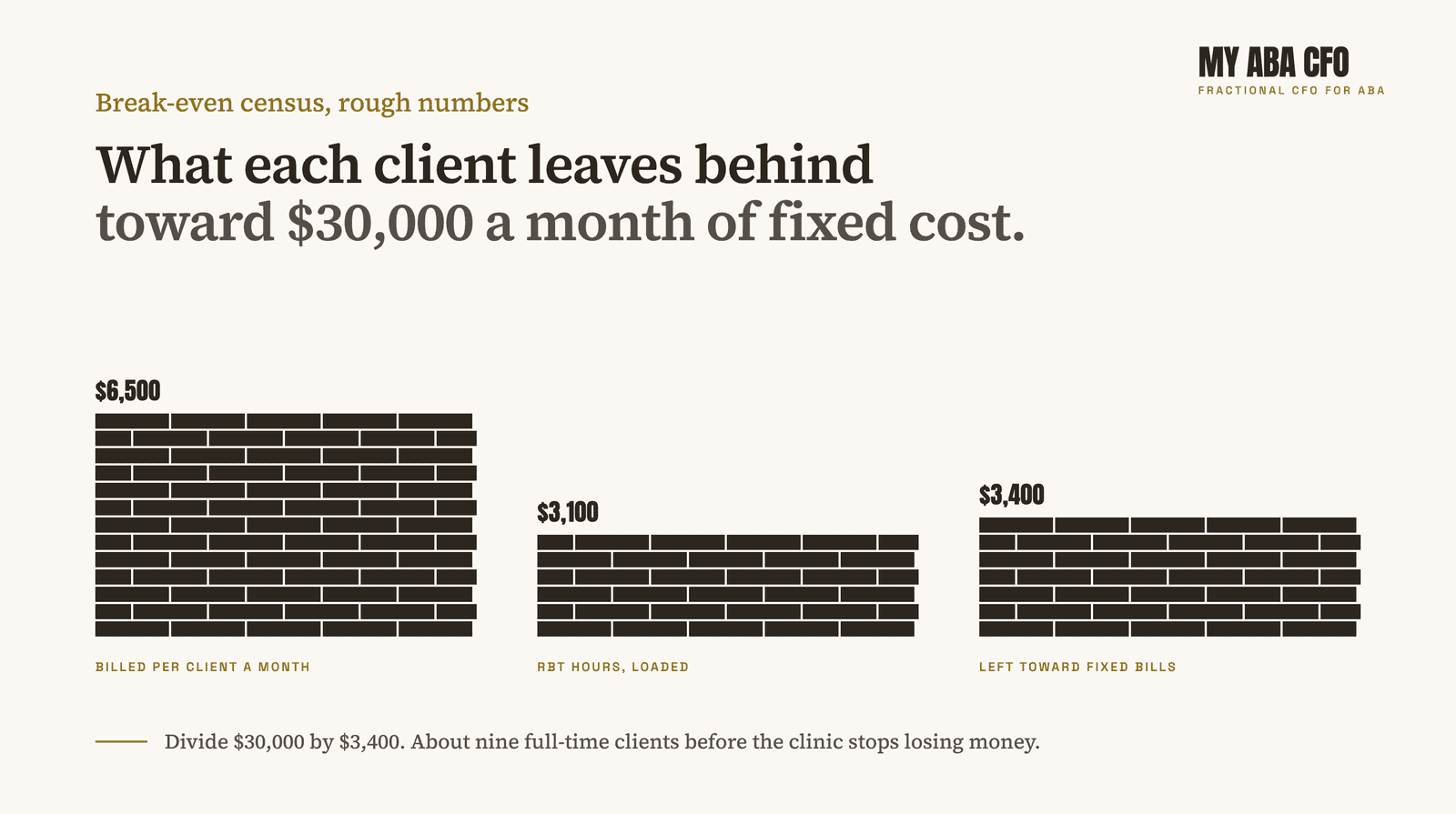
Start with what the clinic costs when it is empty. Say rent, utilities, insurance and supplies run $20,000 a month. Add a BCBA to run the place and a part-time front desk, another $10,000. That is $30,000 a month in fixed cost, with or without a single client.
Now what each client leaves behind. A client at 25 hours a week, billed at $60 an hour, is about $6,500 a month. The RBT hours to deliver that cost you about $3,100, loaded. So each full-time client leaves about $3,400 a month toward the fixed bills.
Divide $30,000 by $3,400. You need about nine full-time clients before the clinic stops losing money.
That is conservative. I left out supervision billing, and I left out the second BCBA you will need as the caseload grows. Those two roughly offset each other.
Do this before you tour a space: Work out your own break-even census. If the number scares you, the lease should too.
Ramp-up time: the pace sets the price
Nine clients do not arrive on opening day. They arrive one intake, one authorization and one hired RBT at a time. Every month below break-even, you write a check for the difference.
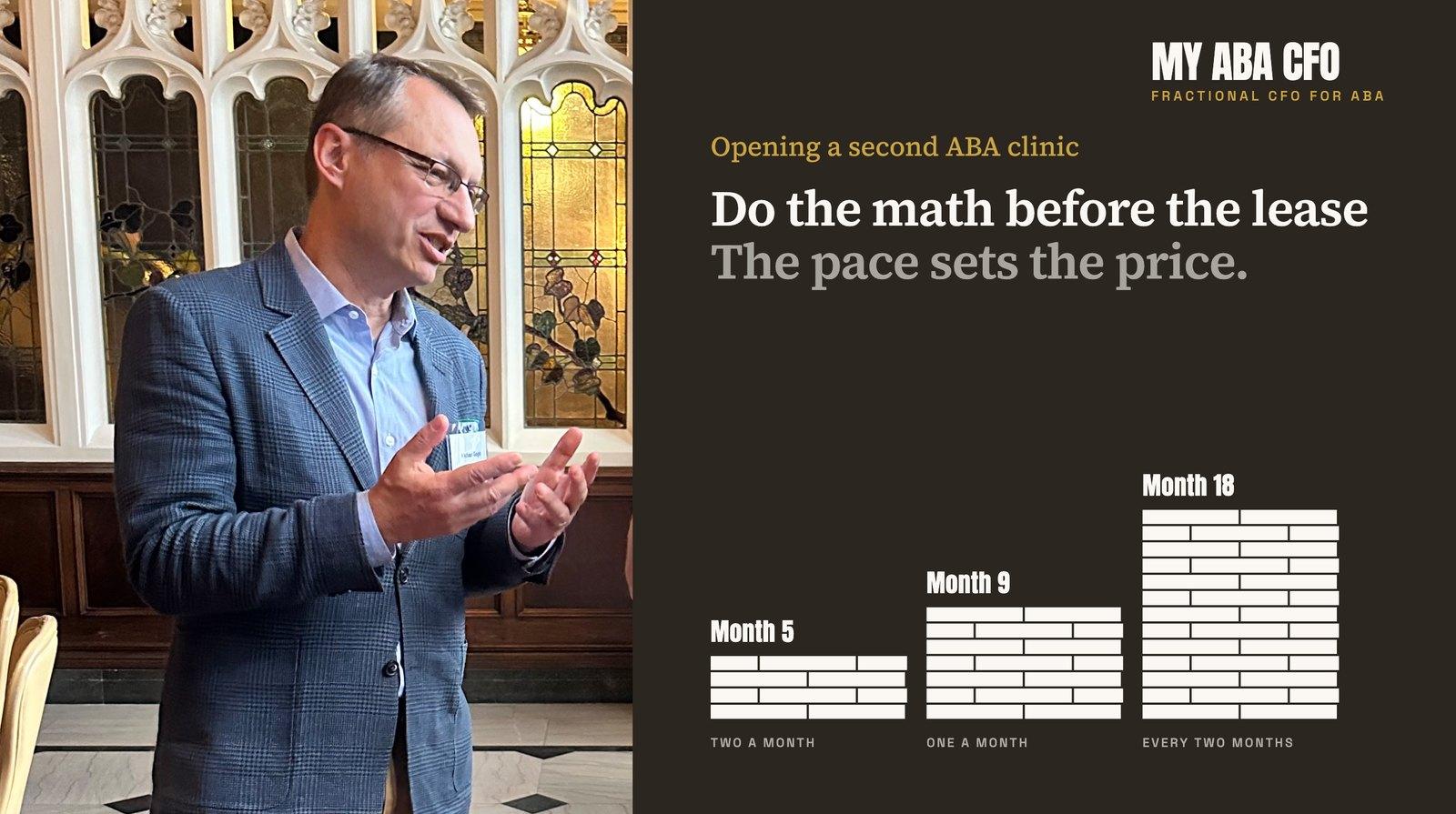
Same clinic, three paces:
| Net new clients | Month you break even | Loss on the way there |
|---|---|---|
| Two a month | Month 5 | About $50,000 |
| One a month | Month 9 | About $120,000 |
| One every two months | Month 18 | About $250,000 |
Nothing changed between those rows except speed. Same rent, same rate, same staff plan.
And speed is not mostly about demand. In my experience the waitlist is rarely what slows a new clinic. Hiring RBTs is. So are authorizations, and getting the new site set up with each payer.
Do this before you sign: Write down how many clients you can start each month, and what limits it. Then run the math at half that pace.
Cash burn: three bills, not one
Most owners budget for the ramp loss and stop. There are two more bills.
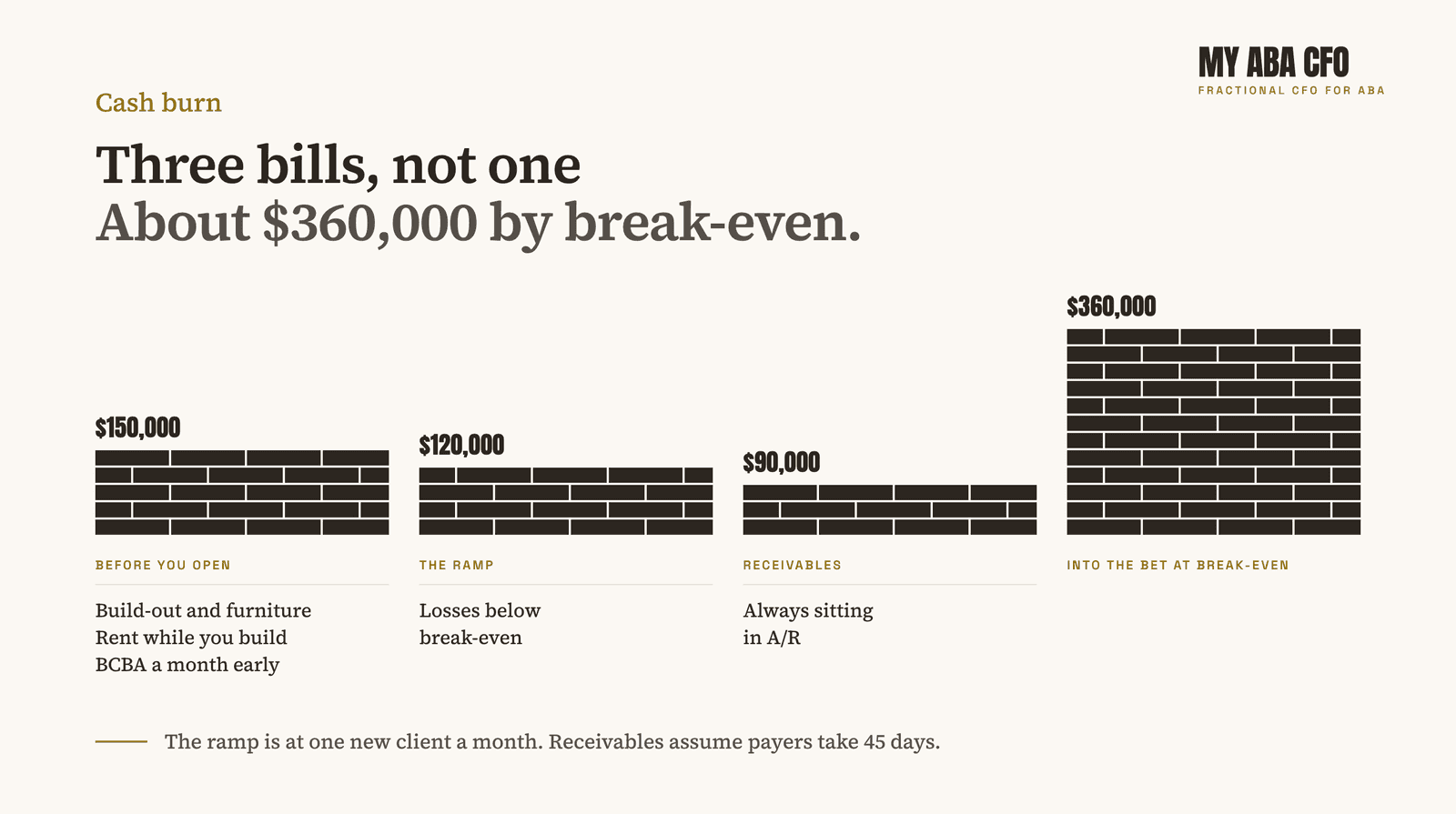
Before you open. Build-out and furniture, say $80,000. Three months of rent while you build and get licensed, $60,000. Your clinic BCBA starting a month early, $10,000. About $150,000 gone before the first session.
The ramp. At one new client a month, about $120,000.
Receivables. At break-even the clinic bills about $58,000 a month. If payers take 45 days, about $90,000 of that is always sitting in A/R. It is your money. You just cannot spend it.
Add them up and you are about $360,000 into the bet on the day the clinic first breaks even.
Break-even is not payback. If the clinic keeps adding a client a month toward 20, it earns back the build-out and the ramp loss around month 21. Roughly two years after you signed the lease.
Put that against a $3 million company at a 10% margin. The second clinic needs more cash than the whole company earns in a year.
Do this before you sign: Know where the $360,000 comes from. Savings, a line of credit, or the first clinic's profit. If the answer is "we will figure it out," you are not ready.
Four checks before you sign the lease
- Is the first clinic actually full? A waitlist with empty afternoon slots is a scheduling problem. Fix that first. It is cheaper than rent.
- Do you have the person? A second clinic needs a BCBA who can run it without you. If that person is not hired or named, the ramp is slower than your model says.
- Is the demand where the building is? Sort your waitlist by zip code. Families will not drive 40 minutes each way, five days a week.
- Can you fund one and a half times the plan? Ramps run late far more often than they run early. If $360,000 is the model, have about $540,000 you can reach.
Ask each payer, in writing, what it takes to add the new location and how long. Then ask the landlord for free rent during build-out. Both shorten the hole.
The rule: If the first clinic cannot carry the second one's losses for two years, wait.
Run the numbers first
A second clinic can be the best move you ever make. It can also drain the first one. The difference is usually visible on one page, before the lease, if someone builds the page.
That is the work I do with ABA owners. Thirty minutes on your business, your numbers and your next move. No pitch if it is not a fit.
Sources and further reading
- Plan your business: Calculate your startup costs and break-even point (U.S. Small Business Administration)
- Private Equity Shifts Focus from Acquisitions to New ABA Clinics (Breaking News ABA)
Common questions
How much does opening a second ABA clinic cost?
In the article's rough model, about $360,000 by the day the clinic first breaks even. That is about $150,000 before the first session, about $120,000 of losses during the ramp at one new client a month, and about $90,000 sitting in A/R. The figures are round and rough, so swap in your own.
How many clients does a new ABA clinic need to break even?
Divide the clinic's fixed monthly cost by what each client leaves after RBT cost. With $30,000 a month in fixed cost and about $3,400 a month left by each full-time client, you need about nine full-time clients before the clinic stops losing money.
How long does a second ABA clinic take to break even?
It depends on the pace of new clients. In the example, two net new clients a month breaks even in month 5 with a loss of about $50,000 on the way. One a month breaks even in month 9 at about $120,000, and one every two months in month 18 at about $250,000.
What slows down the ramp-up of a new ABA clinic?
Speed is not mostly about demand. The waitlist is rarely what slows a new clinic. Hiring RBTs is, along with authorizations and getting the new site set up with each payer.
What should I check before signing a lease for a second ABA clinic?
Four things. Whether the first clinic is actually full, whether you have a BCBA who can run the new one without you, whether the demand is where the building is, and whether you can fund one and a half times the plan. The rule is that if the first clinic cannot carry the second one's losses for two years, wait.