
Nov 12, 2026
You read your books to see how the year went. A buyer reads them to decide what to pay and how much to trust you. Same numbers. Different questions.
Most ABA owners I talk to treat a sale as something years away. Fine. But the books a buyer will open are the ones you are keeping right now. Here is what they look at, in roughly the order they look.
They start with EBITDA, not your bank balance
EBITDA stands for earnings before interest, taxes, depreciation and amortization. The plain version: what the business earns from delivering therapy, before the items that depend on who owns it.
Interest depends on how you financed the company. Taxes depend on your structure. Depreciation and amortization are accounting entries, not cash leaving this month. A buyer will bring their own debt and their own tax setup, so they strip those out and look at what is left.
A rough example. Your company does $3 million in revenue and shows $300,000 of net profit. Add back $20,000 of interest and $30,000 of depreciation. EBITDA is about $350,000.
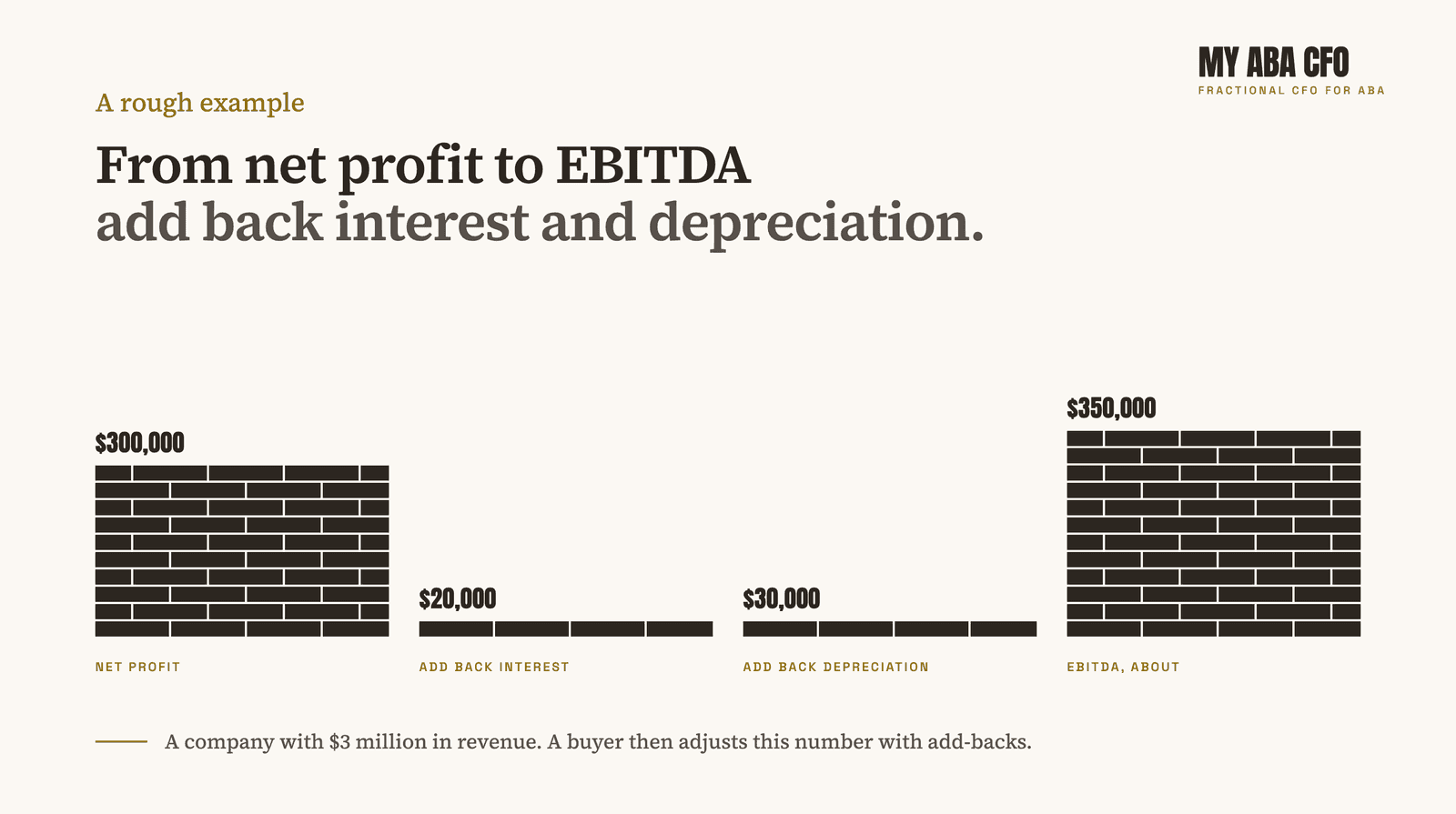
Then they adjust it. Owner pay above or below a market salary. One-time costs. Personal expenses run through the company. Those adjustments are called add-backs, and I have covered which add-backs buyers accept separately.
Know your number: Ask your accountant for last year's EBITDA. If nobody can produce it in a day, that is your first finding.
Every dollar of EBITDA gets priced several times over
Buyers pay a multiple of EBITDA. The multiple moves with size, growth, payer mix and the market that year. I will use five here only because the math is easy. Yours could be higher or lower.
$350,000 times five is $1.75 million. Now run it the other way. Every $10,000 of EBITDA a buyer does not believe takes $50,000 off the price. An expense booked in the wrong year. Revenue that was billed and never collected. Small on your P&L. Not small at five times.
That is why buyers hire accountants to rebuild your earnings line by line. The report is called a quality of earnings, and its job is to find the EBITDA you cannot prove.
Remember: A buyer does not pay for the EBITDA you claim. They pay for what survives the rebuild.
Clean financials means a stranger can check them
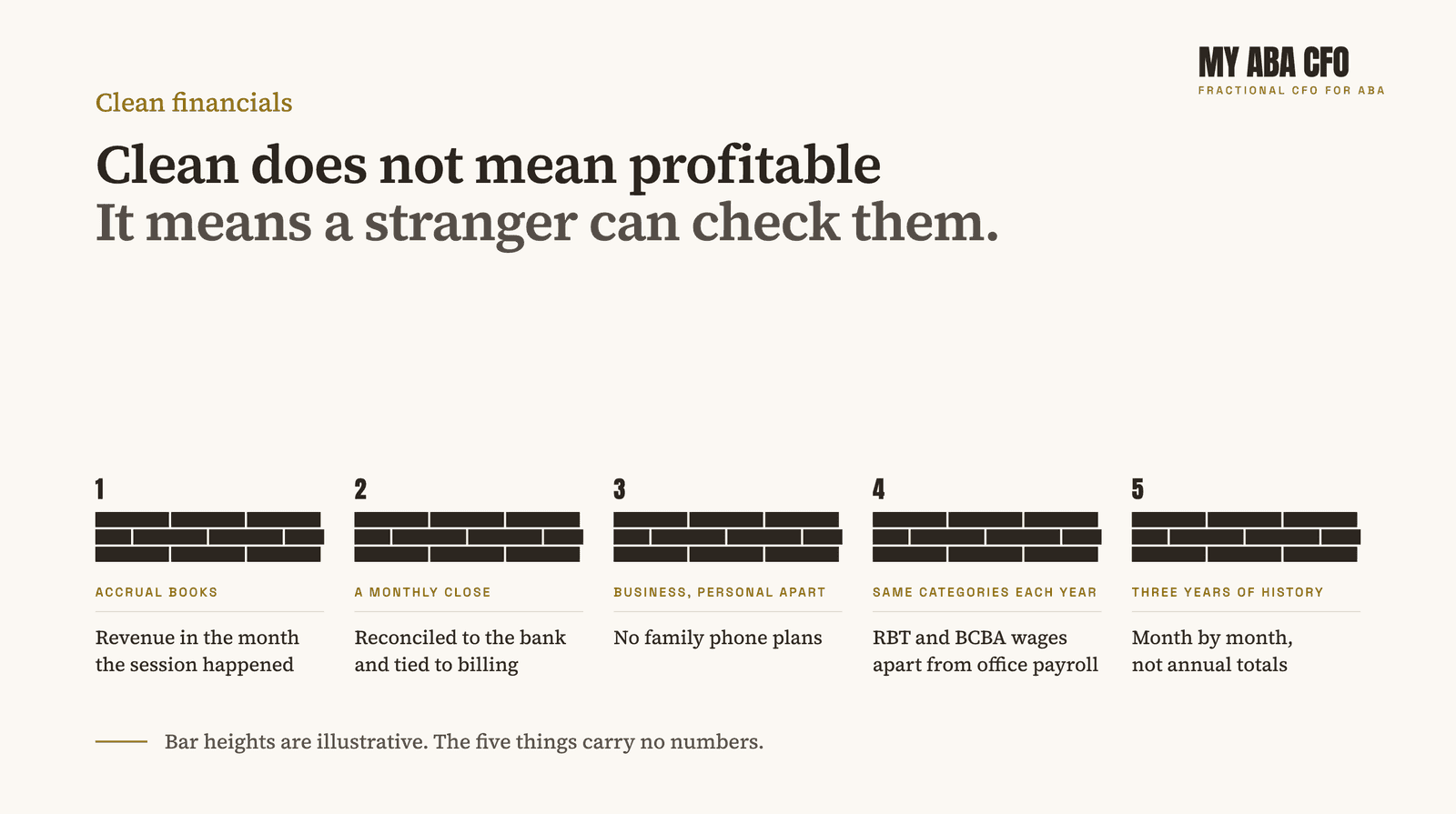
Clean does not mean profitable. It means someone who has never met you can follow the numbers without calling you. In practice, five things:
- Accrual books. Revenue sits in the month the session was delivered, not the month the payer paid.
- A monthly close. Every month reconciled to the bank, and revenue tied back to your billing system.
- Business and personal kept apart. No family phone plans, no cars that never see a client.
- The same categories every year. RBT and BCBA wages separated from office payroll, so gross margin can be read.
- Three years of history, month by month. Annual totals hide the trend a buyer is looking for.
Messy books do not just lower the number. They slow the deal and make the buyer wonder what else is loose. That doubt gets priced too, as a lower offer or as money held back after closing.
Do this now: Hand your last twelve monthly P&Ls to someone outside the company. Count the questions they cannot answer without you.
Then they ask what is behind the revenue
EBITDA tells a buyer how much. The next questions are about how sure.
- How much of your revenue comes from one payer?
- What share of what you bill do you actually collect, and how much A/R is past 90 days?
- Would your session notes and authorizations hold up if a payer audited them? Expect the buyer to sample claims.
- Does the revenue depend on you, or on two BCBAs who could leave?
- Is the monthly trend steady, or did one good quarter make the year?
None of these show on the P&L. All of them move the multiple or the terms.
Build before you get there: One page a month with revenue by payer, collection rate and A/R aging. Start now. A buyer wants history, and history cannot be produced later.
You do not need to be selling to do this
Everything a buyer wants from your books, a bank wants too. So should you. Books that hold up in a sale are books you can run the company on.
And timing matters. Six months of cleanup before a sale looks like six months of cleanup. Three years of clean monthly closes needs no explaining.
If you want to know what a buyer would see in your books today, I am glad to look. Thirty minutes on your business, your numbers and your next move. No pitch if it is not a fit.
Sources and further reading
- Manage your business: Close or sell your business (U.S. Small Business Administration)
- BDO Sets New Standard for Behavioral Health Due Diligence (Breaking News ABA)
Common questions
What does a buyer look at first in ABA company due diligence?
They start with EBITDA, not your bank balance. EBITDA is what the business earns from delivering therapy, before interest, taxes, depreciation and amortization. Then they adjust it for owner pay above or below a market salary, one-time costs and personal expenses run through the company.
What is a quality of earnings report when you sell an ABA company?
It is the report a buyer's accountants produce when they rebuild your earnings line by line. Its job is to find the EBITDA you cannot prove. A buyer does not pay for the EBITDA you claim. They pay for what survives the rebuild.
How does EBITDA affect the price of an ABA company?
Buyers pay a multiple of EBITDA, and the multiple moves with size, growth, payer mix and the market that year. Using five only because the math is easy, $350,000 of EBITDA is $1.75 million. Every $10,000 of EBITDA a buyer does not believe takes $50,000 off the price.
What do clean financials mean to a buyer of an ABA company?
Clean does not mean profitable. It means someone who has never met you can follow the numbers without calling you. In practice that is accrual books, a monthly close, business and personal kept apart, the same categories every year, and three years of history month by month.
What do buyers ask about ABA revenue beyond the P&L?
They ask how much revenue comes from one payer, what share of billing you collect and how much A/R is past 90 days. They ask whether session notes and authorizations would hold up in a payer audit, and expect them to sample claims. They also ask whether revenue depends on you or on two BCBAs who could leave, and whether the monthly trend is steady.