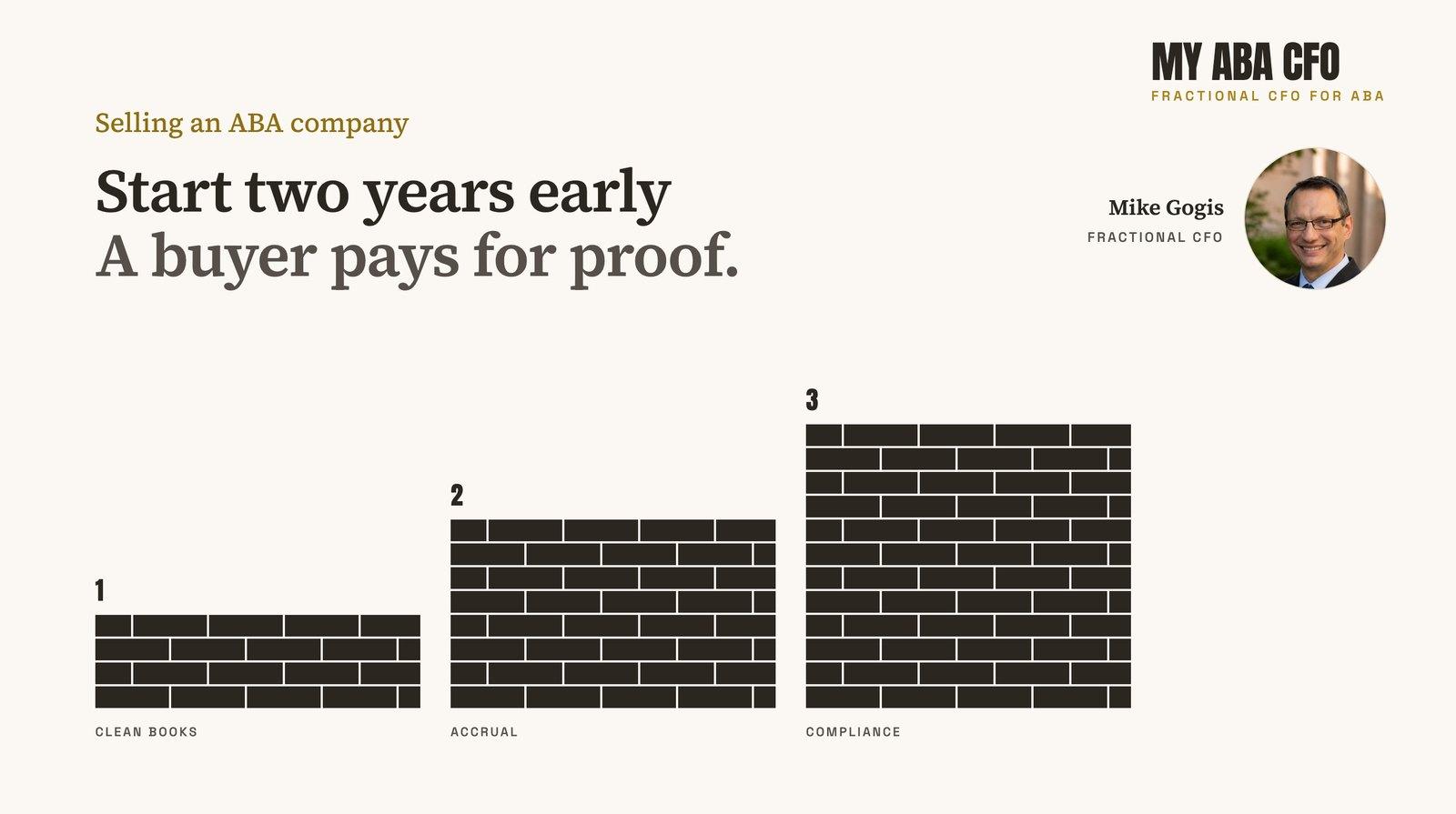
Most ABA owners start getting ready to sell the week a buyer calls. That is about two years too late.
A buyer pays for what you can prove, not for what you tell them. Proof means two or three years of monthly financial statements they can trust, and records showing that the claims behind your revenue would hold up in an audit. You cannot produce history on demand.
Here is what I would fix first, and why it pays even if you never sell.
Clean up the books first
A serious buyer hires an accounting firm to run a quality of earnings review. Their job is to rebuild your profit from the ground up. Every number they cannot tie out becomes a question. Every question becomes a delay or a discount.
Clean books are not complicated. They are consistent:
- The books close every month, within about two weeks of month end.
- Every bank, credit card, payroll and loan account is reconciled.
- Revenue on the P&L ties to a report out of your billing system.
- Revenue and costs are tracked by clinic or location, the same way every month.
- Personal spending is out of the company, or at least labeled.
That last one matters more than owners think. The car, the family phone plan, the trip that was partly a conference. A buyer may add some of it back to your profit if it is documented. They will not go digging to do you the favor.
Do this now: Close the books by the 15th of every month and tie revenue to your billing system. If the two do not match, find out why before a buyer does.
Move to accrual accounting
Most small ABA companies keep cash-basis books. Revenue shows up when the payer pays, which is often 30 to 60 days after the session. So this month's P&L sets this month's payroll against sessions from two months ago.
That makes a growing company look worse than it is and a shrinking one look better. Neither is a picture a buyer will pay for.
Buyers value companies on accrual numbers: revenue in the month the session was delivered, at what you expect to collect, with payroll and PTO recorded when earned. If your books are on cash, the buyer's accountants will convert them. Then you are negotiating over their version of your numbers.
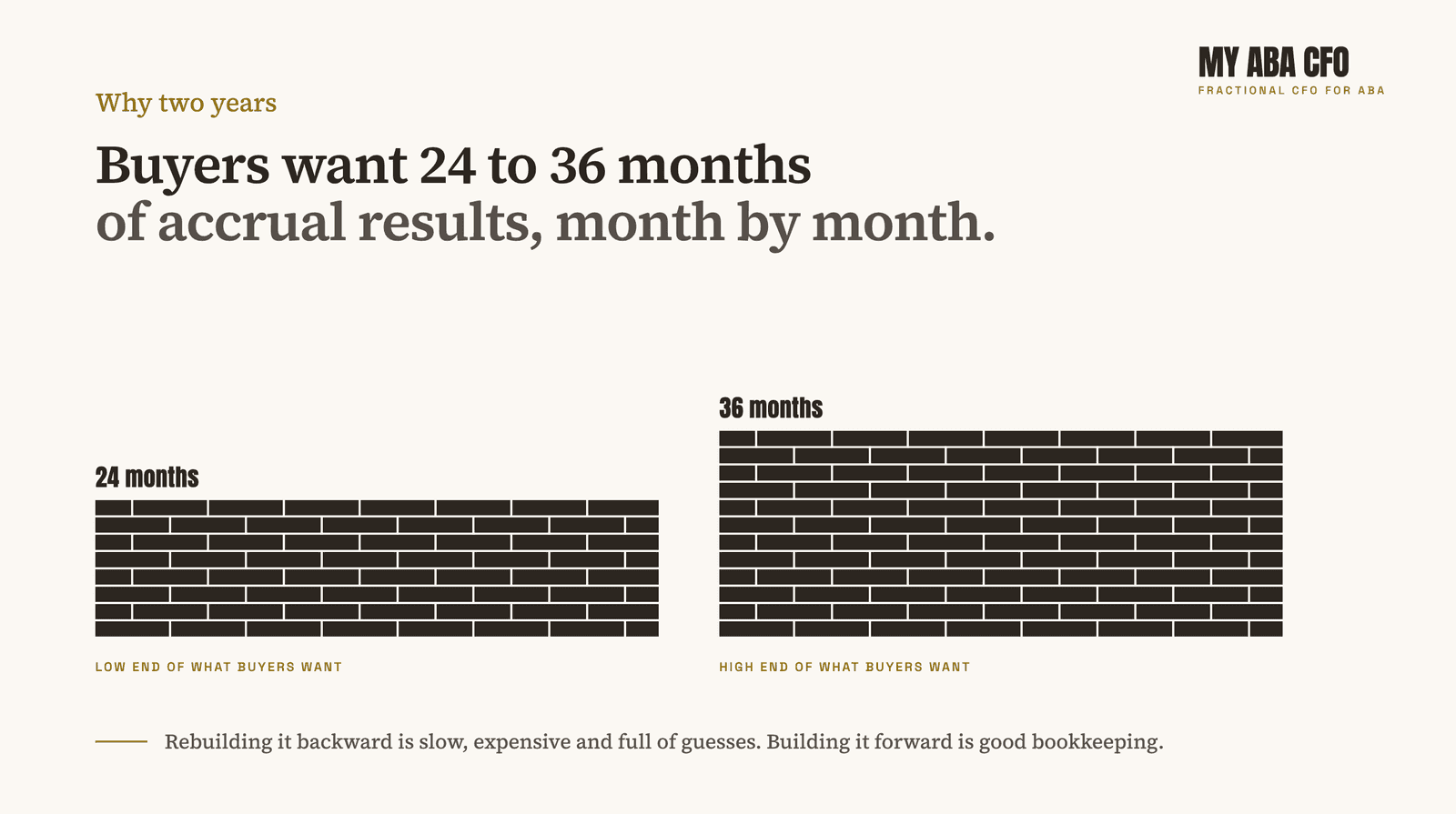
Why two years? Because buyers want to see 24 to 36 months of accrual results, month by month. Rebuilding that backward is slow, expensive and full of guesses. Building it forward is just good bookkeeping.
Your tax return can often stay on the cash method. That is a question for your tax CPA, and it is a separate one.
Do this now: Ask your bookkeeper or controller what it would take to close on accrual starting next month. Then start the clock.
Document your compliance
In ABA, the financial review is only half of diligence. The other half is a billing and coding review. The buyer pulls a sample of paid claims and checks each one against the record. They are asking one question: could a payer take this money back?
Expect them to look for:
- A session note that supports every billed unit, signed on time.
- An authorization covering the date of service.
- Current RBT certifications and BCBA supervision logs.
- Payer credentialing for the provider on the claim.
- Complete personnel files, including background checks.
- Your payer contracts, and what each says about a change of ownership.
A bad sample rarely just trims the price. It becomes money held in escrow, a longer list of promises you have to stand behind after closing, or a buyer who walks away.
Saying "we are compliant" is worth nothing. Showing two years of your own audit results is worth a lot.
Do this now: Pull ten paid claims at random every month and check them the way a buyer would. Fix what you find. Keep the results in a file.
Why preparation raises the multiple
A sale price is profit times a multiple. Owners spend their time on the first number. Preparation moves the second.
The multiple is a measure of risk. A buyer who trusts your numbers pays for them. A buyer who does not will cut the price, or move part of it into an earnout or an escrow you may never collect.
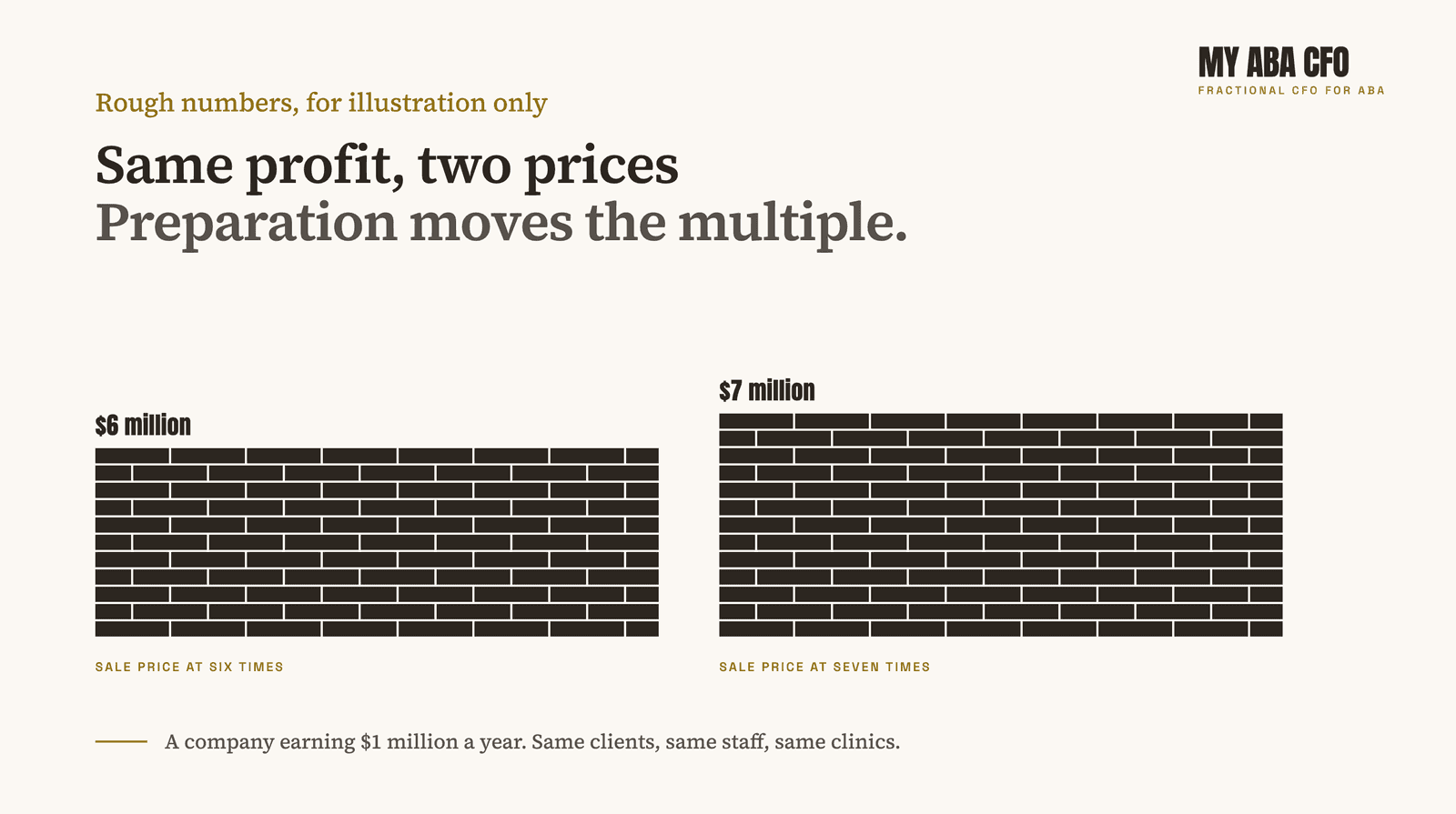
Rough numbers, for illustration only. Take a company earning $1 million a year. At six times, it sells for $6 million. At seven times, $7 million. Same clients, same staff, same clinics. The extra million is the buyer's confidence.
Preparation also changes the process. A company with clean accrual books and a compliance file can talk to several buyers at once and get through diligence without the price being reopened. A company without them usually ends up with one buyer, who knows it.
Do this now: Write down the three questions about your numbers you would least like a buyer to ask. Those are your first three projects.
Worth doing even if you never sell
Nothing on this list is only for a buyer. Accrual books show you where margin is leaking while you can still fix it. A lender says yes faster. A payer audit becomes a nuisance instead of a crisis. And the company stops depending on what is in your head.
A sale-ready company is just a well-run one. Whether you sell it stays your call.
If you want a second set of eyes on where you stand: thirty minutes on your business, your numbers and your next move. No pitch if it is not a fit.
Sources and further reading
- Manage your business: Close or sell your business (U.S. Small Business Administration)
- Billing Codes (ABA Coding Coalition)
- What ABA Founders Who Sold to Roll-Ups Actually Got (Breaking News ABA)
Common questions
How far ahead should I start preparing for selling an ABA company?
About two years before a buyer calls. A buyer pays for what you can prove, and proof means two or three years of monthly financial statements they can trust, plus records showing your claims would hold up in an audit. You cannot produce history on demand.
What should I fix first before selling my ABA company?
Clean up the books first. Close every month within about two weeks of month end, reconcile every bank, credit card, payroll and loan account, and tie revenue on the P&L to a report out of your billing system. Track revenue and costs by clinic the same way every month, and get personal spending out of the company or at least labeled.
Do I need accrual accounting to sell an ABA company?
Buyers value companies on accrual numbers: revenue in the month the session was delivered, at what you expect to collect, with payroll and PTO recorded when earned. If your books are on cash, the buyer's accountants will convert them, and you end up negotiating over their version of your numbers. Buyers want to see 24 to 36 months of accrual results, month by month.
What do buyers check in an ABA billing and compliance review?
They pull a sample of paid claims and check each one against the record, asking whether a payer could take the money back. Expect them to look for a session note supporting every billed unit, an authorization covering the date of service, current RBT certifications and BCBA supervision logs, payer credentialing, complete personnel files and your payer contracts. A bad sample can become money held in escrow, more promises after closing, or a buyer who walks away.
How does preparation raise the multiple when selling an ABA company?
A sale price is profit times a multiple, and the multiple is a measure of risk. A buyer who trusts your numbers pays for them. A buyer who does not will cut the price, or move part of it into an earnout or an escrow you may never collect. As a rough illustration, a company earning $1 million a year sells for $6 million at six times and $7 million at seven times.