
Most ABA owners find out about a cash problem the week it arrives. Payroll is Friday, the balance is thin, and a payer is late. By then every option is a bad one.
A 13-week cash forecast moves that discovery up by two months. It is one spreadsheet. It takes an afternoon to build and twenty minutes a week to keep. It is the first thing I want to see in any ABA company.
Why 13 weeks, and why by week
Your P&L tells you whether you made money last month. It says nothing about whether you can cover payroll three Fridays from now.
Thirteen weeks is one quarter. That is long enough to cover the full trip from a session delivered to a payment banked, plus six payrolls. It is short enough that you can fill it with real numbers instead of hopes.
Weekly matters because your cash moves weekly. A month can look fine in total and still hold one week where payroll goes out before the money comes in. A monthly budget hides that week. A weekly forecast gives it its own column.
Do this now: Open a blank sheet. Thirteen columns, one per week, starting this Monday. Put today's bank balance at the top of the first one.
Top of the sheet: what you will collect
This is the row owners get wrong. They forecast billings. Billings are not cash.
This week's collections come from sessions you delivered weeks ago. So take each week's billings and slide them to the right by how long each payer really takes. If your Medicaid plan pays in about three weeks and your commercial payers take about six, one week of sessions lands in two different columns.
Use your own payment history, not the contract terms. Then take a haircut for what never gets paid. If you have been collecting 95 cents of every dollar billed, forecast 95 cents.
Two things follow. The next five or six weeks of collections are mostly decided already, because those claims are out the door. And any light billing week, from holidays, a staffing gap or a run of cancellations, shows up as a hole in the forecast a month or more before it reaches your bank.
Do this now: Pull three months of remittances by payer and count the days from date of service to deposit. Those lags are your forecast.
Middle of the sheet: what you must pay
This part is easier. You know most of it already.
Payroll first, in the weeks it clears, with employer taxes and benefits included. Then rent. Then the weekly run of software, supplies and everything else. Then the lumpy items people forget: the insurance renewal, tax payments, loan payments, your own distributions.
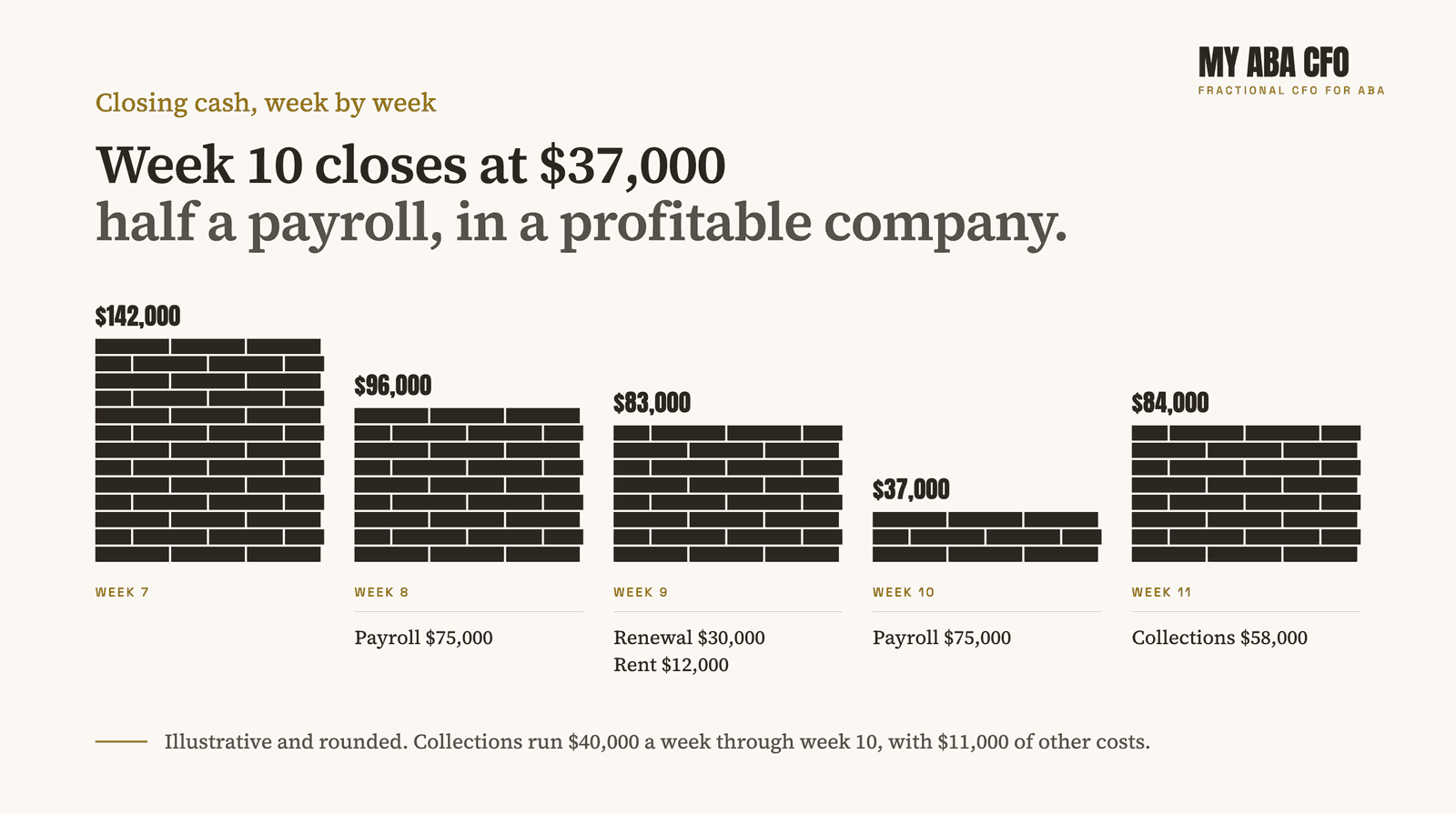
Here is a rough example. A company billing about $250,000 a month, with a $75,000 payroll every other week. Two holiday weeks and a slow January have pulled collections from a normal $58,000 a week down to $40,000 for a stretch. The insurance renewal lands in week 9. The numbers are illustrative and rounded.
| Week 7 | Week 8 | Week 9 | Week 10 | Week 11 | |
|---|---|---|---|---|---|
| Opening cash | $113,000 | $142,000 | $96,000 | $83,000 | $37,000 |
| Collections | $40,000 | $40,000 | $40,000 | $40,000 | $58,000 |
| Payroll | ($75,000) | ($75,000) | |||
| Rent | ($12,000) | ||||
| Insurance renewal | ($30,000) | ||||
| Other costs | ($11,000) | ($11,000) | ($11,000) | ($11,000) | ($11,000) |
| Closing cash | $142,000 | $96,000 | $83,000 | $37,000 | $84,000 |
Week 10 closes at $37,000. That is half a payroll. And this company is profitable.
Do this now: List every payment over $5,000 due in the next 13 weeks and put each one in its week.
Read the bottom row
The bottom row is closing cash, week by week. Run your eye across it and find the lowest number.
Then set a floor. The one I recommend is a full payroll in the bank at all times. In the example the floor is $75,000, and week 10 is $38,000 short of it.
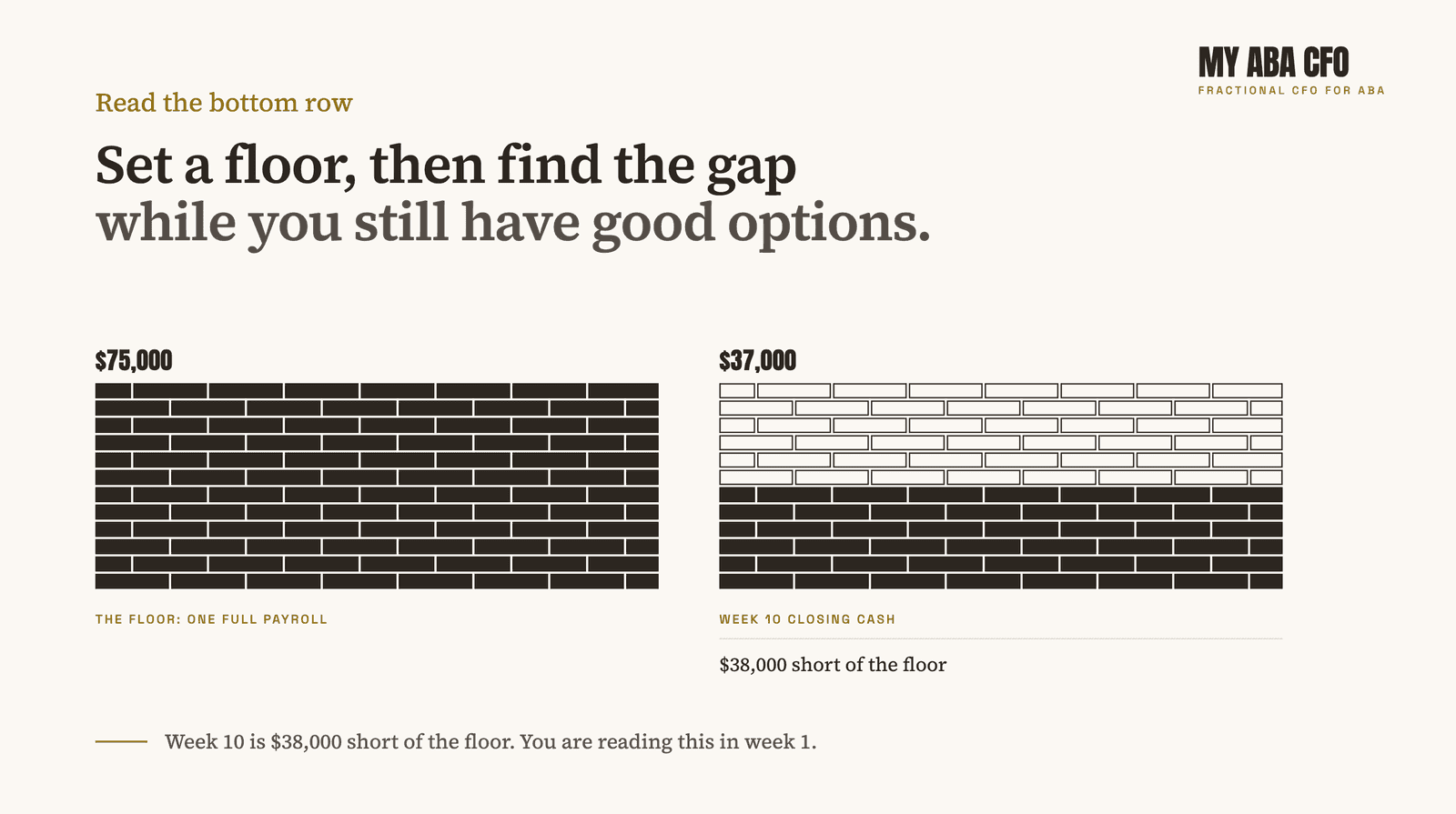
Nothing bounced. But one late deposit that week and payroll is at risk. The point is that you are reading this in week 1. With two months of notice you have good options. Chase the claims sitting past 60 days. Ask the carrier to split the renewal into installments. Hold your own distribution. Arrange a draw on your line of credit while your numbers still look strong. In week 10 you have almost none of those.
Do this now: Highlight every week that closes below your floor. Next to each, write the one move that fixes it.
Keep it honest every Monday
A forecast you build once is a guess. One you update every week is a management tool.
Each Monday, replace last week's forecast with what really happened. Drop that column, add a new week 13 on the end, and refresh the collections row with the latest billings.
Then look at the miss. If collections came in $10,000 under forecast, find out which payer and why. Three weeks of the same payer running late is a trend, and you just caught it early. After a couple of months your misses shrink. You start trusting the sheet enough to decide things with it: a hire, a raise, a second location.
Do this now: Put a recurring 20-minute block on Monday morning. Same person, same sheet, every week.
Want a second set of eyes on yours?
If you have never built one, or yours has not been touched since the bank asked for it, I can help you set it up around your payers and your payroll calendar.
Thirty minutes on your business, your numbers and your next move. No pitch if it is not a fit.
Sources and further reading
- Manage your business: manage your finances (U.S. Small Business Administration)
- Two Weeks to Six: SoonerCare Payment Delays Put Oklahoma ABA Providers Under Pressure (Breaking News ABA)
Common questions
What is a 13-week cash flow forecast for an ABA company?
It is one spreadsheet with thirteen columns, one per week, starting with today's bank balance. The top shows what you will collect, the middle shows what you must pay, and the bottom row is closing cash for each week. It takes an afternoon to build and twenty minutes a week to keep.
Why forecast ABA cash flow for 13 weeks, and why by week?
Thirteen weeks is one quarter. That is long enough to cover the full trip from a session delivered to a payment banked, plus six payrolls, and short enough to fill with real numbers. Weekly matters because a month can look fine in total and still hold one week where payroll goes out before the money comes in.
How do I forecast collections in an ABA cash flow forecast?
Do not forecast billings. Take each week's billings and slide them to the right by how long each payer really takes, using your own payment history and not the contract terms. Then take a haircut for what never gets paid. If you have been collecting 95 cents of every dollar billed, forecast 95 cents.
How much cash should an ABA company keep in the bank?
The floor I recommend is a full payroll in the bank at all times. Find the lowest closing cash number in your 13 weeks and compare it with that floor. Highlight every week that closes below it and write down the one move that fixes it.
How often should I update a 13-week cash forecast?
Every Monday. Replace last week's forecast with what really happened, drop that column, add a new week 13 on the end, and refresh the collections row with the latest billings. Then look at the miss and find out which payer and why.