
The letter is polite. It thanks you for being a network provider. Then it asks for records on a list of claims, some of them two or three years old.
Most owners hand it to the billing team and go back to work. That is a mistake. A payer audit is not a paperwork exercise. It is a claim on cash you already collected, already spent on payroll, and already paid tax on.
How a recoupment works
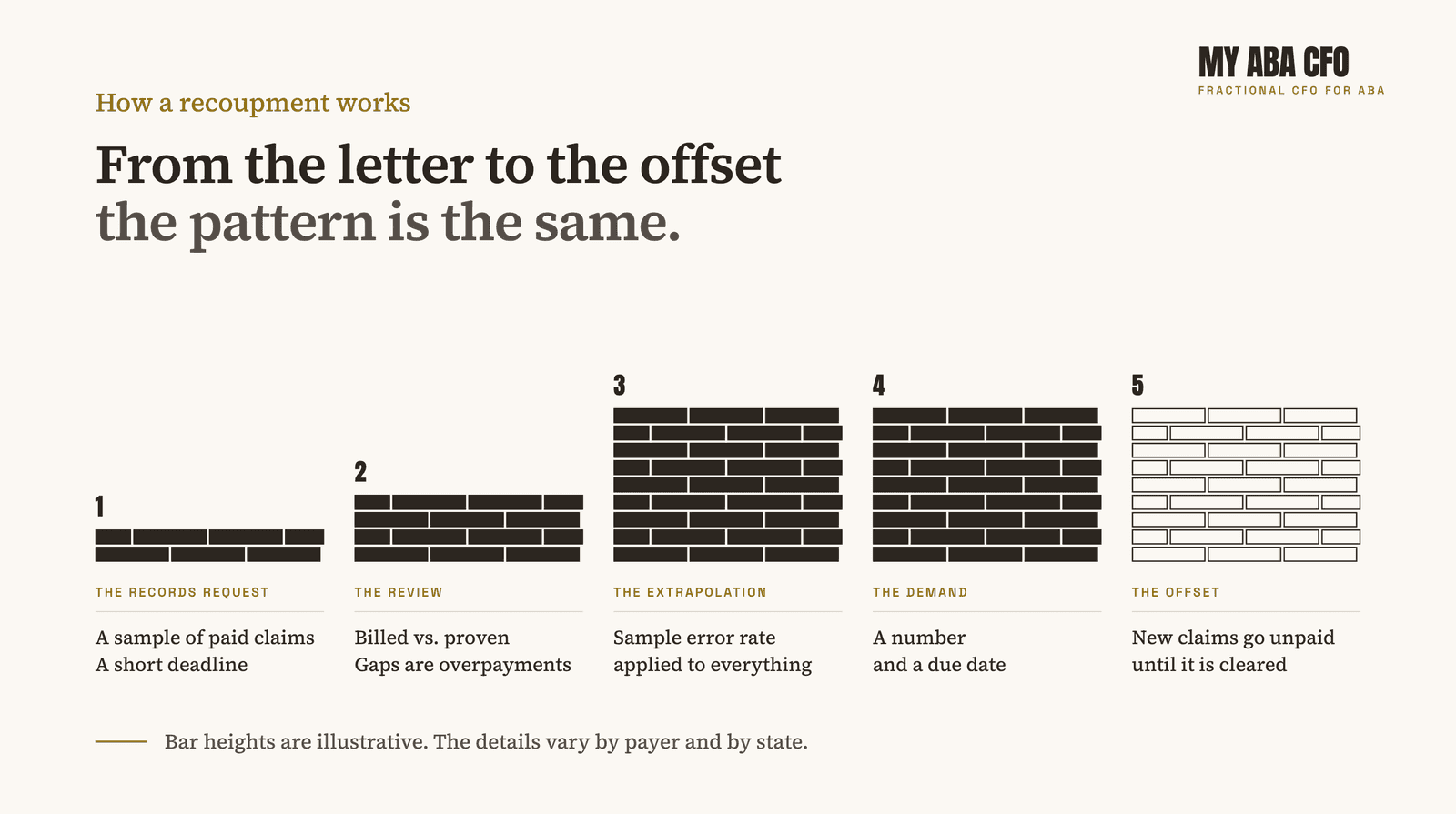
The details vary by payer and by state, but the pattern is the same.
- The records request. The payer picks a sample of paid claims and asks for the documentation behind each one. You get a deadline, often a short one.
- The review. An auditor compares what you billed with what your records prove. Anything they cannot verify is marked as an overpayment.
- The extrapolation. This is the step that hurts. Many payers do not stop at the claims they sampled. They take the error rate from the sample and apply it to everything they paid you in the audit period.
- The demand. You get a letter with a number and a due date.
- The offset. If you do not pay or appeal in time, the payer simply stops paying your new claims until the balance is cleared.
You can appeal, and you often should. But appeal windows are short, and missing one usually ends the argument.
Do this now: Decide who opens payer mail, who owns the response, and who tells you. The same day, not the same month.
Why documentation gaps become repayment demands
Here is the part owners find unfair. The auditor is not asking whether the session happened. The auditor is asking whether you can prove it, to the payer's standard, from the record.
If it is not documented, it was not delivered. The child got the therapy. The RBT got paid. You still owe the money back.
The gaps I see are rarely fraud. They are ordinary sloppiness at volume:
- Session notes that are missing, unsigned or signed weeks late.
- Start and end times that do not match the units billed.
- Hours delivered outside the authorization dates, or past the authorized units.
- Supervision that happened but was never written down.
- An RBT whose credential lapsed for a month nobody noticed.
- Notes copied from one session to the next, word for word.
Each one looks small. In an audit, each one is a claim paid in error.
Do this now: Pull ten paid claims a month at random and test them the way an auditor would. Track the failure rate. That number is the most honest measure of your audit risk.
What it does to your cash
Rough numbers, for illustration only. Take a company with $3 million in revenue and a 10% margin, so about $300,000 in profit. One payer is 40% of the business, about $100,000 a month.
That payer audits two years of claims, roughly $2.4 million paid. The auditor samples 100 claims and rejects eight. An 8% error rate, applied to the whole $2.4 million, is a demand for about $190,000.
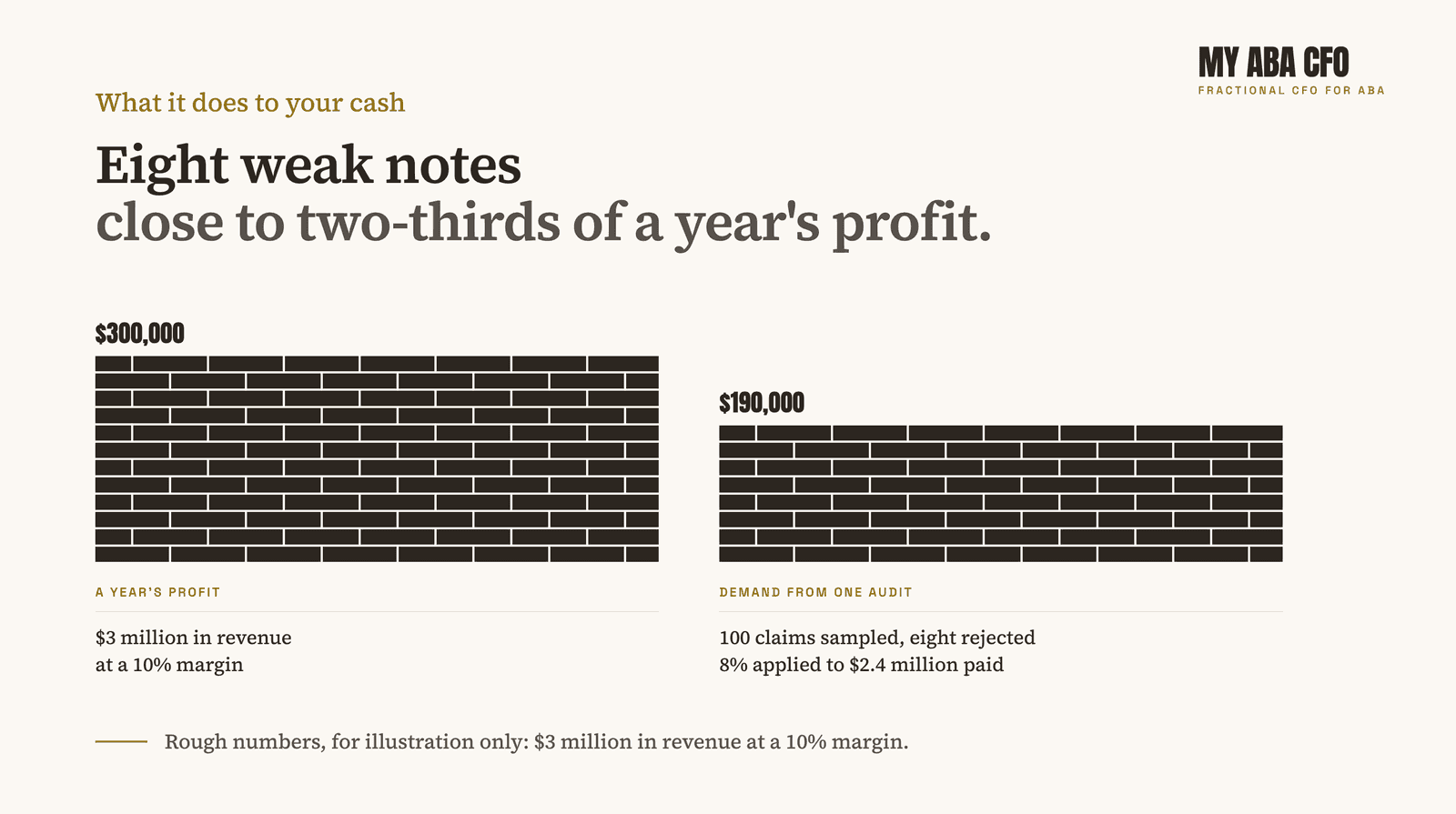
Eight weak notes just cost you close to two-thirds of a year's profit.
Now the timing. If the payer recovers it by offset, your largest payer pays you nothing for almost two months. Payroll does not pause. Neither does rent. A company that looked healthy in March is drawing on its line of credit in May, if it has one.
And the cost is not only the demand. Add the attorney, the staff hours pulling records, and the months your attention is somewhere other than growth.
Do this now: For each major payer, multiply two years of payments by your internal failure rate. That is your rough exposure. Most owners have never seen the number.
Why a reserve belongs on your balance sheet
If some of your revenue will probably be paid back, it is not all revenue. Booking every dollar as earned overstates your profit, and you make decisions on the overstated number.
A reserve fixes that. Each month you hold back a small share of revenue as a liability for estimated repayments. One percent of a $3 million company is about $2,500 a month. Set the rate from your own failure rate and history, not from a guess, and have your CPA agree the method.
Three things follow. Your margin is honest. A demand letter hits a reserve you built slowly instead of one month's profit. And a buyer, who will run a billing audit of their own, sees an owner who already priced the risk.
One caution. A reserve is an accounting entry. It does not pay anyone. Back it with real cash or an open line of credit.
Do this now: Ask your accountant one question: "Where on our balance sheet is the allowance for payer recoupments?" If the answer is silence, you have your next project.
Know the number before the letter comes
You cannot stop a payer from auditing you. You can decide whether the letter is an annoyance or a crisis. If you want help sizing your exposure and building the reserve, let's talk.
Thirty minutes on your business, your numbers and your next move. No pitch if it is not a fit.
Sources and further reading
- Indiana Made at Least $56 Million in Improper Fee-for-Service Medicaid Payments for Applied Behavior Analysis Provided to Children Diagnosed With Autism (HHS Office of Inspector General)
- ABA's Documentation Crisis: Why Session Notes Are the Number One Audit Failure Point (Breaking News ABA)
Common questions
What is a payer audit clawback in ABA?
The payer picks a sample of paid claims and asks for the documentation behind each one. Anything the auditor cannot verify is marked as an overpayment, and you get a letter with a number and a due date. It is a claim on cash you already collected, already spent on payroll, and already paid tax on.
How does extrapolation work in an ABA payer audit?
Many payers do not stop at the claims they sampled. They take the error rate from the sample and apply it to everything they paid you in the audit period. In a rough example, eight rejected claims out of 100, applied to $2.4 million paid over two years, is a demand for about $190,000.
What happens if I do not pay an ABA audit recoupment demand?
If you do not pay or appeal in time, the payer simply stops paying your new claims until the balance is cleared. That is the offset. You can appeal, and you often should, but appeal windows are short, and missing one usually ends the argument.
Why do documentation gaps lead to ABA clawbacks?
The auditor is not asking whether the session happened. The auditor is asking whether you can prove it, to the payer's standard, from the record. Missing or late-signed notes, times that do not match the units billed, hours outside the authorization, undocumented supervision and lapsed credentials each become a claim paid in error.
Should an ABA company keep a reserve for payer audit clawbacks?
Yes. Each month you hold back a small share of revenue as a liability for estimated repayments, with the rate set from your own failure rate and history and the method agreed with your CPA. A reserve is an accounting entry and does not pay anyone, so back it with real cash or an open line of credit.