Draft for MyABACFO.com · Nov 12, 2026
Every ABA owner asks me this one eventually. Usually right after seeing what the billing company took last month.
The question is fair. The way most owners answer it is not. They put the vendor's fee next to a biller's salary and pick the smaller number. Both numbers are wrong, and neither is the one that matters most.
Here is how I run it. The figures below are rough and round. They show the shape of the math, not a quote for your market.
What a percent of collections really costs
Most ABA billing companies charge a percent of what they collect, commonly somewhere from 4% to 8%. I will use 6%.
The appeal is real. No hiring, no software to pick, no scramble when someone quits. At $1 million in collections you pay about $60,000 and get a whole team. That is less than one good biller costs you.
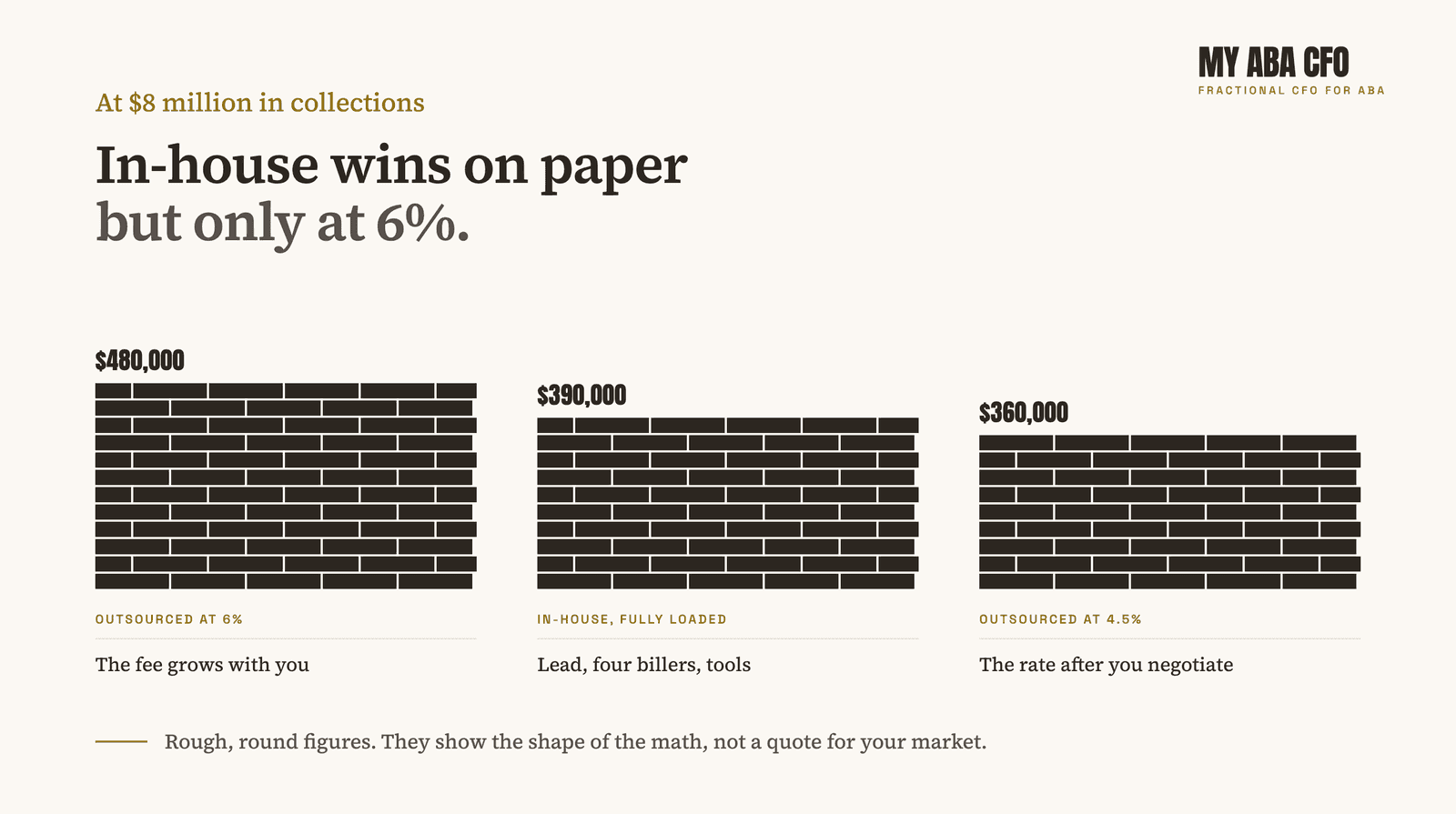
The catch: the fee grows with you, and the work does not grow at the same rate. Double your collections and the bill doubles, even though the vendor did not double its effort. At $8 million, 6% is $480,000 a year.
Two more things hide in the contract. First, check what the percent applies to. A fee on everything you collect, including copays your own front desk took, is a higher fee than it looks. Second, check what stays on your side. Authorizations, eligibility checks and chasing bad session notes often remain with your staff. That labor never shows up in the comparison.
Do this now: Divide last year's total billing fees by collections. Then list every billing task your own people still do.
What in-house billing really costs
A salary is not a cost. A biller at $55,000 runs closer to $70,000 with taxes and benefits. Then add software, a clearinghouse and training.
Then add the part nobody budgets. One biller is a single point of failure. They take a vacation, or a better offer, and your claims stop while payroll does not. So a real in-house department is never one person. It is at least two. Past a certain volume it also needs a lead who knows ABA authorizations and payer rules and can manage the others.
As a rough rule, I plan on one biller for every $1.5 million to $2 million in collections, plus a lead once there are two or more.
Do this now: Price the department you would need, with backup. Not the one hire you have in mind.
Where the answer changes
Put the two side by side at four sizes.
| Annual collections | Outsourced at 6% | In-house, fully loaded | The in-house team |
|---|---|---|---|
| $1 million | $60,000 | $80,000 | One biller, tools, no backup |
| $2 million | $120,000 | $150,000 | Two billers, tools |
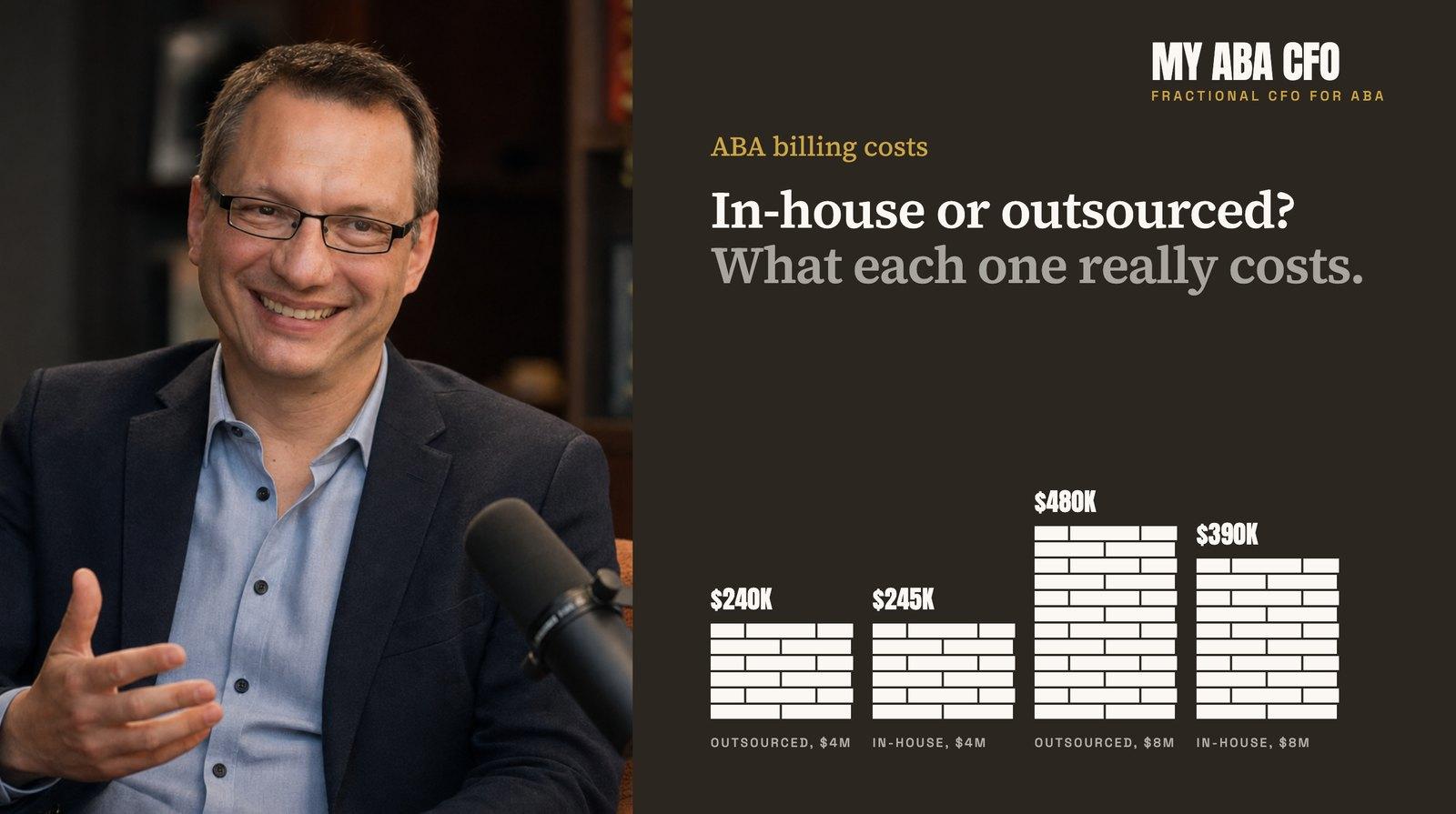
| $4 million | $240,000 | $245,000 | Lead, two billers, tools |
| $8 million | $480,000 | $390,000 | Lead, four billers, tools |
Under about $2 million, outsource. In-house costs more and it is fragile. From roughly $2 million to $5 million, cost is a coin flip, and the decision should turn on quality and control. Past $5 million, in-house usually wins on paper.
But only on paper, and only at 6%. At $8 million you should not be paying 6%. Negotiate it to 4.5% and the fee drops to $360,000, which is under the in-house number again. Size gives you leverage with a vendor. Most owners never use it.
Do this now: If your collections have doubled since you signed, reopen the rate.
The number that matters more than the fee
Here is the part most comparisons miss. The fee is the small number.
Say you bill $4 million. The gap between a team that collects 95% of it and one that collects 93% is $80,000 a year. That is about a third of the entire cost of billing in the table above, and it never appears on an invoice.
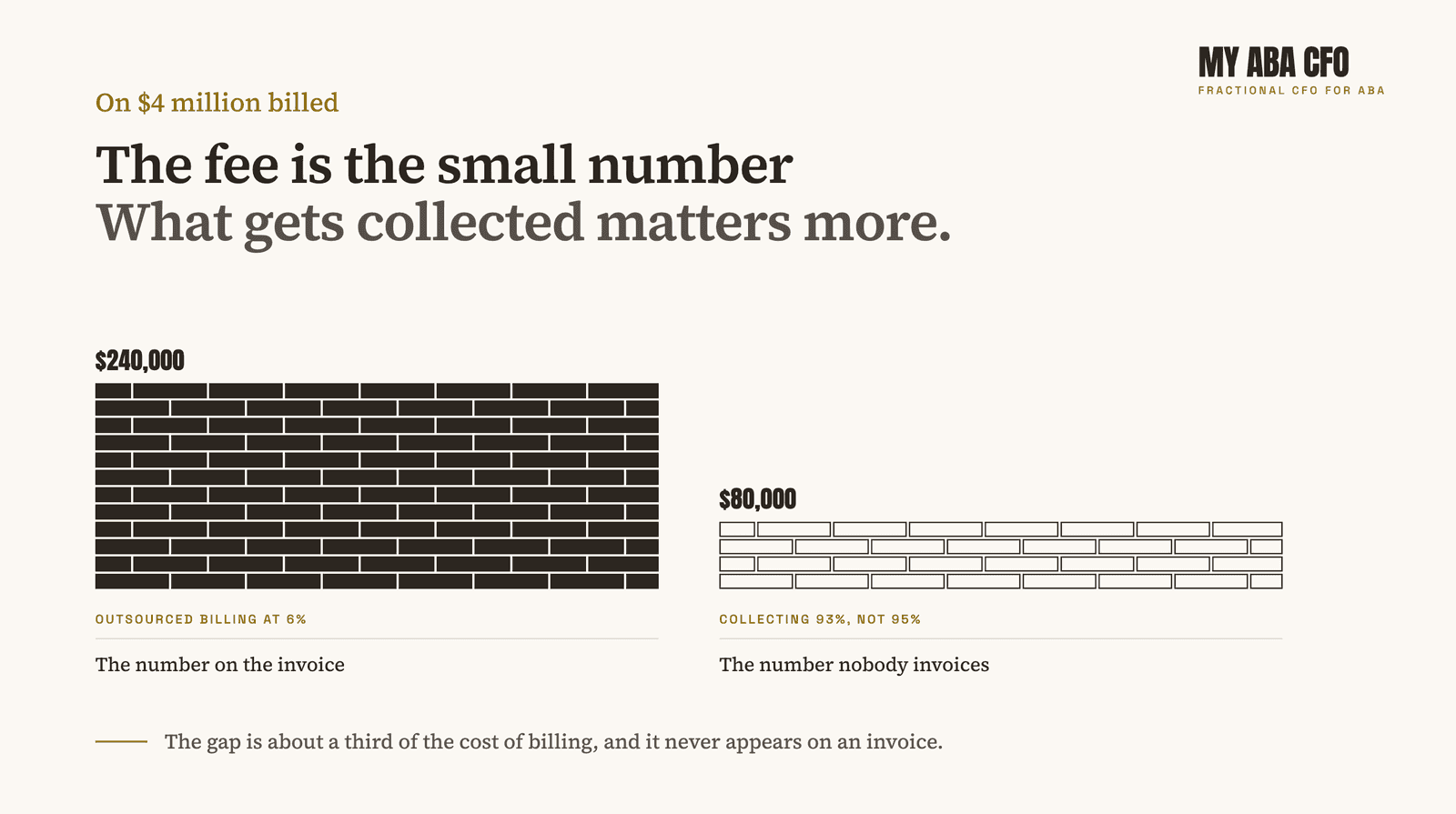
So the real question is not who is cheaper. It is who collects more of what you earned, and how fast. A cheap vendor that works the easy claims and lets the hard ones age is expensive. So is a loyal in-house biller who is three months behind on denials.
Whichever way you go, someone inside your company has to own the scorecard: percent of billed dollars collected, days in A/R, denial rate, and A/R over 90 days. Outsourcing the work does not outsource the accountability.
Do this now: Ask for those four numbers every month. If your biller or vendor cannot produce them, you have your answer on quality.
Want a second set of eyes on the math?
This comparison takes an afternoon once you have real numbers in front of you. If you would like help running it for your company, I am glad to do that.
Thirty minutes on your business, your numbers and your next move. No pitch if it is not a fit.
Sources and further reading
- Billing Codes (ABA Coding Coalition)
- In-House or Out: The ABA Billing Decision That Quietly Makes or Breaks Clinic Cash Flow (Breaking News ABA)
Common questions
Is ABA billing cheaper in-house or outsourced?
It depends on size. Under about $2 million in collections, outsource, because in-house costs more and it is fragile. From roughly $2 million to $5 million, cost is a coin flip and the decision should turn on quality and control. Past $5 million, in-house usually wins on paper.
How much do ABA billing companies charge?
Most ABA billing companies charge a percent of what they collect, commonly somewhere from 4% to 8%. At 6%, $1 million in collections costs about $60,000 a year and $8 million costs $480,000. Check what the percent applies to, and which billing tasks stay with your own staff.
What does in-house ABA billing really cost?
More than a salary. A biller at $55,000 runs closer to $70,000 with taxes and benefits, plus software, a clearinghouse and training. One biller is a single point of failure, so a real department is at least two people. As a rough rule, plan on one biller for every $1.5 million to $2 million in collections, plus a lead once there are two or more.
Can I negotiate my ABA billing company's fee?
Yes. Size gives you leverage with a vendor, and most owners never use it. At $8 million in collections you should not be paying 6%. If your collections have doubled since you signed, reopen the rate.
What should I track to judge ABA billing in-house vs outsourced?
Four numbers, every month: percent of billed dollars collected, days in A/R, denial rate, and A/R over 90 days. The real question is who collects more of what you earned, and how fast. Outsourcing the work does not outsource the accountability.