Nov 12, 2026
Most owners pick in-home or center-based ABA for clinical reasons, or because of how they started. Fair enough. But the choice is also the biggest financial decision you will make, and most owners never run the numbers on it.
I hear the same two claims all the time. "In-home is cheaper because there is no rent." "Centers make more money." Both are half true. The real answer depends on four things: overhead, utilization, drive time and cancellations.
In-home ABA: no rent, but the hours leak
In-home looks cheap. No lease, no build-out, no front desk. You can add a client without adding a square foot.
The cost shows up somewhere else: in hours you pay for and cannot bill. An RBT driving between two homes is on your payroll and off your claims. Add mileage on top.
Cancellations hurt more at home too. When a family cancels at 2:45, your RBT is across town with nobody nearby to see. That hour is gone.
So the in-home model trades rent for lower utilization. You do not see it as a line on the P&L. You see it as a thin margin you cannot explain.
Do this now: For last month, total the RBT hours you paid and the hours you billed, for in-home staff only. The gap is your real cost of the model.
Center-based ABA: fuller days, fixed bills
A center fixes the leaks. Nobody drives between sessions. When a client cancels, another client is often down the hall, and a good scheduler can refill part of the hour. One BCBA can supervise several sessions without getting in a car.
The price is fixed cost. Rent, utilities, cleaning, supplies, a front desk. You owe all of it whether the rooms are full or empty.
And they are often empty. School-age kids cannot come until mid-afternoon, so many centers are busy from 3 to 6 and quiet all morning. You pay rent for the whole day.
A center is a bet on utilization. Fill it and it beats in-home. Half fill it and it is the most expensive way to deliver ABA.
Do this now: Add up everything the center costs you in a month. Then count billed hours by time of day. Know which hours pay the rent.
In-home vs. center-based: the math per RBT
Here is a rough example. The numbers are illustrative, so swap in your own. One RBT, paid 30 hours a week, at a loaded cost of about $25 an hour. You bill 97153 at about $60.
| Per RBT, per week | In-home | Center |
|---|---|---|
| Hours paid | 30 | 30 |
| Hours billed | 23 | 26 |
| Utilization | 77% | 87% |
| Revenue | $1,380 | $1,560 |
| RBT pay and mileage | $800 | $750 |
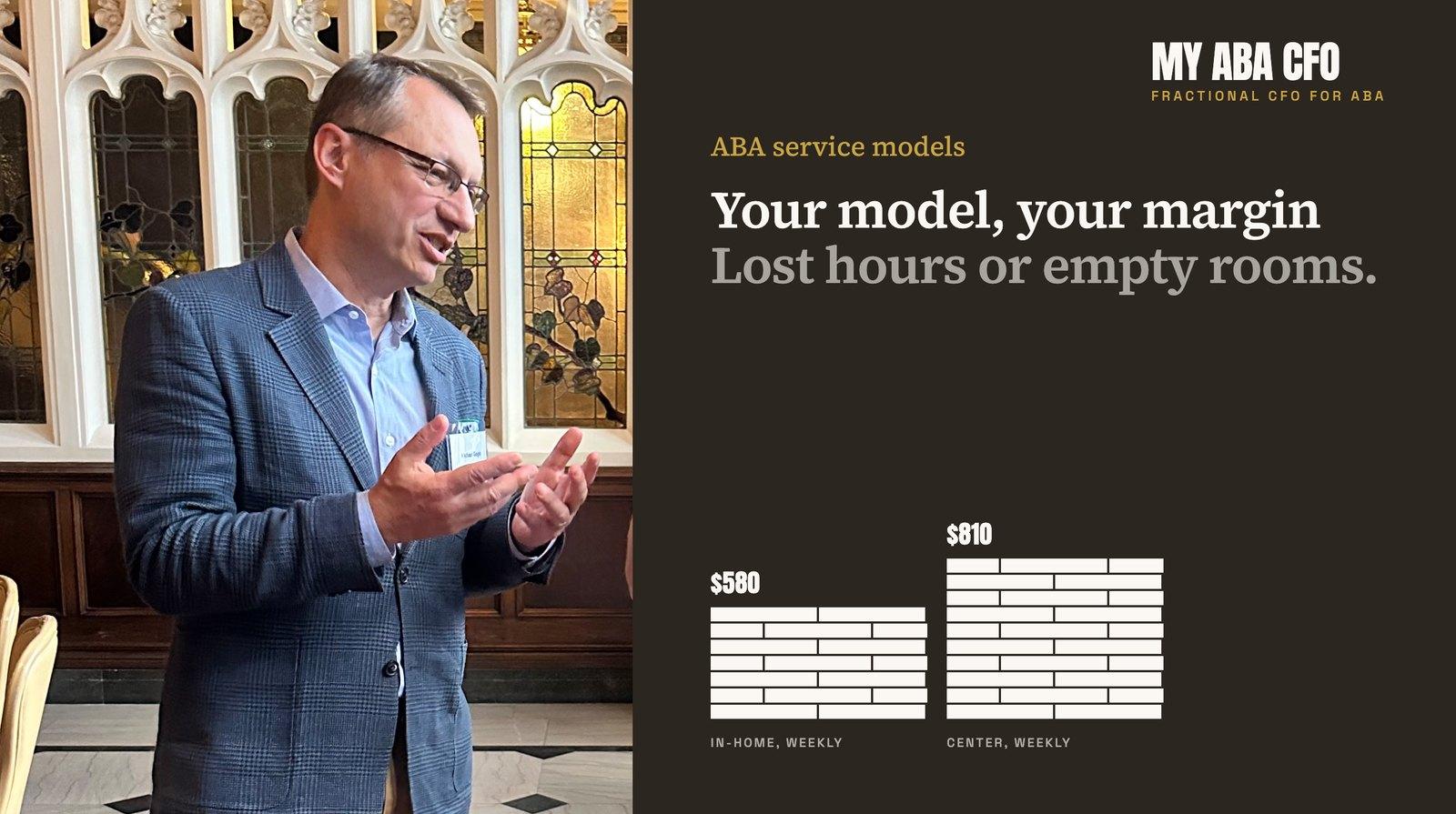
| Left over | $580 | $810 |
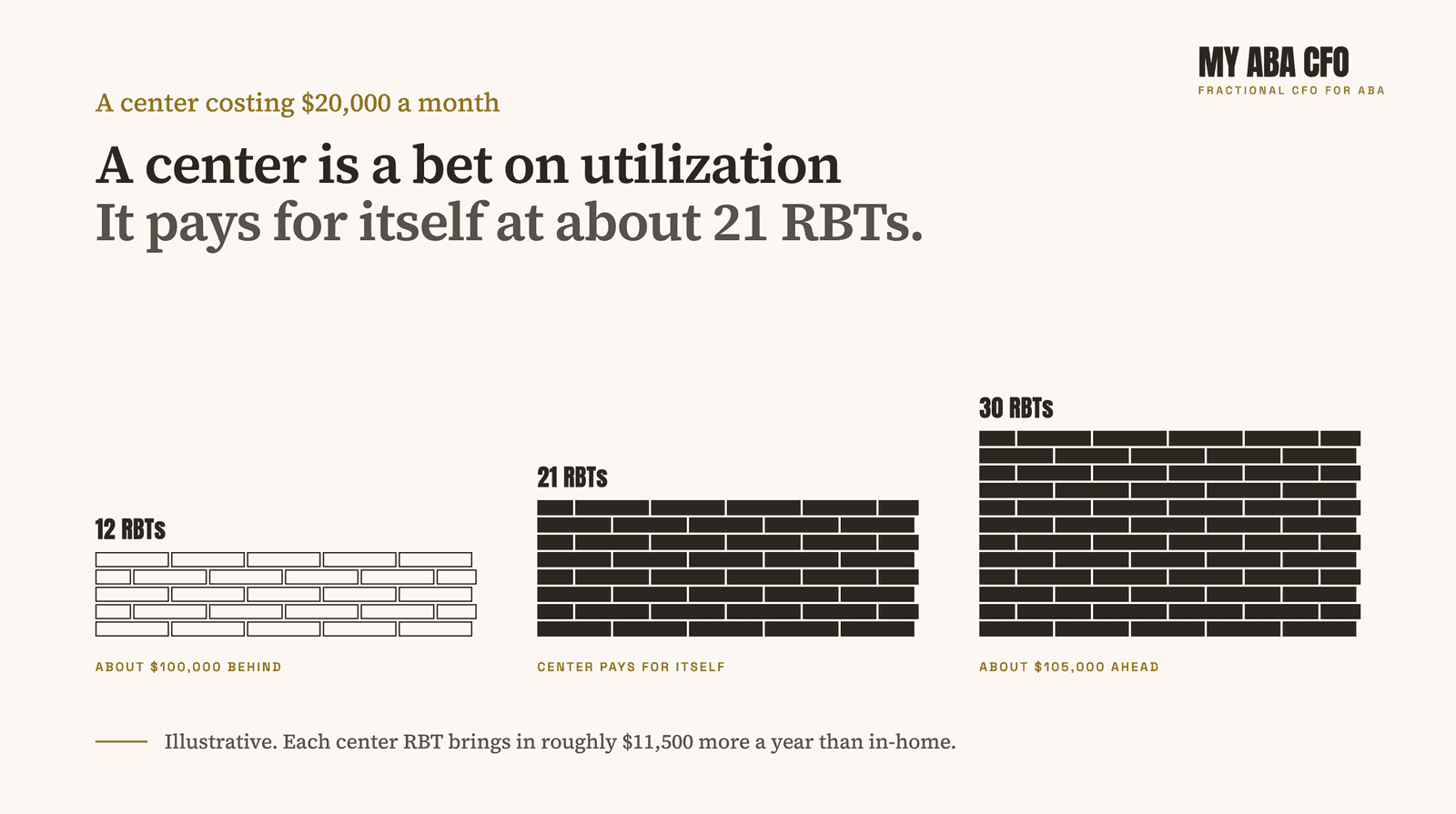
The center RBT brings in about $230 more a week. Over a year, that is roughly $11,500 per RBT.
Now the rent. Say the center costs $20,000 a month all in, or $240,000 a year. Divide by $11,500. You need about 21 RBTs running full schedules before the center pays for itself.
Run 30 RBTs through it and you are about $105,000 ahead of in-home. Run 12 and you are about $100,000 behind. Same building. Same rent. Opposite answer.
Do this now: Work out your own break-even. Annual center cost, divided by the extra margin per RBT. If you are below that number, your problem is not rates or wages. It is empty rooms.
Both: when a hybrid ABA model works
A hybrid can be the best of the two. Younger kids fill the center in the morning. School-age clients get seen at home in the afternoon. The building earns its rent all day and your RBTs get full schedules.
It can also be the worst of the two. I see companies carrying a half-empty center and a staff that still spends hours on the road. They pay rent and drive time. That is not a strategy. It is two leaks.
The difference is whether you planned it. A good hybrid assigns each client to the setting where the hours will actually happen, and tracks the two sides separately.
Do this now: Split your P&L by setting. Revenue, RBT cost, drive time and rent, home on one side and center on the other. Most owners have never seen it that way, and one side is usually carrying the other.
Which model fits your numbers?
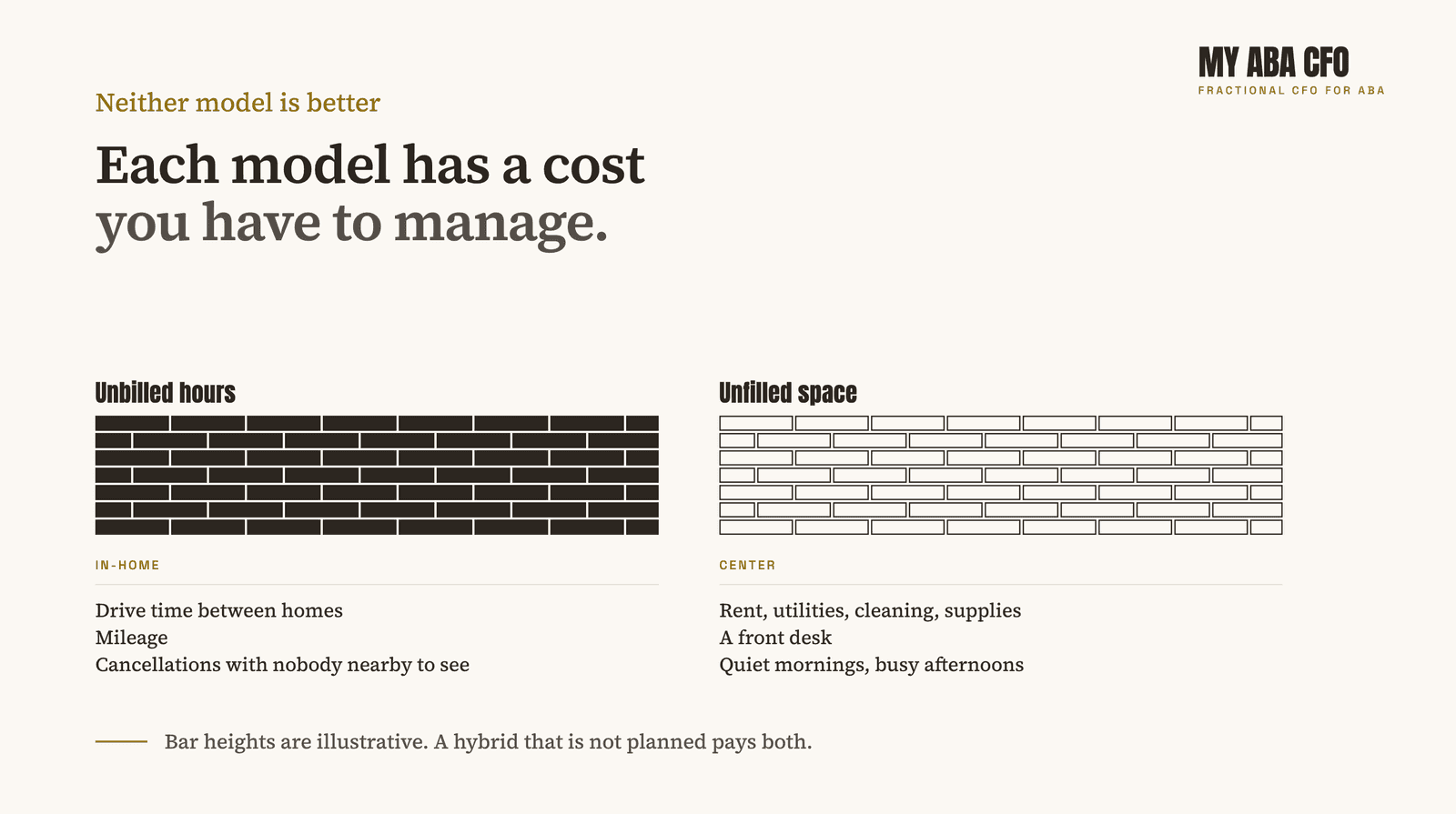
Neither model is better. Each one has a cost you have to manage. At home it is unbilled hours. In a center it is unfilled space. Know which one you are paying, and how much.
If you are weighing a first center, a second one, or a shift in your mix, I am glad to look at it with you. Thirty minutes on your business, your numbers and your next move. No pitch if it is not a fit.
Sources and further reading
- ABA Practice Guidelines, Version 3.0 (Council of Autism Service Providers)
- Action Behavior Centers Builds a School-Age ABA Tier (Breaking News ABA)
Common questions
Is home-based or clinic-based ABA more profitable?
Neither model is better. Each one has a cost you have to manage. At home it is unbilled hours. In a center it is unfilled space. The real answer depends on four things: overhead, utilization, drive time and cancellations.
Is in-home ABA cheaper because there is no rent?
Half true. There is no lease, build-out or front desk, but the cost shows up in hours you pay for and cannot bill. An RBT driving between two homes is on your payroll and off your claims, and a late cancellation at home is an hour that is gone. The in-home model trades rent for lower utilization.
How many RBTs does an ABA center need to break even?
Divide the annual center cost by the extra margin per RBT. In a rough example, a center costing $240,000 a year and an extra $11,500 per RBT means about 21 RBTs running full schedules. Run 30 and you are about $105,000 ahead of in-home. Run 12 and you are about $100,000 behind.
Why do ABA centers sit empty in the morning?
School-age kids cannot come until mid-afternoon, so many centers are busy from 3 to 6 and quiet all morning. You pay rent for the whole day. A center is a bet on utilization.
When does a hybrid ABA model work?
When you planned it. Younger kids fill the center in the morning and school-age clients get seen at home in the afternoon, so the building earns its rent all day. A good hybrid assigns each client to the setting where the hours will actually happen and tracks the two sides separately. A half-empty center plus hours on the road is two leaks.