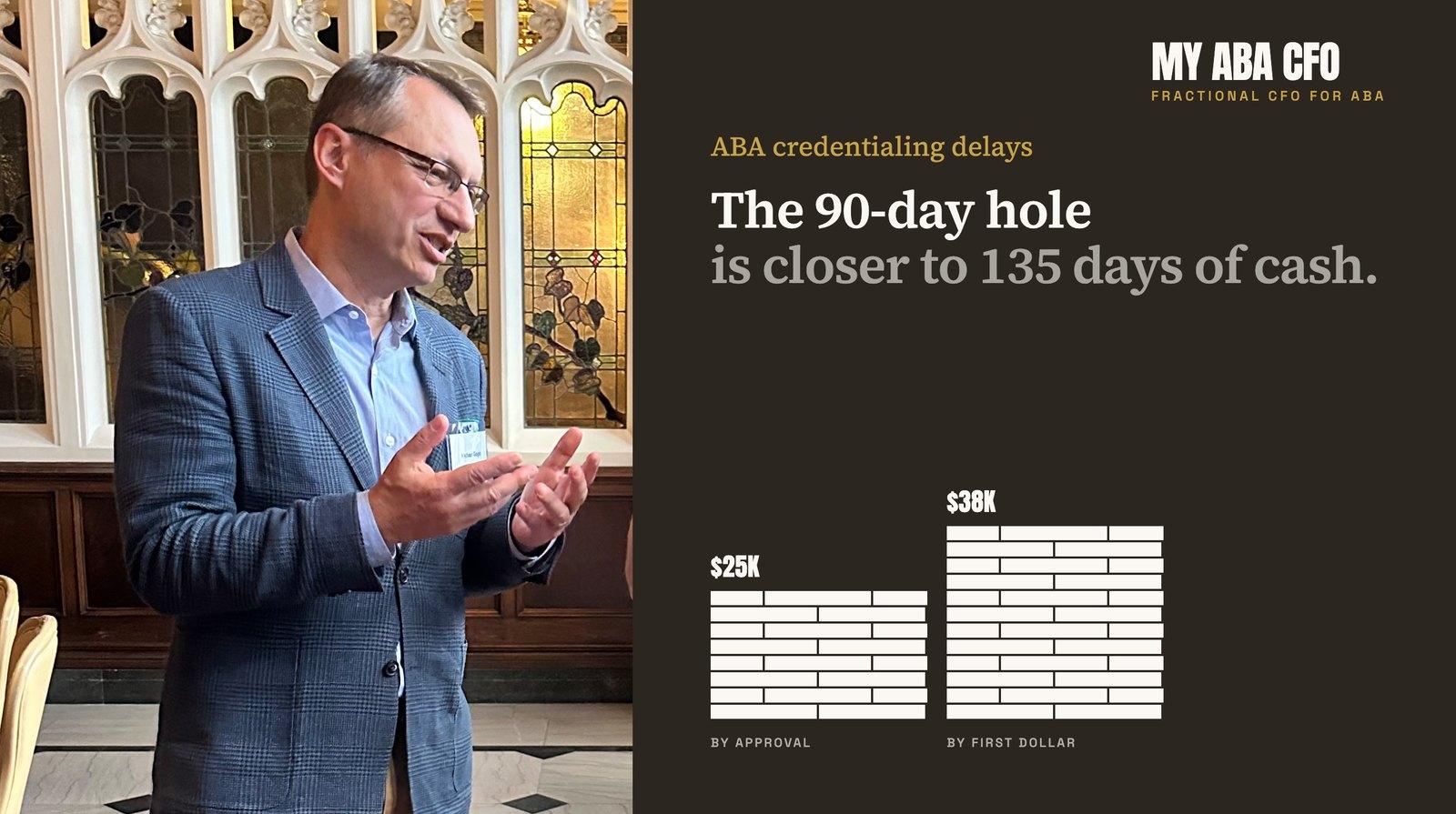
You hired a BCBA. The start date was Monday. Payroll started Monday too.
Billing did not. Until each payer finishes credentialing your new hire, most of that BCBA's work cannot go out on a claim. The gap commonly runs about 90 days, and sometimes longer. I call it the 90-day hole, and most owners I talk to have never put a dollar figure on it.
So let's put one on it. The numbers below are round and illustrative. Yours will differ. The shape will not.
Where the 90 days go
Credentialing is each payer checking your new BCBA's license, certification and work history before it will pay for that person's work. Every payer runs its own process on its own clock. Ninety to 120 days is a common range for commercial plans. Medicaid can run longer in some states.
Here is the part owners miss. The clock starts when a complete application lands at the payer. Not when you made the offer. Not on the start date. If nobody touches the paperwork until orientation week, you just added two or three weeks to the hole.
And most payers will not pay for sessions delivered before the effective date. Some will backdate it if you ask. Many will not.
Know before you hire: your real credentialing time, in days, for each of your top payers.
What one uncredentialed BCBA costs you
Take a BCBA who costs you a rough $100,000 a year, loaded with payroll taxes and benefits. That is about $8,300 a month.
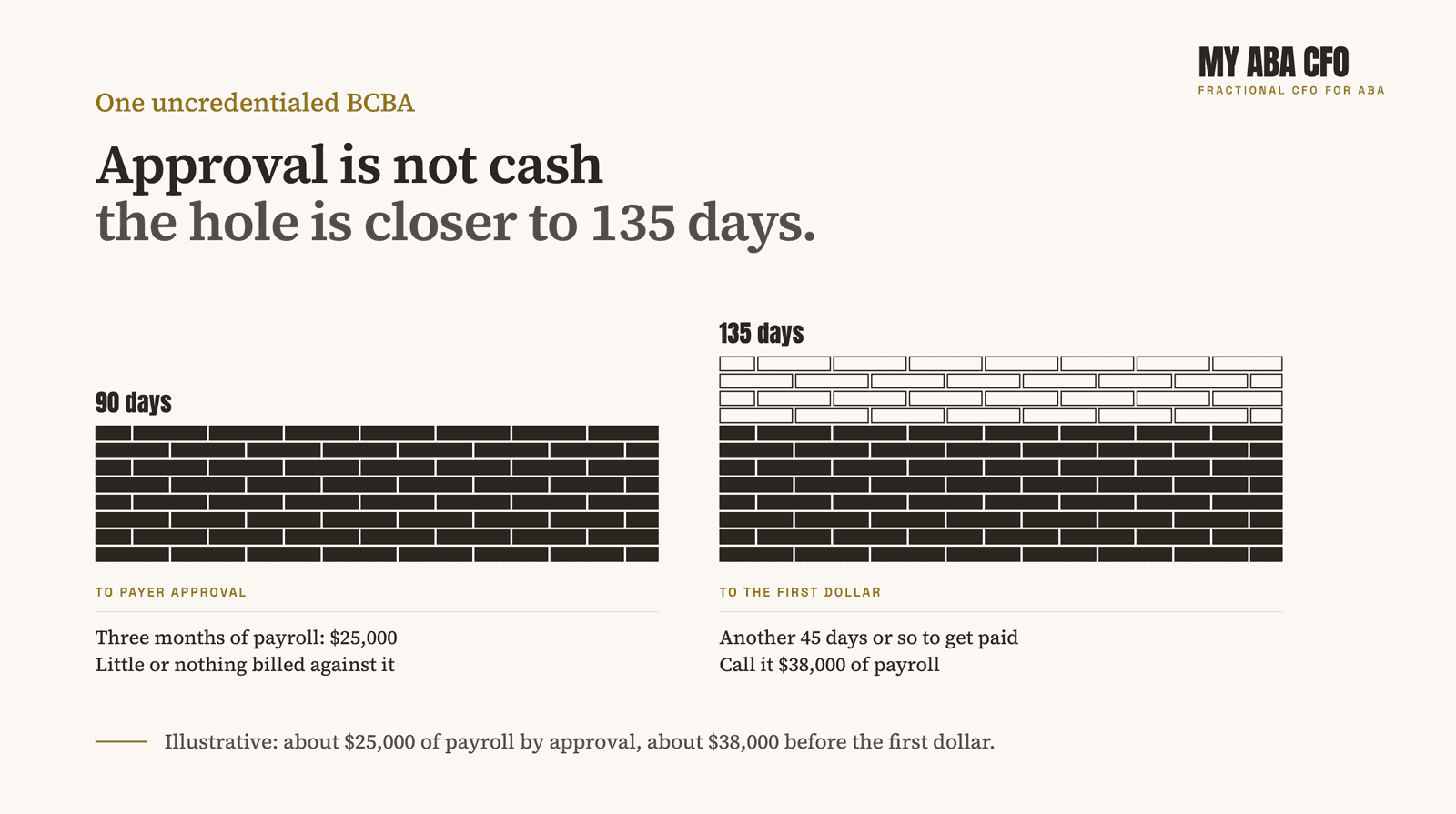
Three months of that is $25,000 paid out with little or nothing billed against it.
But approval is not cash. Once the payer says yes, you bill, and then you wait to get paid. Add another 45 days or so. The 90-day hole is closer to 135 days in your bank account. Call it $38,000 of payroll before that hire's first dollar arrives.
Now multiply. A $3 million company at a 10% margin makes about $300,000 a year. Hire three BCBAs this year and the hole is about $75,000 on payroll alone. That is a quarter of your profit, spent on waiting.
Do this now: add a credentialing line to every hiring budget. Monthly cost times the months you expect to wait.
The bigger number is the revenue that cannot start
Payroll is the small part. You hired that BCBA to open a caseload.
Say a full caseload is eight clients at about 15 hours a week. That is 120 hours of 97153 a week. At a rough $60 an hour, that is $7,200 a week, or about $31,000 a month, before the BCBA's own billable hours. Nobody starts with a full caseload, so treat that as the ceiling.
If those cases cannot start until credentialing clears, three months is as much as $94,000 of revenue pushed back. Some of it never comes. Families on a waitlist do not wait 90 days. They call the next provider.
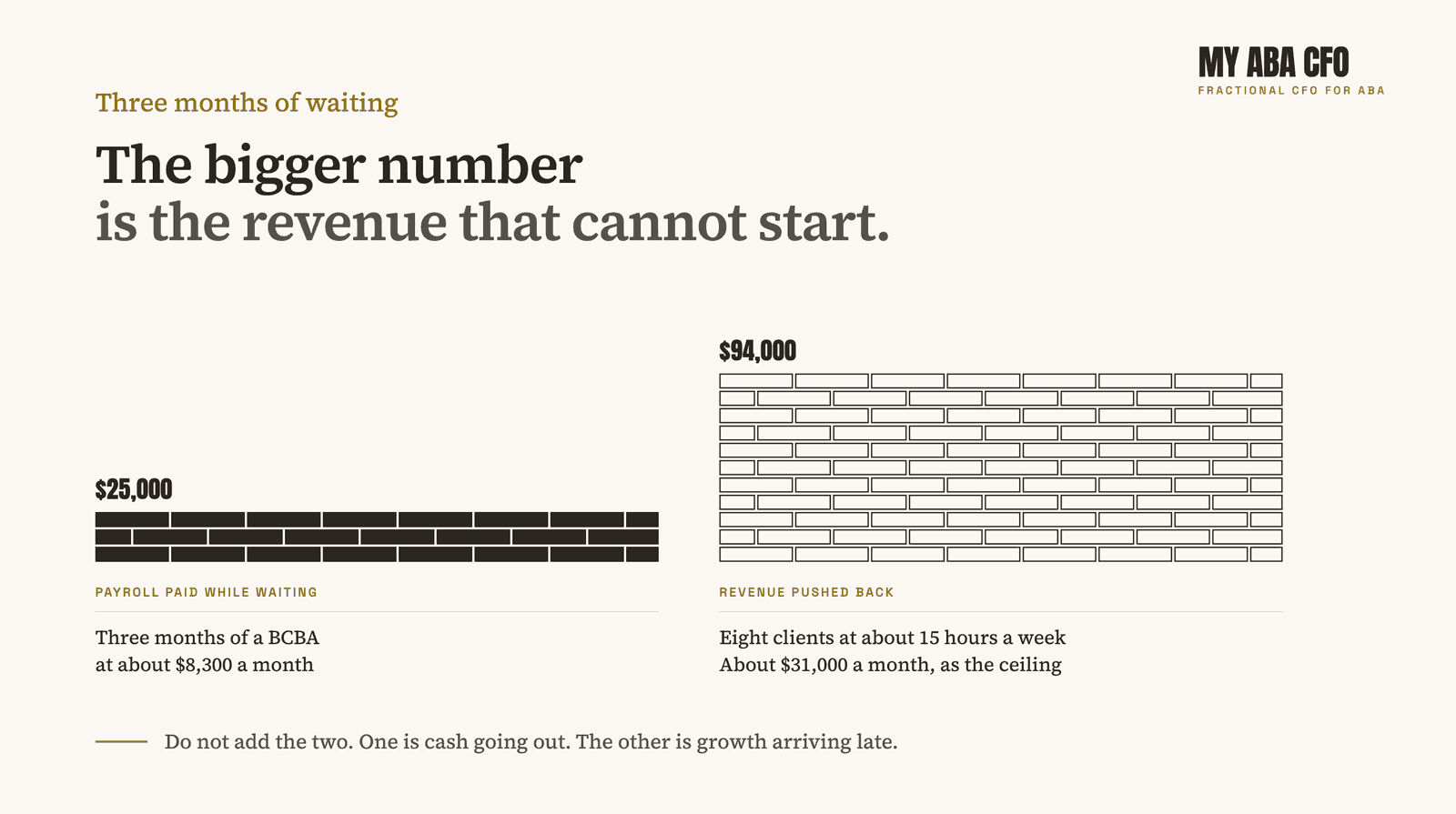
Do not add this to the payroll number as if they were the same thing. One is cash going out. The other is growth arriving late. Both are real, and neither shows up as a line on your P&L. That is why nobody manages it.
Measure it: the number of clients waiting on a BCBA who is waiting on a payer.
How to shrink the hole
You cannot make a payer move faster. You can stop wasting your own days.
Start at the signed offer. Collect the license, certification, NPI and CAQH access the day the offer is accepted, and submit before the start date. A BCBA working out a month's notice somewhere else is a month of head start.
Send a clean application. Many of the delays I see are self-inflicted. A blank field. A CAQH profile nobody re-attested. A date that does not match. Each one can cost you weeks.
Ask about the effective date. In writing, before you schedule anyone. Can it be backdated to the day the application was received? What are the rules for a new BCBA working alongside one who is already credentialed? The answers vary by payer. Do not guess, and do not bill on a guess. That road ends in a clawback.
Schedule around approvals. Payers clear at different speeds. Give the new BCBA cases from whichever payer approves first, and use the waiting weeks for onboarding and case transitions.
Track it and forecast it. One tracker: every clinician, every payer, date submitted, status, days outstanding. One person owns it and follows up weekly. Then put the gap in your cash forecast, so the hole is planned and not discovered.
Build before you grow: credentialing that starts with the offer letter, has one owner, and gets chased every week.
Hiring is a cash decision
Every BCBA you add is an investment that pays back months later. That is fine. Good investments work that way. The trouble comes when you learn the size of the hole while you are standing in it.
If you plan to add BCBAs in the next year, know the number first.
Thirty minutes on your business, your numbers and your next move. No pitch if it is not a fit. Book a confidential call.
Sources and further reading
- Board Certified Behavior Analyst (Behavior Analyst Certification Board)
- Insurers Ask CMS to Set National ABA Credentialing Rules (Breaking News ABA)
Common questions
How long do ABA credentialing delays usually last?
The gap commonly runs about 90 days, and sometimes longer. Ninety to 120 days is a common range for commercial plans, and Medicaid can run longer in some states. Every payer runs its own process on its own clock.
What do credentialing delays cost an ABA company?
In a round, illustrative example, a BCBA who costs about $100,000 a year loaded is about $8,300 a month. Three months of that is $25,000 paid out with little or nothing billed against it. Add another 45 days or so to get paid after approval, and it is closer to $38,000 of payroll before that hire's first dollar arrives.
When does the payer credentialing clock start for a new BCBA?
The clock starts when a complete application lands at the payer. Not when you made the offer, and not on the start date. If nobody touches the paperwork until orientation week, you just added two or three weeks to the hole.
Can I bill for sessions delivered before a BCBA's credentialing effective date?
Most payers will not pay for sessions delivered before the effective date. Some will backdate it if you ask, and many will not. Ask in writing before you schedule anyone, because the answers vary by payer. Do not guess, and do not bill on a guess.
How can an ABA company shorten credentialing delays?
You cannot make a payer move faster, but you can stop wasting your own days. Start at the signed offer, send a clean application, ask about the effective date in writing, and schedule the new BCBA around whichever payer approves first. Keep one tracker with one owner who follows up weekly, and put the gap in your cash forecast.