Ask ten ABA owners how many clients a BCBA should carry and you'll hear ten numbers. Eight. Twelve. Twenty. Most were inherited from a former employer or picked up at a conference.
The number matters more than almost any other in your company. Set it too low and your most expensive clinician doesn't pay for the seat. Set it too high and you lose quality, then the BCBA, then the families. There is a right answer for your company. It comes from arithmetic, not a rule of thumb.
Count hours, not clients
A client is not a unit of work. A child at 30 hours a week of direct therapy and a teenager at 6 hours of focused treatment are both "one client." They are not the same load.
So start with the hours each case demands from the BCBA. The practice guidelines point to as much as two hours of case supervision for every ten hours of direct treatment. In practice, what payers authorize and companies deliver tends to land somewhere between 10% and 20%. Then add parent training, reassessments and treatment plan updates.
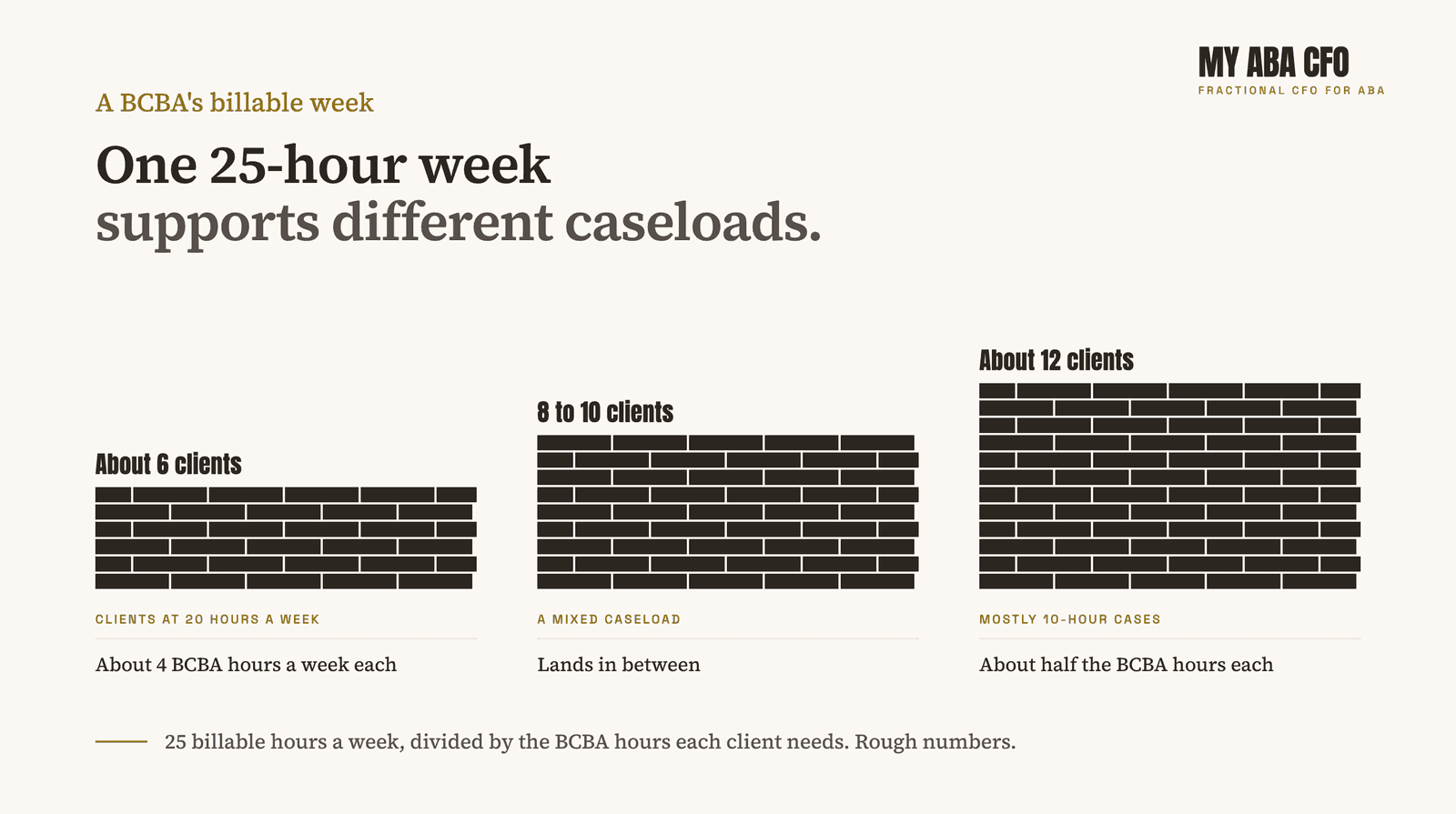
Rough numbers. A client at 20 hours a week needs about 3 hours of supervision at 15%, plus about 1 hour of parent training and other billable BCBA work. Call it 4 BCBA hours a week. A 10-hour client needs about half that.
Do this now: For every BCBA, total the weekly BCBA hours their current clients require. That is the caseload. The headcount is only a label.
What a BCBA's week can really bill
A full-time BCBA does not bill 40 hours. Notes, program writing, RBT training, authorization reports, drive time, meetings. All real work. Most of it unpaid by the payer.
A common expectation is around 25 billable hours a week, and I use that as a planning number. Push it toward 30 and you are borrowing from the unpaid work that keeps the clinical side running.
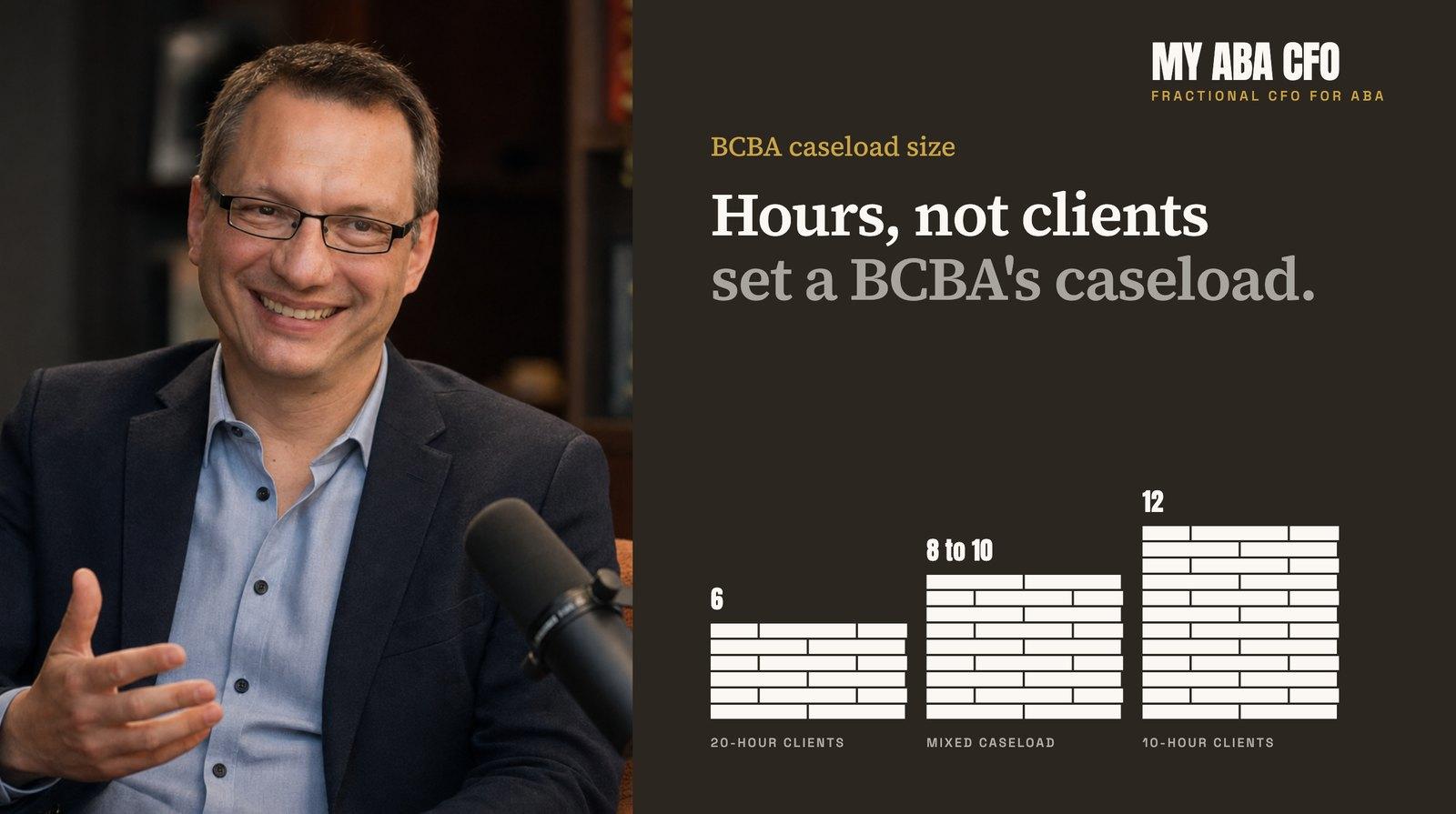
Now divide. 25 billable hours at 4 hours per client is about 6 clients at 20 hours a week. If the caseload is mostly 10-hour cases, the same week supports about 12. A mixed caseload lands in between, around 8 to 10. If you use BCaBAs or other mid-tier supervisors, the number goes up, because some of those hours move off the BCBA's calendar.
That is why the conference answers are all over the map. Each one is right for somebody's case mix.
Do this now: Write down your billable expectation and the BCBA hours per client for your case mix. Divide. That is a target caseload you can defend.
The margin math
Here is what surprises owners. A BCBA's own billing barely pays for the BCBA.
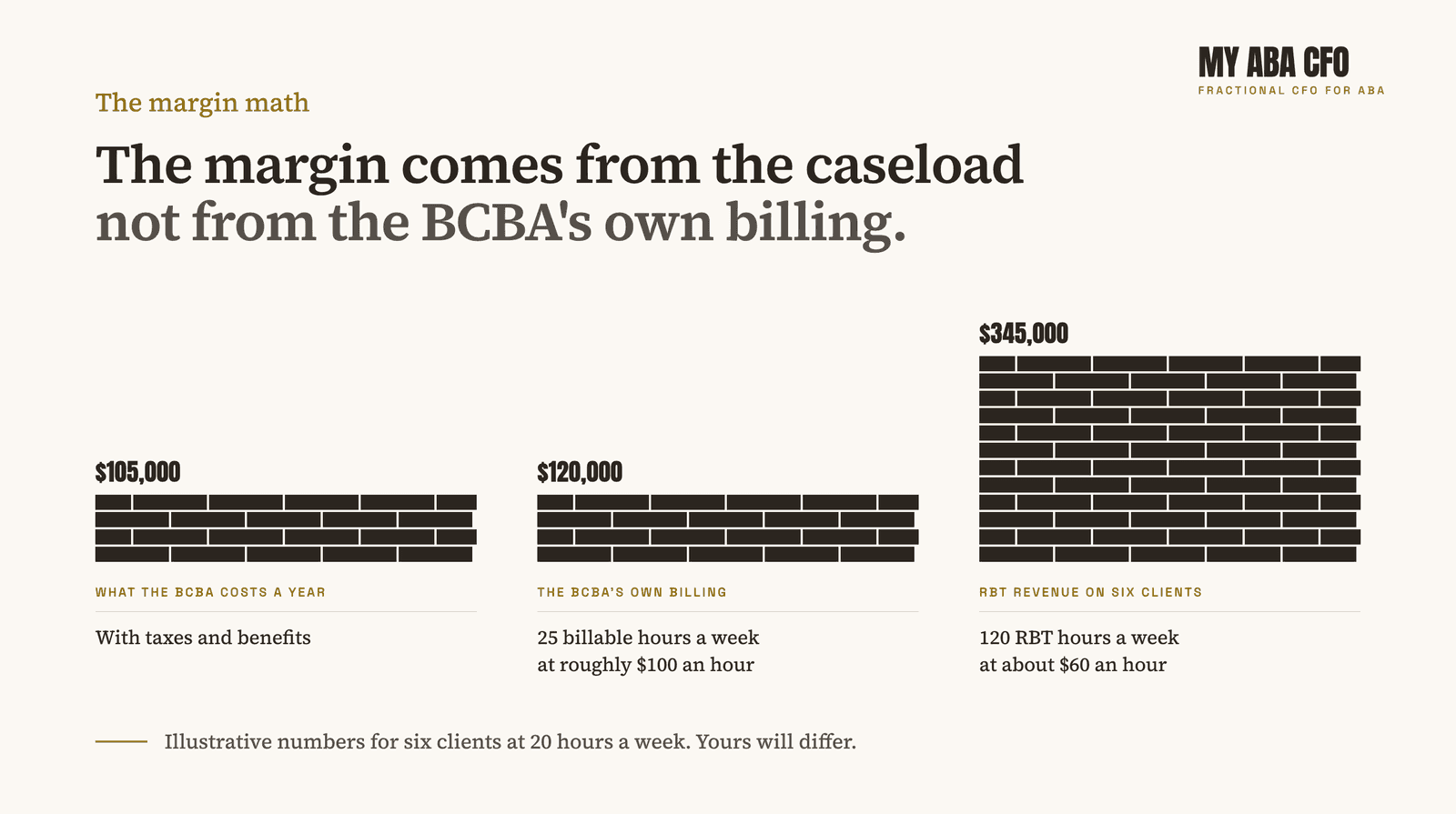
Illustrative numbers, and yours will differ. Say a BCBA costs you about $105,000 a year with taxes and benefits. At 25 billable hours a week, 48 working weeks and roughly $100 an hour, that BCBA bills about $120,000. Thin.
The margin comes from the caseload. Six clients at 20 hours a week is 120 RBT hours. At about $60 an hour, that is roughly $345,000 a year of direct therapy revenue that exists only because a BCBA is supervising it.
So each client on a caseload carries about $75,000 a year in revenue: roughly $58,000 of RBT hours and $19,000 of BCBA hours. A BCBA running at four clients when the math says six is about $150,000 of revenue you are paying a salary to support and not getting. Same salary. Same desk.
Do this now: Next to each BCBA's name, put the revenue their caseload supports and their billable hours against target. Look at it every month.
Where quality and burnout set the limit
So load them up? No. This is where the math turns on you.
Put nine of those 20-hour clients on one BCBA. The caseload now needs 36 billable hours from a week that holds 25. Something gives. Supervision gets thin. Parent training gets skipped. Notes get written at ten at night.
Each of those has a price. Thin supervision means weaker outcomes and, if you fall below what the payer requires, audit exposure. Skipped parent training is authorized revenue you never bill. And the BCBA writing notes at ten at night is updating a resume.
When that BCBA leaves, the caseload is exposed. On a six-client caseload that is about $460,000 a year of revenue with nobody to supervise it, and BCBAs are not quick to replace. One departure can erase everything the extra clients earned.
The ceiling is the point where a BCBA can no longer deliver the supervision each case requires inside a normal week. Past it, the extra revenue is borrowed.
Do this now: Track supervision as a percent of direct hours for every BCBA. When it slides, or billable hours run over target month after month, the caseload is too big. Hire before it breaks.
Want to run this math on your own caseloads?
Caseload is where clinical quality and margin meet, and most owners have never seen the two on one page. I can help you build that page.
Thirty minutes on your business, your numbers and your next move. No pitch if it is not a fit.
Sources and further reading
- ABA Practice Guidelines, Version 3.0 (Council of Autism Service Providers)
- The BCBA Burnout Crisis: 58% Have Considered Leaving, One-Third Under Extreme Stress for Two Years, and 32% Credentialed in the Last Five (Breaking News ABA)
Common questions
How many clients should a BCBA carry?
It depends on the hours each case demands, not the headcount. At about 25 billable hours a week, a BCBA can carry about 6 clients at 20 hours a week, or about 12 if the caseload is mostly 10-hour cases. A mixed caseload lands in between, around 8 to 10.
How do I calculate the right BCBA caseload size for my ABA company?
Write down your billable expectation and the BCBA hours per client for your case mix, then divide. A client at 20 hours a week needs about 3 hours of supervision at 15%, plus about 1 hour of parent training and other billable BCBA work, so about 4 BCBA hours a week. 25 billable hours at 4 hours per client is about 6 clients.
How many billable hours a week should a full-time BCBA have?
A full-time BCBA does not bill 40 hours. A common expectation is around 25 billable hours a week, and I use that as a planning number. Push it toward 30 and you are borrowing from the unpaid work that keeps the clinical side running.
How does BCBA caseload size affect ABA margin?
A BCBA's own billing barely pays for the BCBA. The margin comes from the caseload, because the RBT hours exist only because a BCBA is supervising them. In the illustrative numbers, each client on a caseload carries about $75,000 a year in revenue, so a BCBA at four clients when the math says six is about $150,000 of revenue you are not getting.
What happens when a BCBA caseload is too large?
The caseload needs more billable hours than the week holds, so something gives. Supervision gets thin, parent training gets skipped, and notes get written at ten at night. Thin supervision means weaker outcomes and audit exposure, and when the BCBA leaves, the whole caseload is exposed.