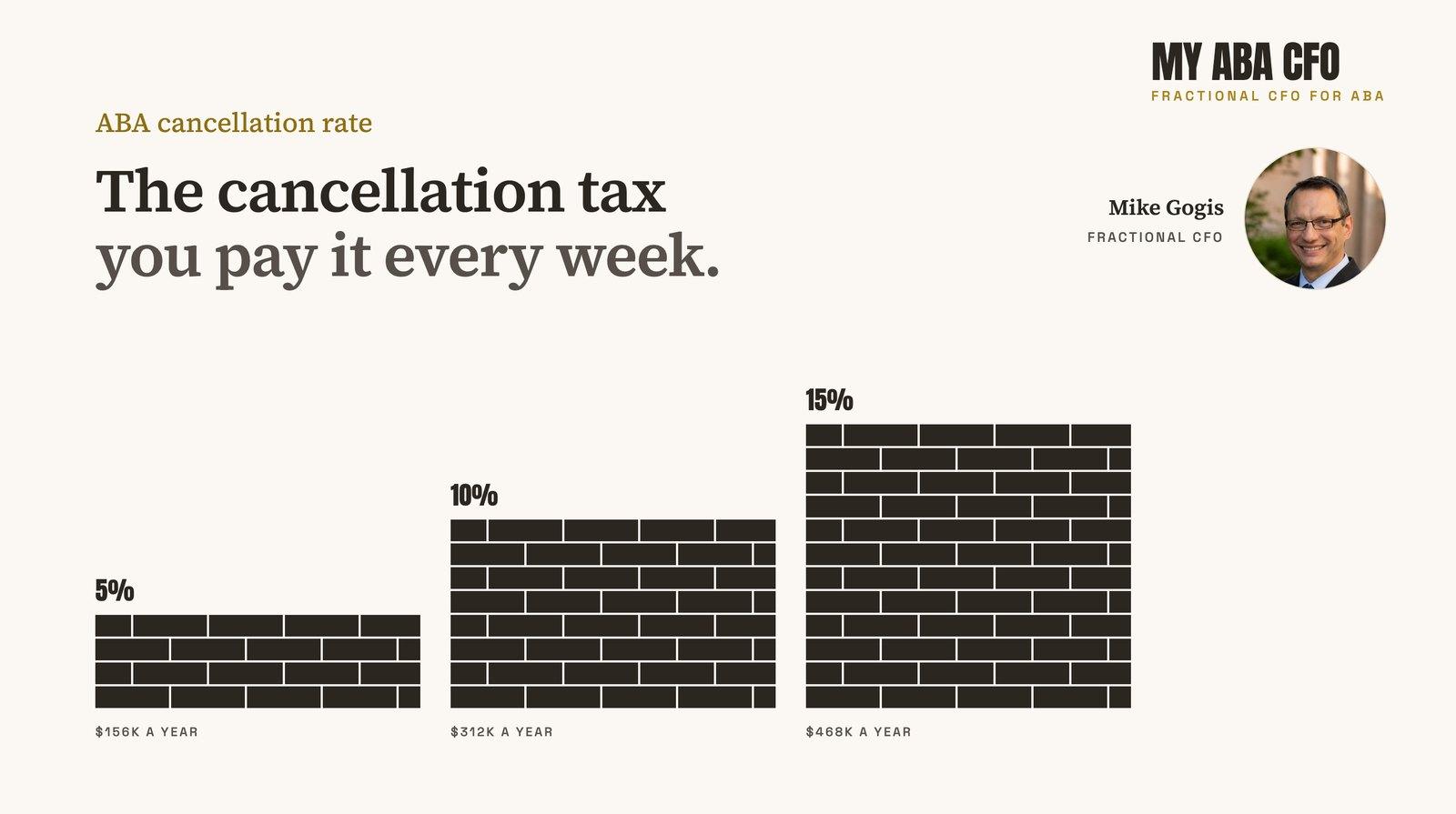
Most ABA owners know their cancellation rate is "too high." Very few have put a dollar figure on it. That is a mistake, because cancellations are not a scheduling annoyance. They are a tax on every hour you planned to bill, and you pay it every week.
Here is the math I walk owners through. The numbers are round and illustrative. Swap in your own.
What a 10 or 15 percent cancellation rate costs
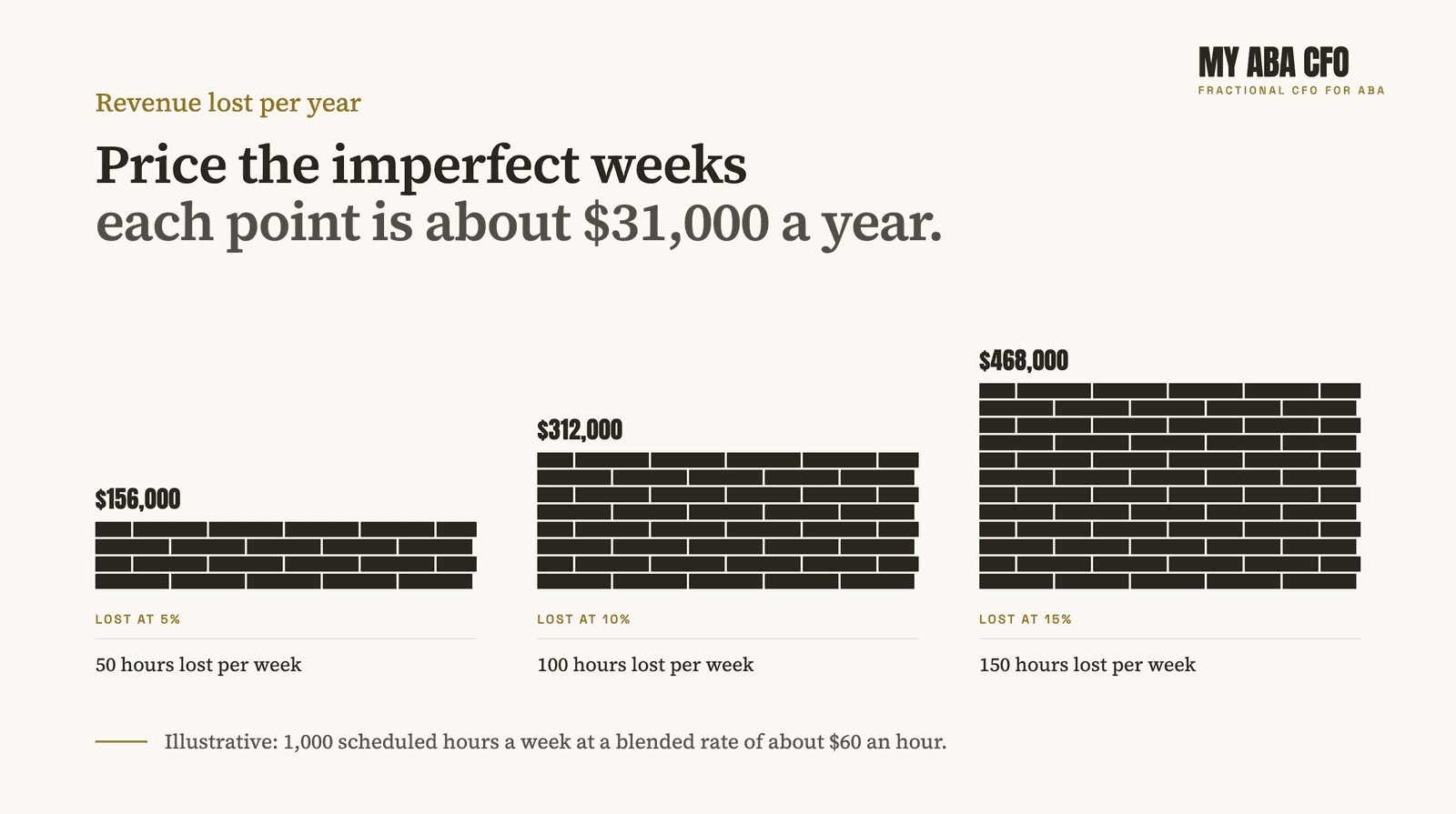
Take a company with 40 RBTs scheduled for 25 hours a week each. That is 1,000 scheduled hours a week. At a blended rate of about $60 an hour, a perfect week bills $60,000, or roughly $3.1 million a year.
Nobody has a perfect week. So price the imperfect ones.
| Cancellation rate | Hours lost per week | Revenue lost per year |
|---|---|---|
| 5% | 50 | about $156,000 |
| 10% | 100 | about $312,000 |
| 15% | 150 | about $468,000 |
Each point of cancellation is worth about $31,000 a year at this size. The gap between 15 percent and 10 percent is $156,000. If this company runs a 10 percent margin, that gap is half its annual profit.
And this counts only RBT hours. Supervision that was tied to a cancelled session often goes with it.
Do this now: Multiply your scheduled hours per week by your average rate, then by 52. One percent of that number is what each point of cancellation costs you.
Your pay policy decides who pays the tax
Lost revenue is only half the answer. The other half is what you do with the RBT whose session just disappeared. Assume a loaded cost of about $25 an hour.
You pay the RBT anyway. The revenue is gone and the wage is not. Every cancelled hour costs you the full $60 in profit. At 10 percent, that is the whole $312,000.
You send the RBT home unpaid. You lose $60 and save $25, so each cancelled hour costs $35. At 10 percent, about $182,000. At 15 percent, about $273,000.
On paper, the second policy saves $130,000 a year. This is where owners stop the math too early.
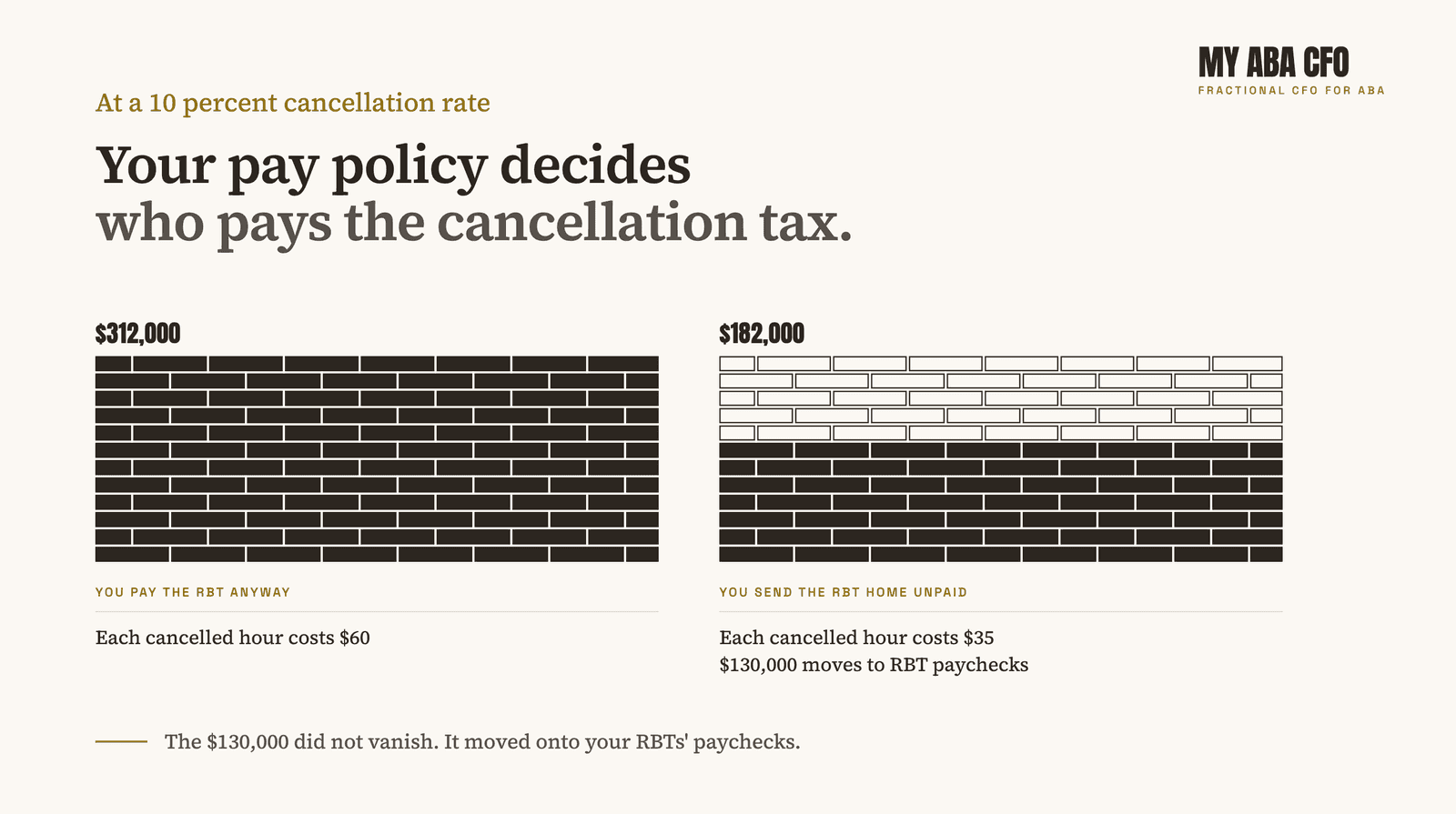
That $130,000 did not vanish. You moved it onto your RBTs' paychecks. A tech who expects 25 hours and gets paid for 21 does not stay long, and replacing that tech is not free. Unpaid cancellations look cheap on the P&L and show up later in turnover, open cases and unused authorized hours. Some states also have rules on pay for shifts cancelled at the last minute, so check with your employment lawyer.
Do this now: Write down your actual policy, not the one in the handbook. Then ask your schedulers what really happens when a family cancels at 7 a.m.
The better answer: pay, then refill the hour
The policy I like best is the third one. Keep the RBT's hours predictable, and work hard to turn the cancelled hour back into a billable one.
That means a make-up session the same week while the authorization still has room. Or a short list of clients who want more hours and can take a same-day slot. If neither works, use the hour for training you would have paid for anyway.
The payoff is easy to price. If the example company refills half of its 100 cancelled hours a week, it gets back about $156,000 a year. No new clients. No new hires.
Do this now: Track one number each week: cancelled hours that were rebilled, divided by total cancelled hours. Most owners I talk to have never seen it.
Cut the rate at the source
A company-wide cancellation rate hides more than it shows. Break it down three ways.
- By client. A handful of families usually drive a large share of the cancellations. Those are conversations, not statistics.
- By who cancelled. Staff call-outs and family cancellations have different fixes. Count them separately.
- By day and time. If Friday afternoons fall apart every week, stop building a schedule that depends on them.
Then set an attendance policy and enforce it. Be careful with no-show fees. Medicaid generally does not let you bill a family for a missed session, and commercial contracts vary, so read yours first.
Do this now: Pull 90 days of cancellations and sort by client. Start with the top five names.
Put a number on it
Cancellations will never be zero. Kids get sick. Cars break down. The goal is to know what each point costs, decide on purpose who absorbs it, and refill as many hours as you can.
If you want a second set of eyes on that math, I am glad to help. Thirty minutes on your business, your numbers and your next move. No pitch if it is not a fit.
Sources and further reading
- Billing Codes (ABA Coding Coalition)
- Why ABA Scheduling Is the Industry's Hardest AI Problem (Breaking News ABA)
Common questions
How much does a 10 percent ABA cancellation rate cost?
In an illustrative example, a company with 40 RBTs scheduled for 25 hours a week has 1,000 scheduled hours a week. At about $60 an hour, a 10 percent cancellation rate is 100 hours lost per week and about $312,000 of revenue lost per year. At 15 percent it is about $468,000.
How do I calculate what my ABA cancellation rate costs?
Multiply your scheduled hours per week by your average rate, then by 52. One percent of that number is what each point of cancellation costs you. In the example company, each point is worth about $31,000 a year.
Should I pay RBTs for cancelled ABA sessions?
If you pay the RBT anyway, every cancelled hour costs you the full rate. If you send the RBT home unpaid, it looks cheaper on the P&L, but you moved the cost onto your RBTs' paychecks and it shows up later in turnover, open cases and unused authorized hours. The policy I like best keeps the RBT's hours predictable and works hard to turn the cancelled hour back into a billable one.
How can I get back revenue lost to ABA no-shows and cancellations?
Refill the hour. That means a make-up session the same week while the authorization still has room, or a short list of clients who want more hours and can take a same-day slot. If the example company refills half of its 100 cancelled hours a week, it gets back about $156,000 a year.
Can an ABA company charge a no-show fee?
Be careful with no-show fees. Medicaid generally does not let you bill a family for a missed session, and commercial contracts vary, so read yours first. Set an attendance policy and enforce it.