Most ABA owners file RBT turnover under HR. A people problem. Unfortunate, constant, and somebody else's meeting.
It is a cost. A large one. And it appears nowhere on your P&L, which is why almost nobody manages it.
So let's price it. One departure, in dollars. The figures below are rough and illustrative. Yours will differ, but the method holds.
What one RBT departure costs
There are four pieces.
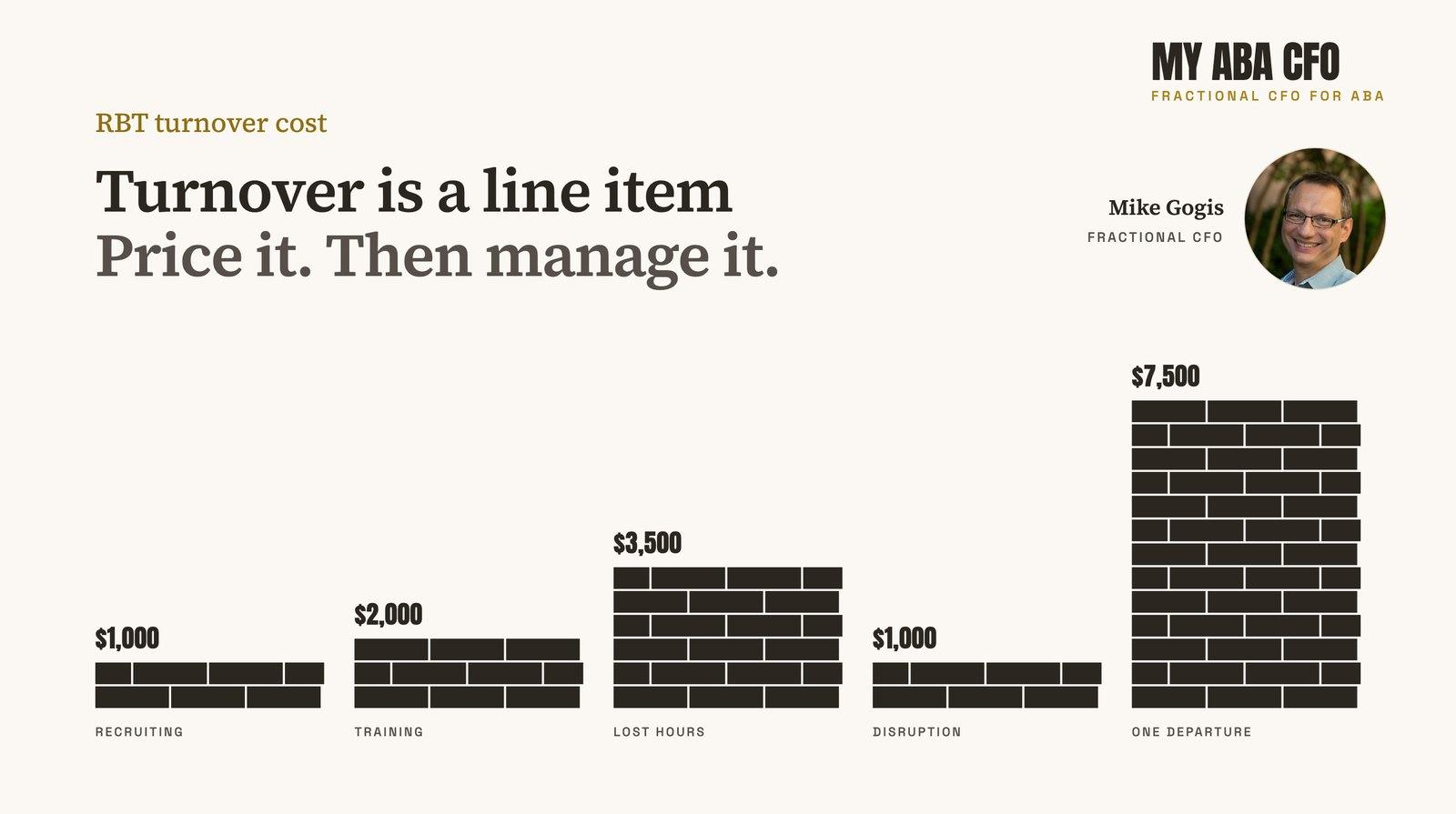
Recruiting. Job ads, the hours your recruiter or office manager spends screening and interviewing, the background check. Call it $1,000 a hire.
Training. The 40-hour course, paid. The competency assessment. Shadow shifts where two techs sit with one client and you bill for one. BCBA time that could have been billed elsewhere. Call it $2,000. Less if you hire someone already certified, but you pay for that in the wage.
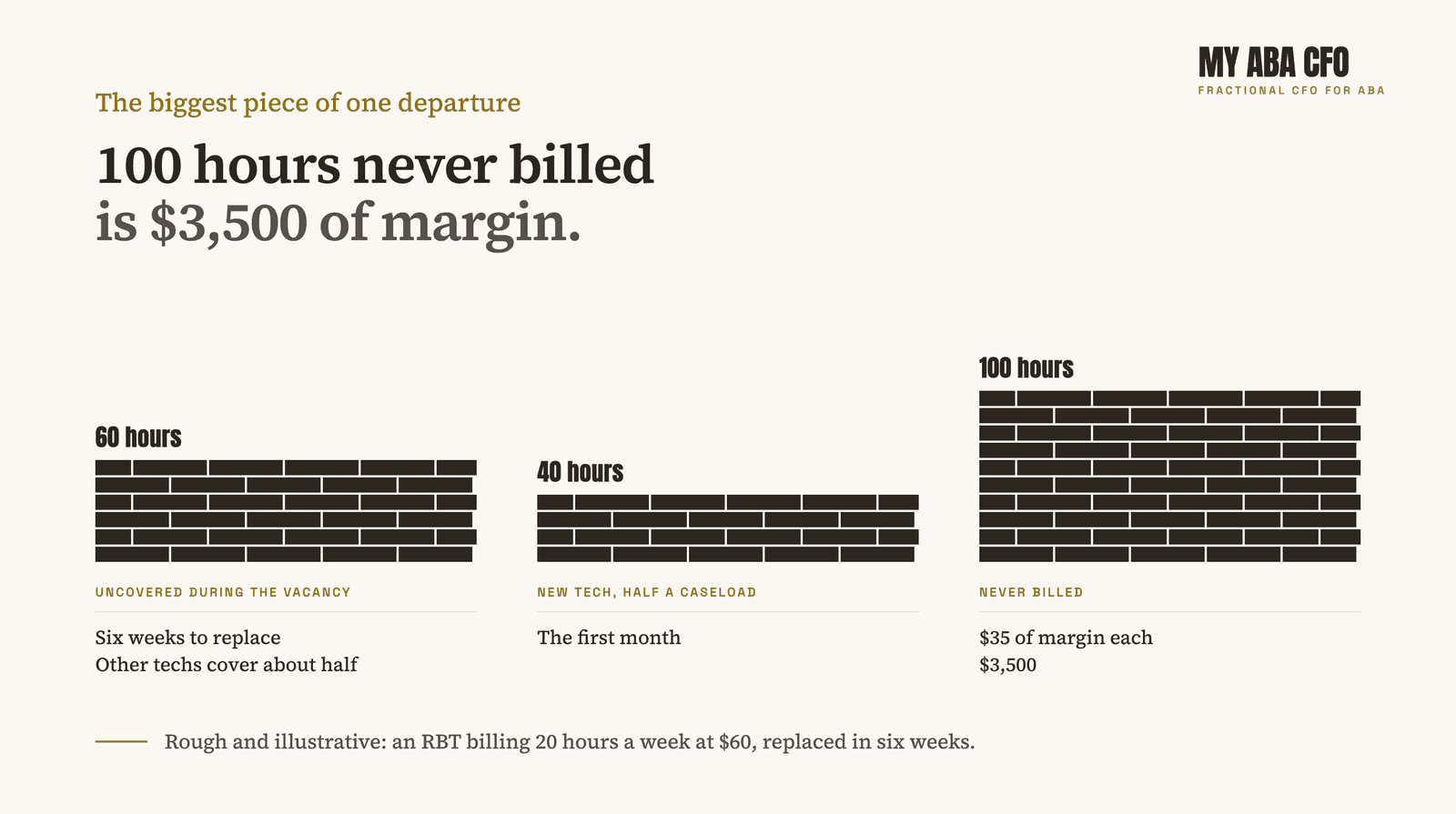
Lost billable hours. The biggest piece. Say the RBT billed 20 hours a week at $60. Six weeks pass between the last shift and a replacement working those cases. Other techs cover about half, which leaves 60 hours. Then the new tech carries half a caseload for the first month. Another 40. That is 100 hours never billed. You did not pay wages on those hours either, so the loss is not the full $60. At a loaded cost of about $25 an hour, each lost hour costs you $35 of margin. So $3,500.
Client disruption. The hardest to price, so most owners price it at zero. That is wrong. The client restarts with a stranger. Progress stalls. Authorized hours go unused. Sometimes the family leaves. Say one departure in ten costs you a family, and a 20-hour slot takes three months to refill. That is about $8,400 of margin, or roughly $840 spread over each departure. Round it to $1,000. I think that is low.
| Cost of one departure | Rough figure |
|---|---|
| Recruiting | $1,000 |
| Training and onboarding | $2,000 |
| Lost billable hours | $3,500 |
| Client disruption | $1,000 |
| Total | $7,500 |
Do this now: swap in your own rate, wage and vacancy time. It takes fifteen minutes.
Multiply by your headcount
One departure at $7,500 is an annoyance. The annual figure is the problem.
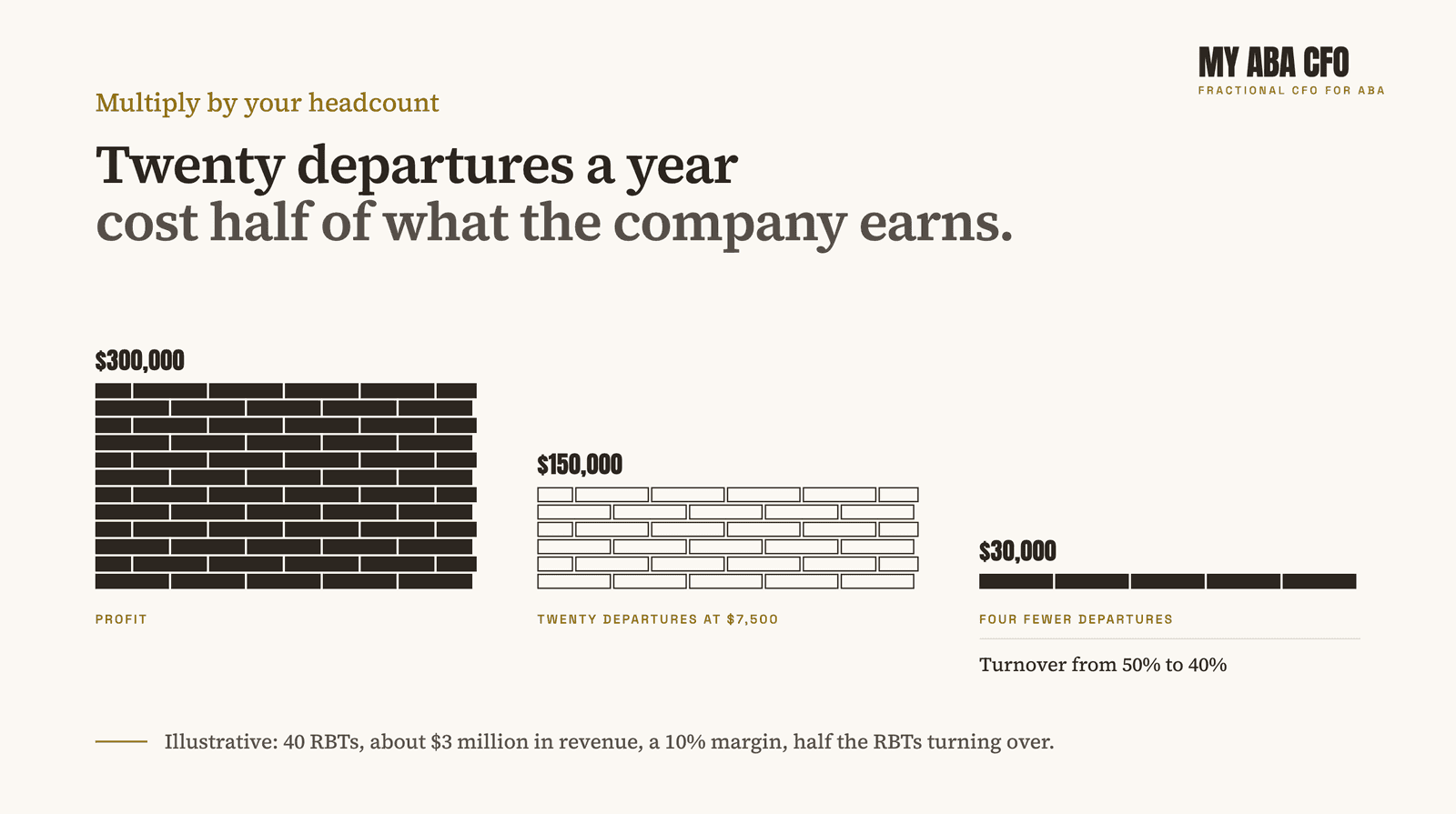
Take a company with 40 RBTs, about $3 million in revenue and a 10% margin. That is $300,000 of profit.
Now assume half the RBTs turn over in a year. I am not quoting a study. It is a rate plenty of owners will recognize. Twenty departures at $7,500 is $150,000. Half of what the company earns.
Nobody gets turnover to zero in this field. You do not have to. Move it from 50% to 40% and you have four fewer departures. That is $30,000 a year, straight to the bottom line, without adding a single client.
Do this now: count last year's RBT departures and multiply by your own figure.
Why you never see it on the P&L
Because it is scattered. Recruiting sits in advertising and in admin salaries. Training sits in wages. The BCBA's time sits in a salary you were paying anyway.
And the largest piece is not there at all. Hours you never billed have no line. Your P&L records what happened, not what should have.
So make the line yourself. One row in the monthly reporting package: departures this month, times your cost per departure. Next to it, the turnover rate, annualized. "Two departures, $15,000."
An owner who reads that every month starts asking different questions.
Do this now: add the row to next month's report.
Spend where the departures are
Measure before you spend. Sort last year's departures three ways.
- By tenure. Leaving inside 90 days is a hiring and onboarding problem, and the most expensive kind. You paid for the training and got almost no billing back. Leaving at 18 months is a pay or growth problem.
- By supervisor. If one BCBA's techs leave at twice the rate of another's, a pay raise will not fix it.
- By reason. Unstable hours come up often. A tech whose paycheck swings with every cancelled session is already looking.
Then apply one test. Any retention spend that costs less than $7,500 for each departure it prevents is worth doing.
A $1,000 bonus at six months, paid to 30 techs, costs $30,000. It has to prevent four departures to pay for itself. Guaranteed minimum hours and mentor pay get the same test.
A blanket raise usually fails it alone. One dollar an hour for 40 RBTs runs about $58,000 a year. That needs to prevent eight departures. Targeted beats blanket.
Do this now: pick the one group with the worst turnover and price one fix for it.
Turnover is a number. Manage it like one.
You will always lose RBTs. What you can control is whether you know what each one costs, see it every month, and spend against it on purpose.
If you want help building that figure for your company, let's talk. Thirty minutes on your business, your numbers and your next move. No pitch if it is not a fit.
Sources and further reading
- Registered Behavior Technician (RBT) (BACB)
- BACB Report: RBT Turnover a Pervasive and Intractable ABA Challenge (Breaking News ABA)
Common questions
How much does it cost to replace an RBT?
A rough, illustrative figure is $7,500 for one departure. That is about $1,000 for recruiting, $2,000 for training and onboarding, $3,500 in lost billable hours and $1,000 for client disruption. Your numbers will differ, but the method holds.
What is the biggest part of RBT turnover cost?
Lost billable hours. Between the last shift and a replacement working those cases, and then a new tech carrying half a caseload for the first month, about 100 hours are never billed. At about $35 of margin an hour, that is $3,500.
Why does RBT turnover cost not show up on the P&L?
Because it is scattered. Recruiting sits in advertising and admin salaries, and training sits in wages. The largest piece, hours you never billed, has no line at all. Your P&L records what happened, not what should have.
How much does RBT turnover cost an ABA company in a year?
Take a company with 40 RBTs, about $3 million in revenue and a 10% margin, which is $300,000 of profit. If half the RBTs turn over in a year, twenty departures at $7,500 is $150,000. Moving turnover from 50% to 40% is four fewer departures, or $30,000 a year.
How do I decide what to spend on RBT retention?
Measure first. Sort last year's departures by tenure, by supervisor and by reason. Then apply one test: any retention spend that costs less than $7,500 for each departure it prevents is worth doing. Targeted beats blanket.