
Most ABA owners run the company on two numbers. The bank balance and last month's profit. Both are late. By the time either one looks bad, the cause is 60 days old.
I have written about the twelve numbers I put on a full monthly dashboard. If you have no dashboard today, twelve is too many to start with. Start with five. One page, every month.
The examples below use one made-up company: about $3 million a year in revenue, $250,000 a month in billings, 40 RBTs. The figures are rough and only there to show the math.
Two numbers about hours: utilization and authorization usage
These two get confused. They answer different questions.
Utilization asks how much of the time you pay for gets billed. Billed hours divided by paid hours. Say your 40 RBTs are paid for 1,000 hours a week and you bill 800. That is 80%. The other 200 hours are drive time, cancellations, training and gaps in the schedule.
One point is worth more than it sounds. Ten more billed hours a week at $60 is about $31,000 a year, with no new hire and no new client.
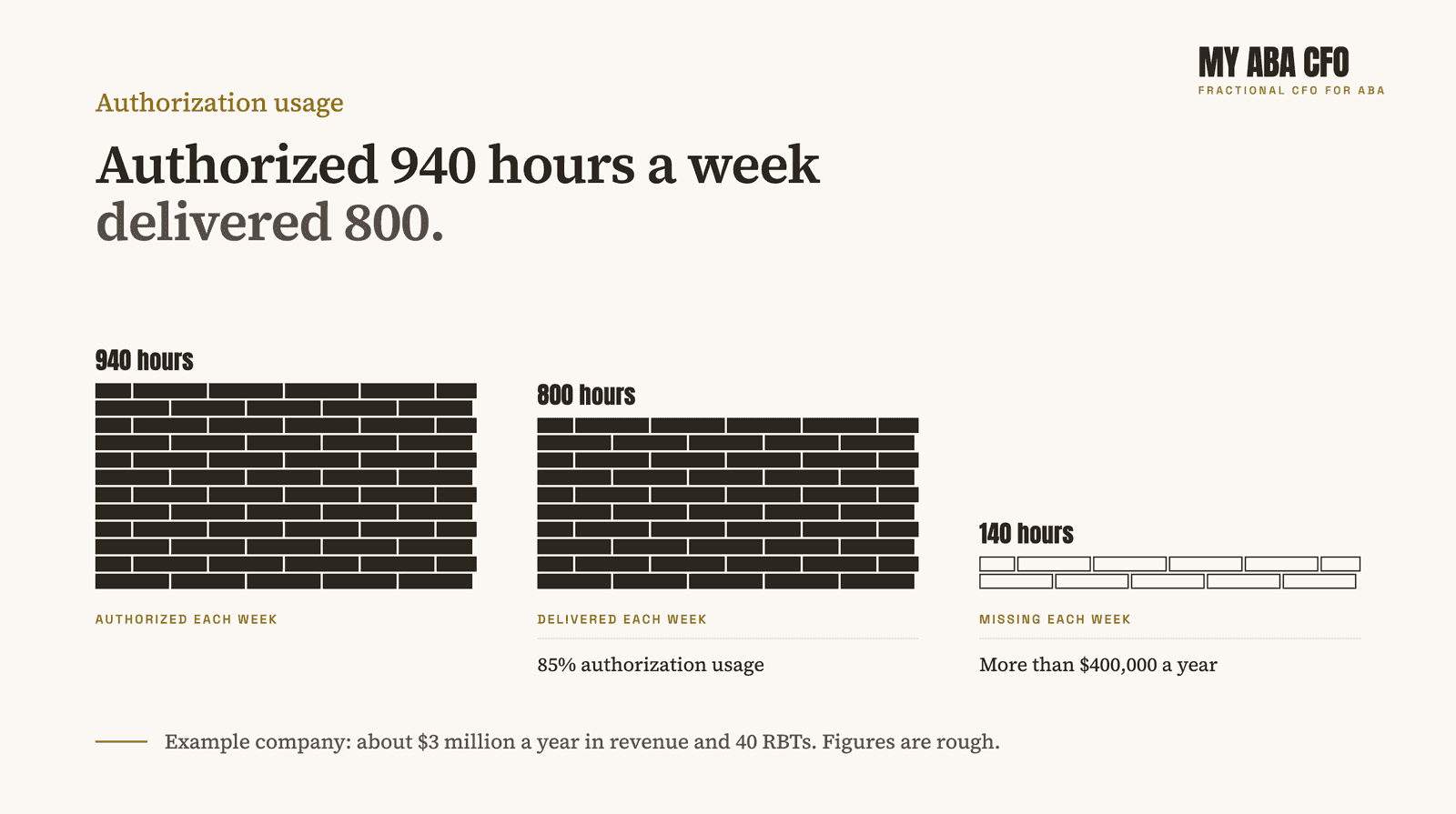
Authorization usage asks how much of what the payer approved you actually delivered. Delivered hours divided by authorized hours. If your clients are authorized for 940 hours a week and you deliver 800, you are at 85%. The missing 140 hours a week is more than $400,000 a year of care the payer already said yes to.
You can score well on one and badly on the other. Fully booked staff and under-served clients means you need to hire. Idle staff and unused authorizations means you have a scheduling problem.
Do this now: pull both by clinic, not just company-wide. The average hides the clinic that is dragging it down.
One number about cost: payroll as a percent of revenue
Payroll is most of what an ABA company spends. So this one ratio tells you most of what you need to know about margin.
Total payroll, with taxes and benefits, divided by revenue for the same month. In the example, payroll runs about $162,500 a month against $250,000 in revenue. That is 65%. Each point is $2,500 a month, or $30,000 a year.
I will not give you a target. It depends on your rates, your mix of home and clinic, and how much admin you carry. What matters is the direction. When this number climbs two or three points, something specific happened. Utilization slipped. A raise went through without a rate increase. You hired ahead of the caseload.
One warning. Do not divide the paychecks that cleared this month by the cash that came in this month. A three-paycheck month will look like a disaster and a slow-collections month will look worse. Match the payroll earned to the revenue earned.
Do this now: ask your bookkeeper for this ratio for each of the last twelve months, on that matched basis. The trend line is the answer.
Two numbers about cash: days in A/R and cash runway
Days in A/R is how long your money sits with the payers. Take what you are owed and divide by an average day of billings. The example company bills about $8,300 a day and is owed $375,000. That is 45 days.
Watch what happens when it drifts. Ten more days means about $83,000 that used to be in your account is now in someone else's. Nothing about your profit changed. Your cash did.
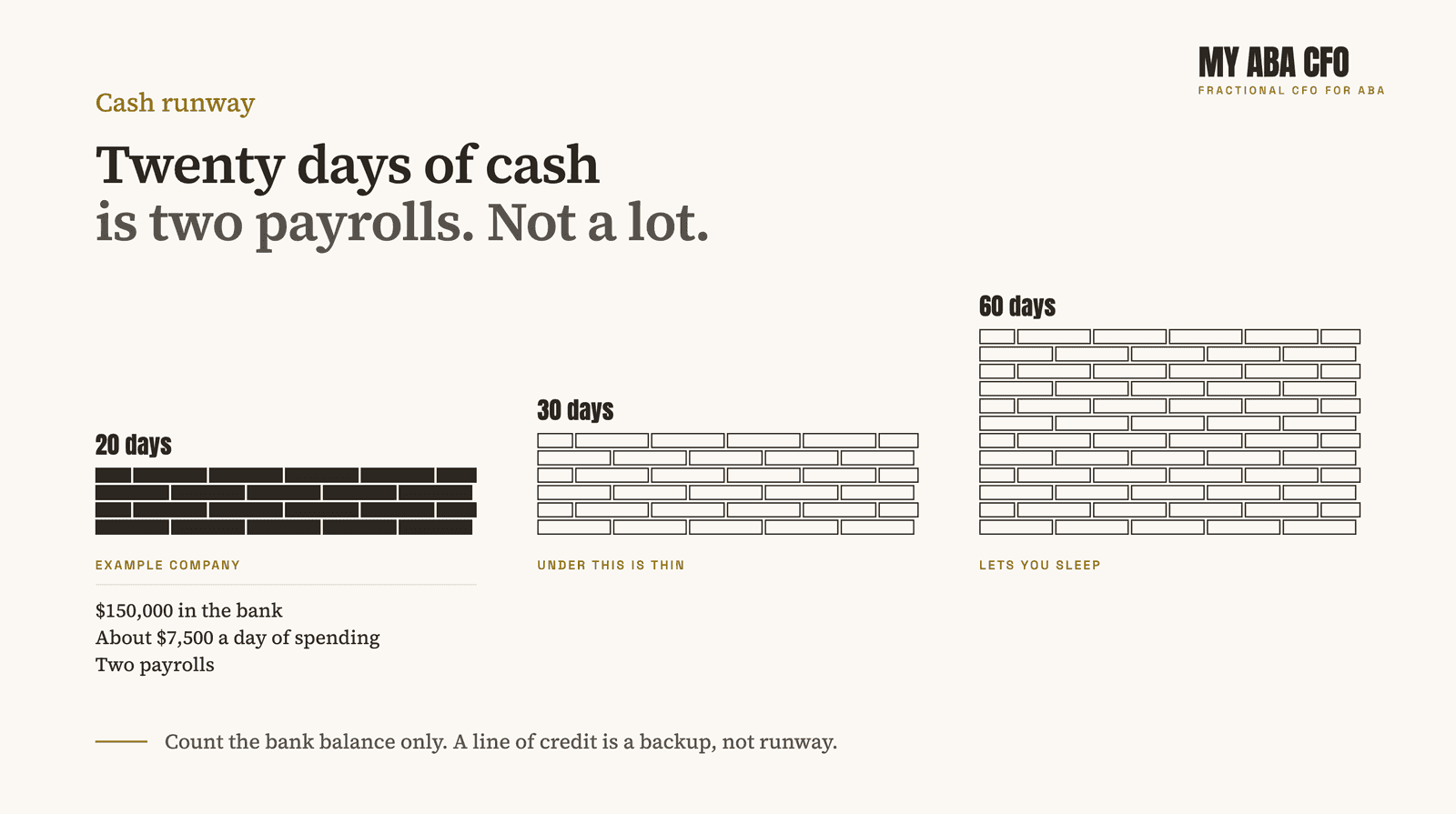
Cash runway is how long you could keep paying everyone if collections stopped. Cash in the bank divided by an average day of spending. If the example company has $150,000 in the bank and spends about $7,500 a day, runway is 20 days. That is two payrolls. Not a lot.
My rough rule: under 30 days is thin, and 60 lets you sleep. Count the bank balance only. A line of credit is a backup, not runway.
Do this now: write both numbers down today. Then look at them next month before you look at the P&L.
One page, by the 10th
| Number | How to get it | Example company |
|---|---|---|
| Utilization | Billed hours ÷ paid hours | 80% |
| Authorization usage | Delivered hours ÷ authorized hours | 85% |
| Payroll % of revenue | Payroll ÷ revenue, same month | 65% |
| Days in A/R | A/R ÷ average daily billings | 45 days |
| Cash runway | Cash ÷ average daily spending | 20 days |
Put this month next to last month and the month before. Three columns. The level matters less than the direction.
Read them as a chain. Authorization usage drops, so utilization drops, so payroll takes a bigger share of revenue. Then days in A/R stretches and runway shrinks. The first two numbers warn you weeks before the last one hurts.
Get the page by the 10th of the month. On the 28th it is history.
Want a second set of eyes on your five?
If you cannot produce these five numbers in an afternoon, that is the first finding. It usually means the data lives in three systems and nobody owns the page. That is fixable.
Thirty minutes on your business, your numbers and your next move. No pitch if it is not a fit.
Sources and further reading
- Manage your business: manage your finances (U.S. Small Business Administration)
- Beyond the ABA Income Statement: The Profitability Analysis Every Owner Needs (Breaking News ABA)
Common questions
What financial KPIs should an ABA owner track every month?
Start with five: utilization, authorization usage, payroll as a percent of revenue, days in A/R and cash runway. Put them on one page, with this month next to last month and the month before. The level matters less than the direction.
What is the difference between utilization and authorization usage in ABA?
Utilization asks how much of the time you pay for gets billed: billed hours divided by paid hours. Authorization usage asks how much of what the payer approved you actually delivered: delivered hours divided by authorized hours. You can score well on one and badly on the other.
What should payroll be as a percent of revenue in an ABA company?
There is no single target. It depends on your rates, your mix of home and clinic, and how much admin you carry. What matters is the direction. When the ratio climbs two or three points, something specific happened, such as utilization slipping or a raise going through without a rate increase.
How do I calculate cash runway for an ABA practice?
Divide cash in the bank by an average day of spending. A company with $150,000 in the bank that spends about $7,500 a day has 20 days of runway. A rough rule is that under 30 days is thin and 60 lets you sleep. Count the bank balance only, not a line of credit.
How soon after month-end should ABA financial KPIs be ready?
By the 10th of the month. On the 28th it is history. If you cannot produce the five numbers in an afternoon, that usually means the data lives in three systems and nobody owns the page.