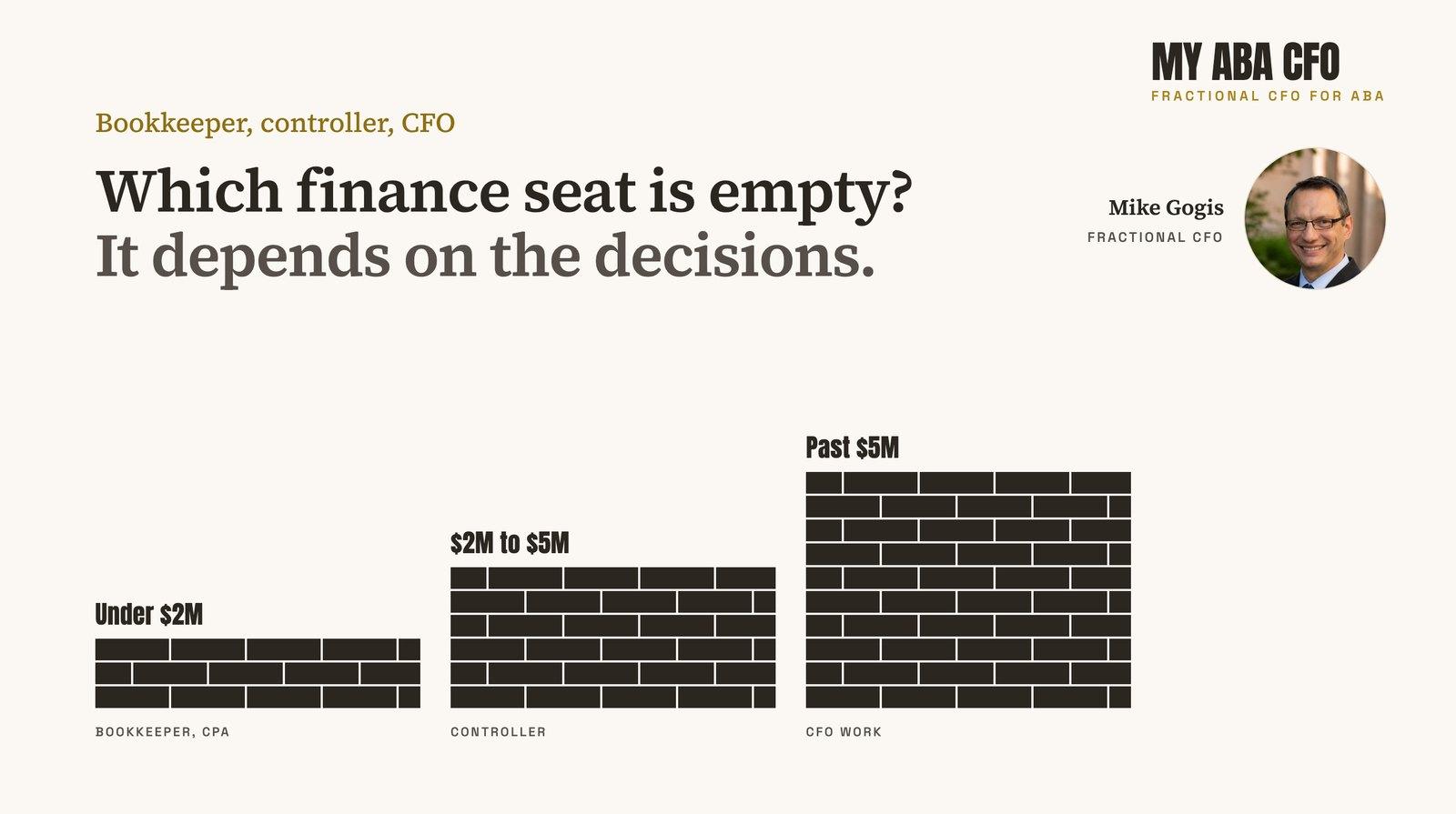
Most ABA owners I meet have a bookkeeper and a tax CPA, and they assume that adds up to a finance department. It does not. It is two people looking backward, one monthly and one yearly.
The titles get used loosely, so here is who does what, when each one earns the money, and when you need a CFO. Short answer: later than some consultants will tell you, and earlier than most owners think.
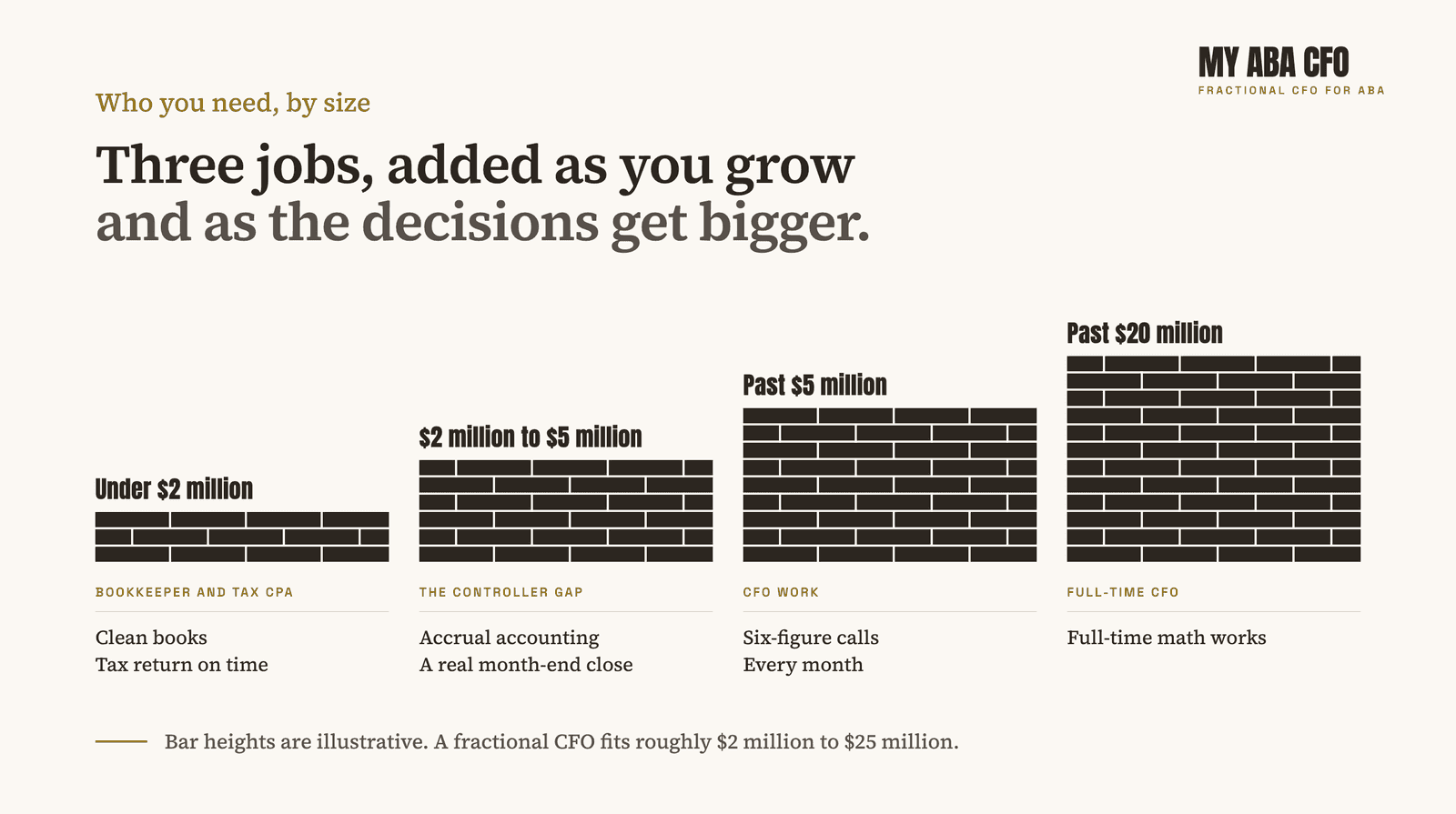
Three jobs, three different questions
A bookkeeper records what happened. Deposits, payroll, bills, bank reconciliations.
A controller makes sure the record is right. Accrual accounting, a real month-end close, revenue booked in the month the sessions happened, A/R that ties to your billing system.
A CFO uses the numbers to decide what happens next. Forecasts, payer mix, hiring pace, debt, a sale.
| Role | Looks | Question it answers |
|---|---|---|
| Bookkeeper | Backward | Where did the money go? |
| Controller | Backward, accurately | Can I trust these numbers? |
| CFO | Forward | What should we do next? |
The test: ask who in your company can tell you what your cash balance will be in 90 days. If the answer is nobody, you know which seat is empty.
Under $2 million: a bookkeeper and a tax CPA
At this size you need clean books and a tax return filed on time. A good bookkeeper, in-house or outsourced, and a CPA. That is enough.
You are the CFO, like it or not, and the decisions are still small enough to fit in your head. A full-time CFO here is a waste of money. I would say that even if you offered me the job.
One caution. Cash-basis books hide things. A strong collections month looks like a strong month, even if sessions were down.
Do this now: ask for financials by the 20th of the following month. If you only see them quarterly, or at tax time, fix that first.
$2 million to $5 million: the controller gap
This is where it breaks. Several payers, maybe a second location, 50 or more people on payroll. The bookkeeper who was great at $1 million is underwater, and nobody says so.
The signs are easy to spot:
- The books close six weeks late.
- Revenue on the P&L does not match what the billing system says you billed.
- Margin swings from month to month and nobody can explain why.
- The bank asks for financials and you stall.
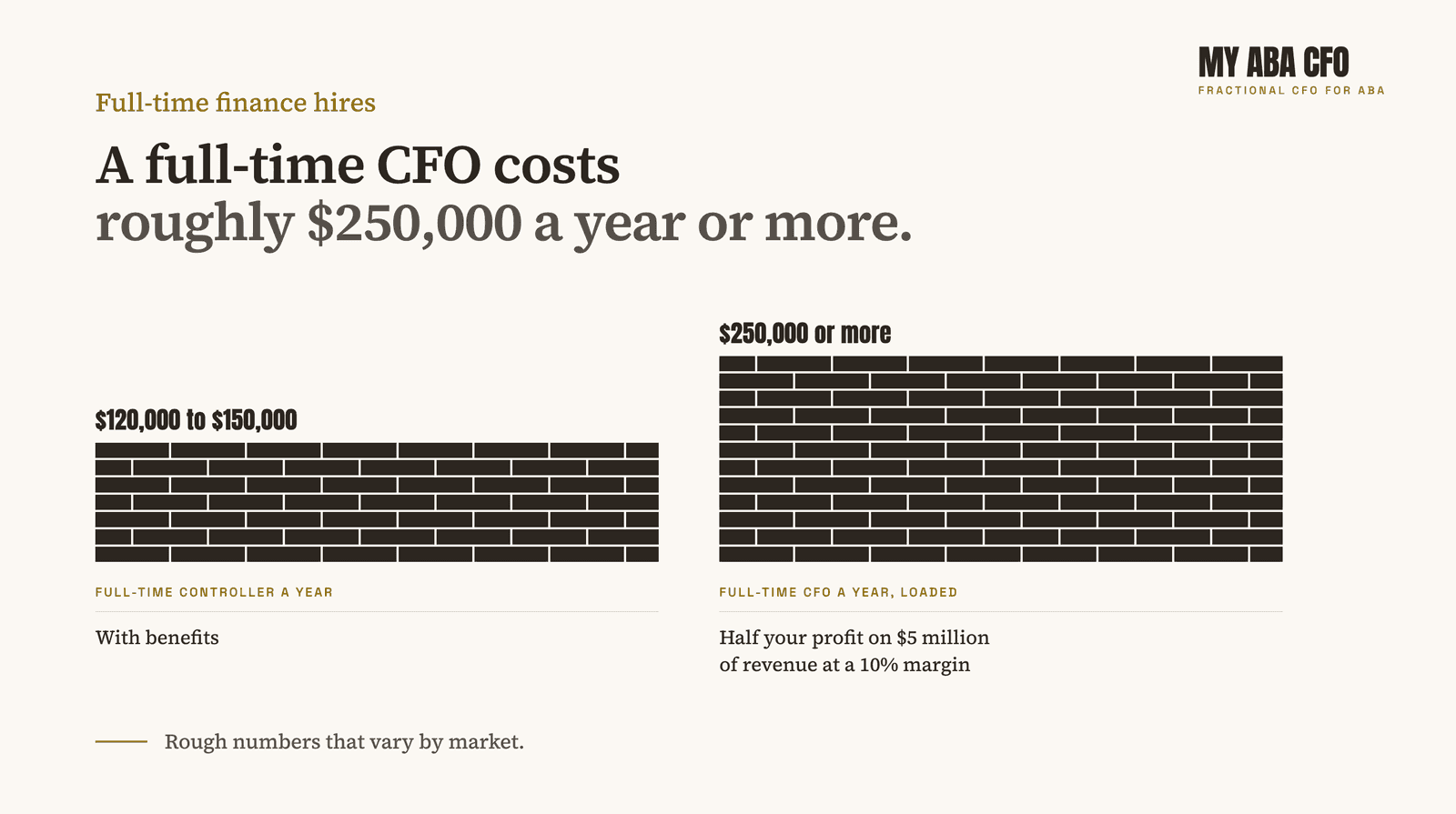
That is controller work. A full-time controller runs roughly $120,000 to $150,000 a year with benefits. Those are rough numbers and they vary by market. Many companies this size cover it with a part-time or outsourced controller.
In my experience, a lot of owners who go looking for a CFO need a controller first. A forecast built on bad books is a confident guess.
Do this now: compare last month's revenue on your P&L to last month's billings in your practice management system. If they do not tie and nobody can explain the gap, you have a controller problem.
Past $5 million, or facing a big decision: CFO work
Revenue is only a proxy. What creates the need for a CFO is the size of the decisions in front of you:
- Opening a new clinic or entering a new state.
- Renegotiating a payer contract.
- Borrowing, or living with a bank covenant.
- A buyer calling, or a plan to sell in two or three years.
- Revenue growing while margin shrinks, and no clear reason.
Below $5 million these come up now and then. Past it, they come up every month, and each one is a six-figure call made on gut feel.
So hire a full-time CFO? Usually not yet. A seasoned one costs roughly $250,000 a year or more, loaded. On $5 million of revenue at a 10% margin, that is half your profit. For most ABA companies the full-time math does not work until somewhere past $20 million.
Know before you hire: write down the three biggest decisions you face this year. If you cannot put a number on any of them, that is the gap.
Where a fractional CFO fits
A fractional CFO is the same job, bought by the day instead of by the year. A few days a month of senior judgment, at a fraction of the full-time cost.
It fits the gap between too big to run on gut and too small for a full-time hire. In ABA, that is roughly $2 million to $25 million in revenue.
It is not a replacement for your bookkeeper or controller. I work alongside the people who keep your books. I do not keep them. If the books are a mess, the first job is getting that fixed, and sometimes that means helping you find the right controller.
After that, the work is the forward-looking part: a monthly reporting package you can read, a cash forecast, a budget, wage and payer decisions, the bank, and when the time comes, the buyer.
Ask before you hire anyone: what is stopping me from making my next big decision? If the answer is "I do not trust the numbers," you need a controller. If it is "I trust the numbers and still do not know what to do," you need a CFO.
Not sure which one you need?
Most owners are not, and that is a fine reason to talk. Thirty minutes on your business, your numbers and your next move. No pitch if it is not a fit.
Sources and further reading
- Publication 538, Accounting Periods and Methods (IRS)
- Manage your business: get accounting help (U.S. Small Business Administration)
- Why Independent ABA Operators Need a Fractional CFO (Breaking News ABA)
Common questions
When does an ABA company need a CFO?
Revenue is only a proxy. What creates the need is the size of the decisions in front of you: a new clinic, a payer contract, borrowing, a sale, or revenue growing while margin shrinks. Below $5 million these come up now and then. Past it, they come up every month.
What is the difference between a bookkeeper, a controller and a CFO?
A bookkeeper records what happened. A controller makes sure the record is right, with accrual accounting and a real month-end close. A CFO uses the numbers to decide what happens next: forecasts, payer mix, hiring pace, debt, a sale.
Does a small ABA practice need a CFO?
Under $2 million, no. You need clean books and a tax return filed on time, which means a good bookkeeper and a CPA. A full-time CFO at that size is a waste of money.
How do I know if my ABA company needs a controller or a CFO?
Ask what is stopping you from making your next big decision. If the answer is that you do not trust the numbers, you need a controller. If you trust the numbers and still do not know what to do, you need a CFO. A lot of owners who go looking for a CFO need a controller first.
What does a fractional CFO do for an ABA company?
It is the same job as a CFO, bought by the day instead of by the year. It fits the gap between too big to run on gut and too small for a full-time hire, roughly $2 million to $25 million in revenue in ABA. It is not a replacement for your bookkeeper or controller. The work is the forward-looking part: a monthly reporting package, a cash forecast, a budget, wage and payer decisions, the bank and the buyer.