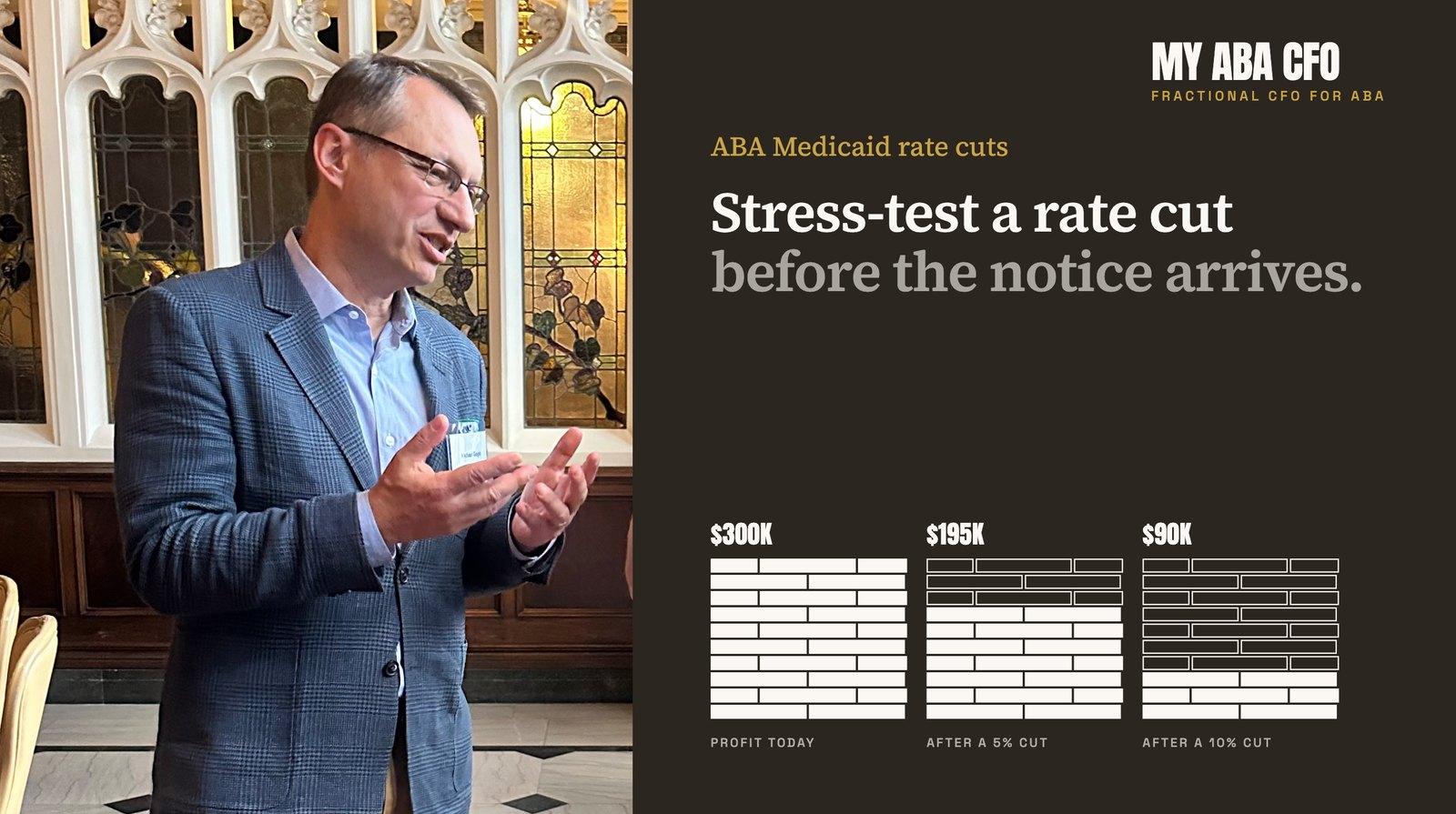
State budgets get tight. When they do, Medicaid rates end up on the table, and ABA has no special protection.
Most owners I talk to learn what a rate cut costs them after the notice arrives. That is the wrong order. A rate cut is the easiest bad news in your business to model, because it changes one number and leaves every cost exactly where it was.
You can run the whole test in an afternoon with a spreadsheet and last year's financials. Here is how I do it.
Step one: find your Medicaid number
Pull last year's collections by payer. Not billings. Collections. Add up everything Medicaid paid you, including the Medicaid managed care plans, which often follow the state fee schedule down.
That total, as a share of revenue, is your exposure.
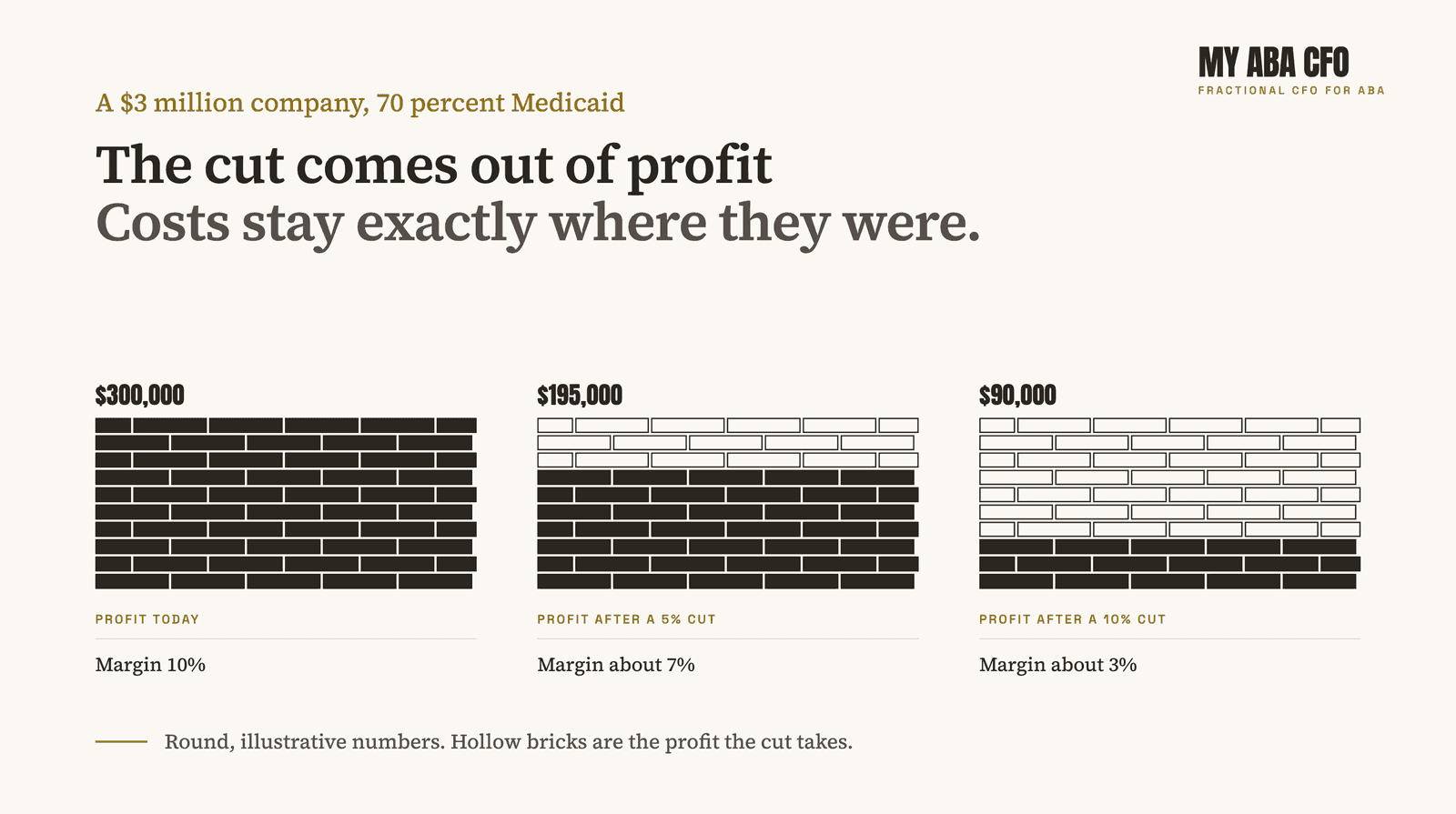
I will use one rough example all the way through: a $3 million company that is 70 percent Medicaid and earns a 10 percent margin. That is $2.1 million of Medicaid revenue and $300,000 of profit. These are round, illustrative numbers. Yours will differ, and the method will not.
Know before the notice: your Medicaid share of collections, to the percentage point.
Step two: run the cut
Here is the part owners underestimate. A rate cut does not lower your costs by a penny. Same RBTs, same wages, same rent, same hours delivered. So every dollar of the cut comes straight out of profit.
| Today | 5% cut | 10% cut | |
|---|---|---|---|
| Medicaid revenue | $2,100,000 | $1,995,000 | $1,890,000 |
| Total revenue | $3,000,000 | $2,895,000 | $2,790,000 |
| Profit | $300,000 | $195,000 | $90,000 |
| Margin | 10% | About 7% | About 3% |
A 5 percent cut takes about a third of the profit. A 10 percent cut takes 70 percent of it. The headline number sounds small. The effect is not.
Now work out one more figure: the cut that takes your profit to zero. Divide profit by Medicaid revenue. Here, $300,000 over $2.1 million is about 14 percent. That is your break-even cut.
Know before the notice: your break-even cut. If it is close to 10 percent, you have work to do now.
Step three: price your levers
Price each lever in dollars, the same way you priced the cut.
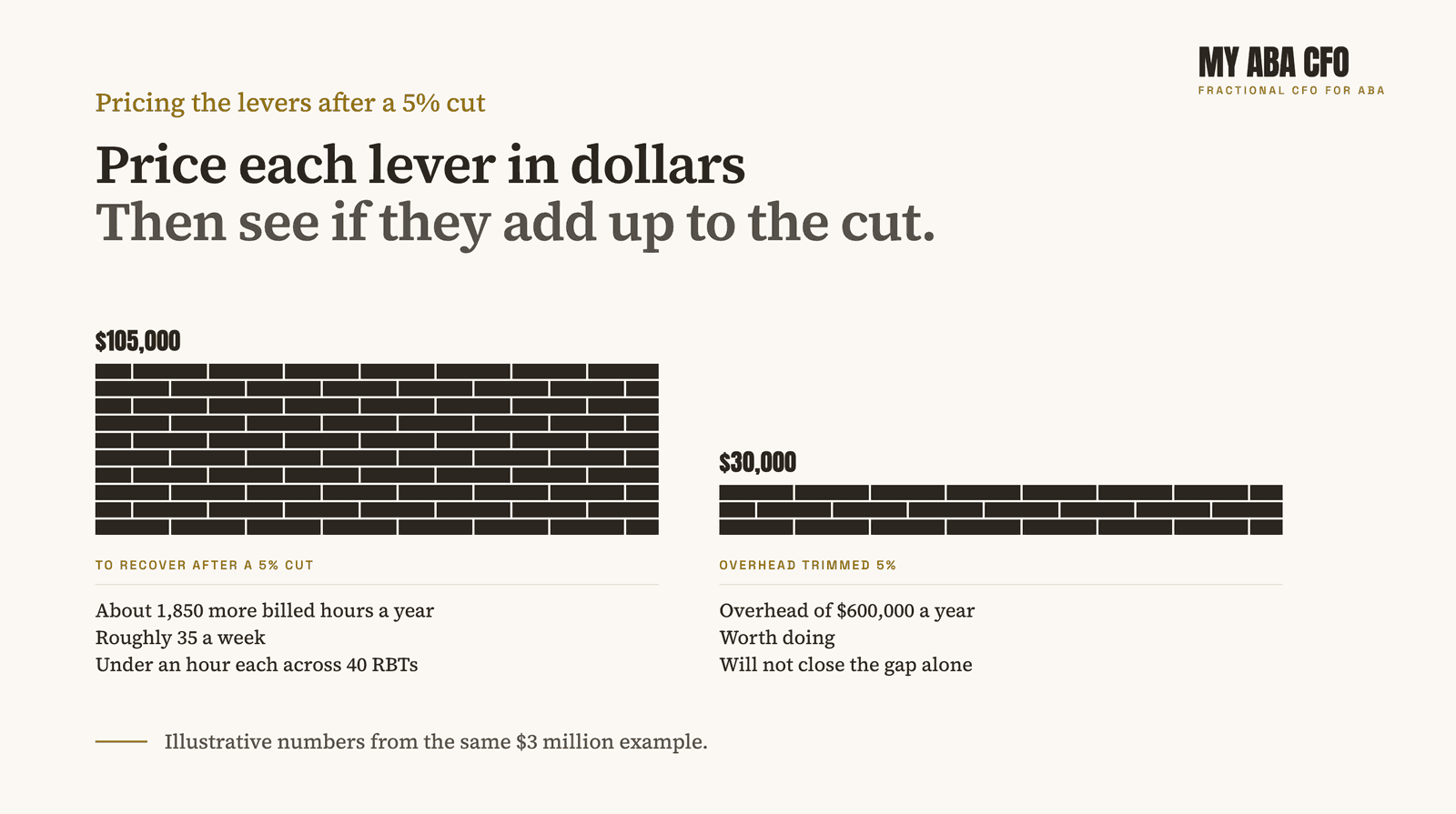
Billed hours. The strongest lever, because the staff are already paid. After a 5 percent cut, a $60 hour pays $57. Recovering $105,000 takes about 1,850 more billed hours a year, roughly 35 a week. Across 40 RBTs, that is under an hour each. Fewer cancellations, tighter scheduling, authorized hours actually delivered. A 10 percent cut needs about 75 hours a week. Harder, still possible. The math only works if those hours come out of time you already pay for.
Overhead. Everything that is not clinical labor. If that runs $600,000 a year, trimming 5 percent finds $30,000. Worth doing. It will not close the gap alone.
Payer mix. Point new intakes toward commercial plans. This is real, but slow. It changes next year, not next quarter.
Unprofitable work. Every company has cases that barely cover their cost at today's rate: long drives, chronic cancellations. After a cut, they lose money. Know which ones.
Cash. The cut reaches your deposits soon after the effective date. Your fixes take months. Set up a line of credit while your financials still look good.
Do this now: put a dollar figure next to every lever, then check whether they add up to the cut.
The lever to pull last
Cutting RBT pay looks like the fastest fix. In my experience it is usually the most expensive one.
Every RBT who leaves takes billed hours with them, and billed hours are the lever you just counted on. You save a dollar an hour and lose the hour.
Remember that every provider in your state took the same cut. The companies that keep their staff are the ones still able to serve the clients.
Freeze non-clinical hiring first. Slow the raise schedule if you must. Touch frontline pay last, and only after you have run the numbers on what turnover will cost you.
Decide in advance: the order you will pull your levers in, written down, before anyone is panicking.
Run it before the letter arrives
A stress test done in a calm month is a plan. The same math done the week after a rate notice is damage control.
If you would like a second set of eyes on your numbers, that is what I do. Thirty minutes on your business, your numbers and your next move. No pitch if it is not a fit.
Sources and further reading
- Provider payment and delivery systems (MACPAC)
- States Slash ABA Medicaid Rates as Spending Surges Past $2 Billion (Breaking News ABA)
Common questions
How do ABA Medicaid rate cuts affect profit?
A rate cut does not lower your costs by a penny. Same RBTs, same wages, same rent, same hours delivered. So every dollar of the cut comes straight out of profit. In a rough example of a $3 million company that is 70 percent Medicaid with a 10 percent margin, a 5 percent cut takes about a third of the profit.
How do I stress-test my ABA company for a Medicaid rate cut?
Pull last year's collections by payer and add up everything Medicaid paid you, including Medicaid managed care plans. Then run a 5 percent and a 10 percent cut against that number and take the whole amount out of profit. You can do it in an afternoon with a spreadsheet and last year's financials.
What is a break-even Medicaid rate cut for an ABA company?
It is the cut that takes your profit to zero. Divide profit by Medicaid revenue. In the example, $300,000 over $2.1 million is about 14 percent. If your break-even cut is close to 10 percent, you have work to do now.
What can an ABA company do to offset a Medicaid rate cut?
Price each lever in dollars. Billed hours are the strongest lever, because the staff are already paid. Overhead is worth trimming but will not close the gap alone. Shifting new intakes toward commercial plans is real but slow. Know which cases lose money after the cut, and set up a line of credit while your financials still look good.
Should an ABA company cut RBT pay after a Medicaid rate cut?
That is the lever to pull last. Cutting RBT pay looks like the fastest fix, but it is usually the most expensive one. Every RBT who leaves takes billed hours with them. Freeze non-clinical hiring first, slow the raise schedule if you must, and touch frontline pay only after you have run the numbers on turnover.